





Want More? Second Chances: How to Upgrade Your Safety Rating
Don’t Get Caught Using Obsolete Driver Forms
Two federally mandated driver forms were revised recently, and the new forms must be used for a motor carrier to be compliant.
September 6, 2021
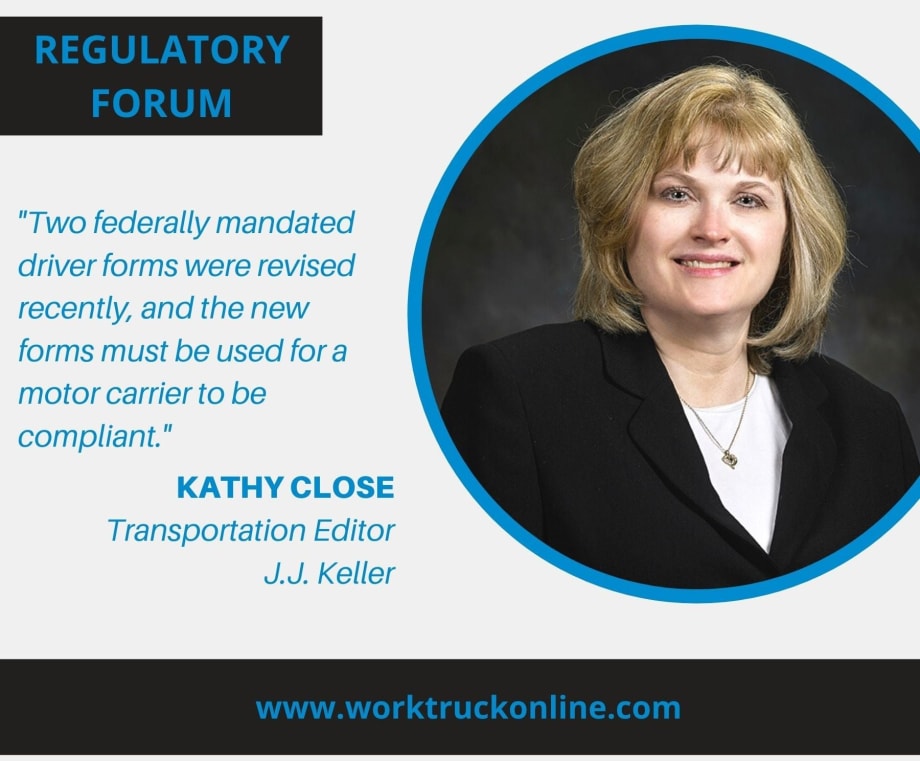
Kathy Close, Transportation Editor for J.J. Keller writes a bi-monthly Regulatory Forum column for Work Truck.
Photo: J.J. Keller
3 min to read
Two federally mandated driver forms were revised recently, and the new forms must be used for a motor carrier to be compliant.
One of these revised forms deals with DOT drug collections; the other with driver physicals.
DOT Drug Testing Form
The Federal Drug Testing Custody and Control Form (CCF) is used to track a drug test from collection site to a laboratory to the medical review officer (MRO). The following changes identify the new form:
Spaces were added for recording a CDL driver’s license number and state of issuance. (The Federal Motor Carrier Safety Administration’s (FMCSA) testing rules require the entry of the driver’s license as the employee ID number in Step 1 of the CCF.
The CDL information is needed to report results to the CDL Drug and Alcohol Clearinghouse.) New fields were added to allow for saliva testing in addition to urine. (Note: Saliva-based drug testing is not allowed for DOT testing until the department updates its testing procedures in Part 40.)
Instructions were removed from the back of the form. The instructions are available on a government website instead.
DOT-regulated employers, collectors, laboratories, and MROs were authorized to use the revised CCF beginning September 1, 2020, but were permitted to use the previous version until August 29, 2021. This additional time allowed for the depletion of existing supplies of the CCF. After this date, employers and their service agents must use the new form.
Driver’s Physical Exam Form
The FMCSA made minor changes to the driver’s physical exam form (Medical Examination Report Form, MCSA–5875). The most notable change was the removal of a field asking driver gender.
This form is used to record the results of medical exams performed in accordance with §391.43. Unlike previous updates to the form, there is no grace period allowing use of the old form. As a result, all driver physicals must be documented using the new form effective September 7, 2021.
Alert Staff to New Forms
Motor carriers must ensure an older version of a form is not mistakenly used beyond its respective deadline.
Motor carriers should provide reminders to employees who:
Schedule driver physicals,
Notify drivers of required drug testing, and
Order required forms.
Any obsolete forms should be discarded to avoid confusion and future errors.
Communicate with Service Agents
Many contracts require that the facility provide all required forms. When the error is on the collection site or the medical examiner’s office, the motor carrier is still held responsible for the mistake.
As a result, motor carriers must make sure a service provider keeps up to date on the requirements, or the carrier may face a violation.
For those carriers that have an agreement where forms are provided, they should contact the facilities to:
Make sure they are aware of the recent changes and have depleted or purged prior versions of the forms; and
Confirm all facilities within a network (if multiple locations are used) are aware and executing the changes.
What if an Incorrect Form is Used?
If, in the first few weeks or even months of implementation, incorrect forms are used, you should:
Address errors right away,
Contact employees and/or service providers about the error,
Instruct motor carrier employees on the right forms to use, and
Explain the consequences of continued errors.
For clinics and collection sites, the motor carrier has little control over the actions of someone else’s employees. If the problem persists, however, a motor carrier should be prepared to seek an alternate provider.
Subscribe to Our Newsletter
More Safety & Compliance

When Work Trucks Under 26,001 Pounds Need IRP Registration
Think trucks under 26,001 pounds are automatically in the clear when it comes to IRP? Not always. Learn where lighter vehicles can still run into trip permit, apportioned registration, and IFTA compliance requirements when crossing state or provincial lines.
Read More →
Volvo Trucks Releases New Safety Recommendations for Traveling with Pets
One of the most important recommendations for professional drivers traveling with pets is to ensure pets are properly restrained while the truck is moving. Other tips are available in the new guide from Volvo Trucks North America and Center for Pet Safety.
Read More →
API Issues Refueling Safety Guidelines
The American Petroleum Institute offers a list of safe vehicle refueling guidelines, including ways to avoid potential problems with static electricity discharges in fall, winter, and early spring.
Read More →


Winter Fleet Prep: Expert Tips to Keep Vehicles Running Smoothly
Cold weather can expose weak batteries, tires, fuel systems, and maintenance gaps fast. Use this winter fleet checklist to prepare trucks and drivers before temperatures drop.
Read More →
When a Work Truck Breaks Down, the Job Can Stop, Too
A work truck breakdown can stop more than the vehicle. Discover how payloads, jobsites, and specialty equipment change the roadside response.
Read More →
What Stronger Long-Term Fleet Service Partnerships Actually Require
Fleet service partnerships rarely fall apart all at once. Learn the three warning signs that trust is eroding and what fleets and providers can do before downtime, frustration, and lost revenue follow.
Read More →
Applause & TRUCE Software Partner to Improve Driver Safety Through AI-Powered Telematics & Employee Performance Management
Applause has integrated TRUCE driving metrics directly into its employee-first performance and safety platform that transforms mobile devices into AI-powered telematics.
Read More →
How Detroit Assurance with Active Brake Assist Works
Do you want to see what it is like to experience Detroit Assurance’s Active Brake Assist? In this video, Work Truck will put you in the cab to see how it all works and then hear more details from DTNA’s Mike Young.
Read More →
Get Left of Loss: A 5-Step Workplace Violence Prevention Framework for Fleet Operators
Violence risks do not stop at the driver’s door. Learn five practical steps fleets can take to spot threats early and protect workers before loss occurs.
Read More →
Sponsored•July 17, 2026
How Better Visibility Cut Speeding Violations by 48%
Fleet leaders don't need more data, they need clearer visibility into what the data is saying. This case study explores how one utility replaced speeding-event counts with a single metric — miles driven in violation — to strengthen safety and significantly reduce speeding violations.
Read More →