




The Benefit Battle of Alternative Fuels
Today, the sky is the limit with alternative-fuels and propulsion systems being developed, tested, and produced for the work truck industry.

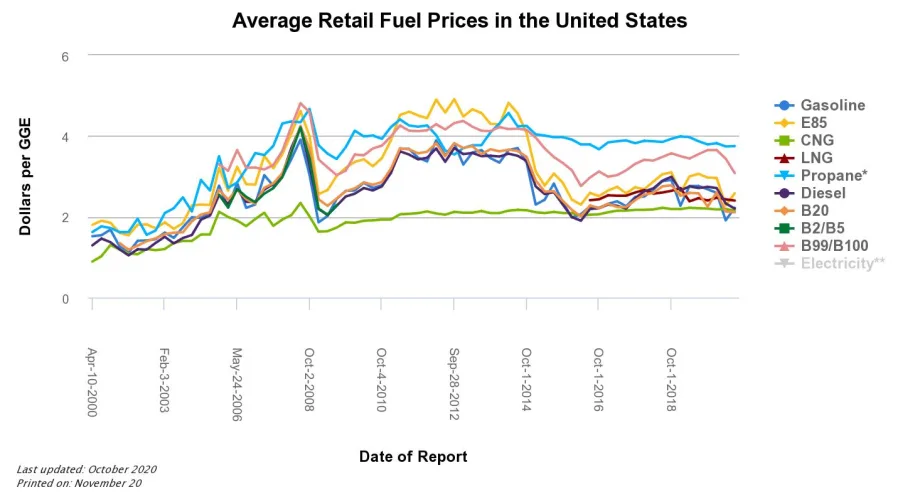
A cost comparison of average retail alternative-fuel prices over the past 20 years shows much fluctuation, with some fuel types, such as compressed natural gas (CNG) remaining slightly more stable year-over-year.
Photo: Alternative Fuels Data Center
It is well known that, in fleet, rarely is there going to be a one-size-fits-all solution. This is never truer than when looking at how a fleet fuels its vehicles. A decade ago, the choice was mostly gasoline or diesel, and the decision on the best fuel type for your operation was selected by how, where, and how much you drove.
Today, the sky is the limit with alternative-fuels and propulsion systems being developed, tested, and produced for the work truck industry.
“Numerous OEMs offer alternative-fuel/propulsion variations for their respective work truck chassis. While the available variety is growing, it may not provide specific chassis configurations fleets want, which can lead purchasers to find other sources for chassis platforms on which to base their vehicles,” according to Christopher Lyon, director of Fleet Relations for NTEA – The Association for the Work Truck Industry.
However, Lyon warns that extreme care must be taken to ensure other sources of propulsion conversions to traditional chassis powertrains have been developed and certified as those qualified under the programs available through OEM channels.
“Chassis manufacturers have formed partnerships with both technology suppliers and installers to ensure all applicable Federal/Canadian Motor Vehicle Safety Standards, emissions certification, and build quality standards are met in the final product, along with OEM warranty preservation. Additional propulsion conversion programs have been developed through OEM quality programs to enable combinations of alt-fuel chassis that might not be available from the factory but still ensure compliance to safety and emissions standards. In other words, choose alt fuel/propulsion vehicle partners strategically,” Lyon added.
Making YOUR Choice
As noted, there is no one-size-fits-all solution when it comes to work trucks and alternative fuels. What works best for one utility may not work at all for another. A truck that is perfect for one construction fleet may not have the range needed for another. Infrastructure (to be discussed in-depth in January 2021) is probably one of the most significant determining factors a fleet has to consider aside from overall costs.
A fleet must take into consideration its overall vehicle needs, budget, and goals before making a decision. Likely, one fuel type will not be your fleet’s “one and only,” but rather a combination of two or more options.
I’m enjoying the number of new launches and billions of miles of real-world data coming out of these alt-fuel units. The December 2020 issue digs a little deeper into the alternative-fuels and propulsion options, looking at the current trends, myths and truths, maintenance advice, and a quick peek into the future for each fuel type.
What do you think about alt-fuel trucks today? Are you operating any in your fleet operation and want to share your challenges or successes?
E-mail me, let’s chat!
Lauren Fletcher
Lauren.Fletcher@bobit.com
More Blog Posts

Can America Replace Canadian Truck Production Without Hurting U.S. Fleets?
U.S. tariffs are targeting Canadian truck production, but Ford and GM show why moving that manufacturing south isn’t so simple. After 60 years of building one North American supply chain, what could fleets lose by pulling it apart?
Read More →
The Fleet Skills We Keep Missing on Veterans’ Resumes
What if some of the strongest candidates are already out there, but we are overlooking them because their experience is written in a language our industry does not always recognize?
Read More →
Technicians Are Doing More Than Turning Wrenches
Technicians do far more than repair vehicles. Six professionals reveal the problem-solving, pressure, and pride behind keeping fleets moving.
Read More →
WWCD? What Would Coach Do?
A personal reflection on Ed "Coach" Bobit, the mentor who shaped my career, and why I still ask myself one question 12 years later: WWCD?
Read More →
What the Fleet Industry Still Gets Wrong About Talent
What can the fleet industry learn from the women helping shape its future? A look at talent, leadership, sponsorship, and why new perspectives drive progress.
Read More →
AI Isn’t Killing Content, but Lazy Expertise Is
Thought leadership loses value when AI does the thinking. Here’s why authentic industry voices still matter most.
Read More →
Do I Need a U.S. DOT Number?
Whether you operate a small fleet of light-, medium-, or heavy-duty units, or are merely the owner of one truck wanting to ensure you adhere to the law, knowing if you can need a U.S. DOT number can be confusing.
Read More →
Is Retirement in Fleet Now More Like ‘Rewiring’?
Fleet professionals rarely retire for good. They return as advisors, mentors, and consultants, keeping hard-won experience in the industry.
Read More →
What Does Visibility in Fleet Really Look Like?
Advocacy changes things. Visible trust changes things. Structure changes things. Access changes things. A willingness to share connections, rooms, and opportunities, and a belief in someone before it is convenient, changes things.
Read More →
Work Truck Week 2026 Shows an Industry Focused on Practical Progress
Taken together, these themes show an industry that is not chasing a single technological solution. Instead, it is building a broader toolkit designed to support the diverse and demanding jobs fleets perform every day.
Read More →