





Related News: State of the Wholesales Used Vehicle Market
Wholesale Prices Increase at Slower Pace in November
Wholesale prices appear to have peaked the week before Thanksgiving as weekly prices have declined slightly in each of the last two weeks. But retail prices continue to increase.
December 8, 2021
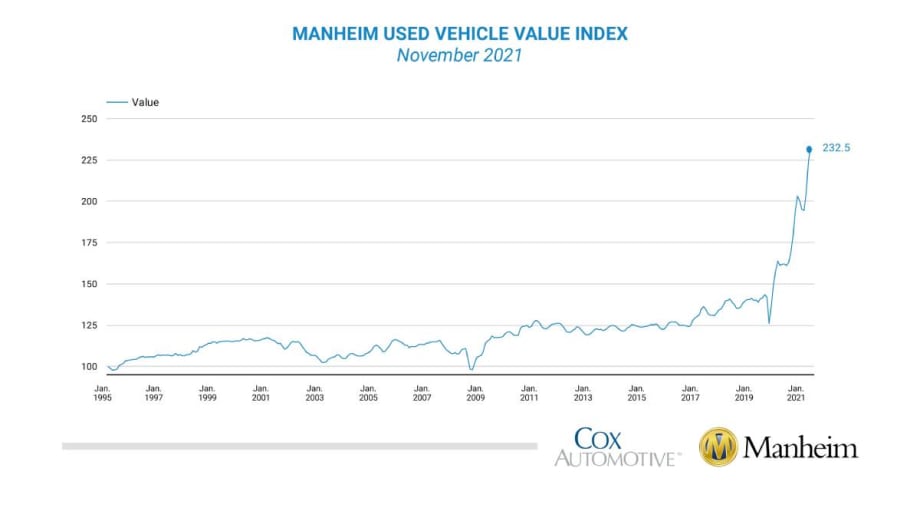
Manheim Used Vehicle Value Index, November 2021
Graphic: Cox/Manheim
4 min to read
Wholesale used vehicle prices (on a mix-, mileage-, and seasonally adjusted basis) increased 3.9% month over month in November, according to a Cox Automotive news release., This brought the Manheim Used Vehicle Value Index to 232.5, a 43.5% increase from a year ago. The non-adjusted price increase in November was 1.9% compared to October and 43.8% year over year.
Manheim Market Report (MMR) values saw weekly price increases decelerate and reverse over the course of November. Over the full four weeks in the month, the Three-Year-Old Index increased a net 1.9%. Over the month of November, daily MMR Retention, which is the average difference in price relative to current MMR, averaged 99.4%, which meant that market prices were behind MMR values.
The average daily sales conversion rate also declined in the month to 59%, which remained elevated for the time of year. For example, the sales conversion rate averaged 52% in November 2019. This indicates that buyers remained more aggressive in buying than is typical in the fall but were less aggressive than in October.
On a year-over-year basis, all major market segments saw seasonally adjusted price increases in November. Vans had the largest year-over-year performance, while the pickup and luxury car segments lagged the overall market. On a month-over-month basis, no segment saw declines, with compact cars outpacing the market and remaining segments.
Vehicle sales continued downward. According to Cox Automotive estimates, total used vehicle sales were down 2% year-over-year in November. Cox estimates the November used SAAR to be 37.2 million, down from 38.1 million last November and flat compared to October’s 37.2 million SAAR. The November used retail SAAR estimate is 20.4 million, up from 20.2 million last year and flat month-over-month.
Using a rolling seven-day estimate of used retail days’ supply based on vAuto data, we see that used retail supply peaked at 114 days on April 8, 2020. Normal used retail supply is about 44 days’ supply. It ended November at 49 days, above normal levels. Cox estimates that wholesale supply peaked at 149 days on April 9, 2020, when normal supply is 23. It ended November at 29 days. The final week of November brought large fluctuations in supply metrics due to the Thanksgiving holiday.
November total new-vehicle sales were down 17% year-over-year, with one more selling day compared to November 2020. Month over month, November new vehicle sales were down 4%. The November SAAR came in at 12.9 million, a decrease from last year’s 15.9 million and November 2019’s 17.1 million rate.
Combined sales into large rental, commercial, and government buyers were down 21% year over year in November and down 1% year to date through November compared to the same time period in 2020. Sales into rental decreased 55% year over year in November and are down 4% year to date through last month compared to the same time period last year. Commercial sales are up 23% year over year in November and are up 12% year to date in 2021 versus 2020. Including an estimate for fleet deliveries into the dealer and manufacturer channel, we estimate that the remaining retail sales were down 15% year over year in November, leading to an estimated retail SAAR of 11.2 million, which was down from 13.5 million last November and down from November 2019’s 13.7 million rate.
Rental risk mileage increases: The average price for rental risk units sold at auction in November was up 46% year over year. Rental risk prices were down 6% compared to October. Average mileage for rental risk units in November (at 76,000 miles) was up 39% compared to a year ago and up 25% month-over-month.
November saw mixed trends with consumer confidence: Consumer Confidence according to the Conference Board declined 1.9% in November, and October’s index was revised down as well. The declines left confidence down 17.4% compared to February 2020. Confidence has declined in four of the last five months and is now at the lowest level since February. The underlying measures of present situation and future expectations both declined with present situation declining the most. Plans to purchase a vehicle in the next six months declined to the lowest level since 2010. Plans to purchase a home also declined to its lowest level since 2010. In comparison, the sentiment index from the University of Michigan reported a 6% decline in November, leaving it down 33% since February 2020. The Morning Consult daily index saw modest improvement of 1.1% in November after having declined in every month since April.
Originally posted on Vehicle Remarketing
More Small Fleet


Developing Budget-Friendly Driver Safety Programs
From driver training and safety meetings to one-on-one coaching and incentive programs, several small fleets share how they have developed a safety culture with their drivers using low- to no-cost resources.
Read More →
Sponsored•March 9, 2026
Boosting Last-Mile Fleet Uptime, Safety, and Value with AI Vehicle Inspections
AI-powered inspections are transforming last-mile fleets by replacing manual checks with highly accurate automated scans that detect defects in seconds. By giving fleet operations visibility into the daily condition of their vehicles, you can identify trends over the vehicle’s lifecycle that enable improved procurement decisions, route management, driver training and accountability.
Read More →
Five Ways Seat Belts Help Prevent Injuries
There are five ways seat belts protect occupants from injuries, according to the Tennessee Department of Safety and Homeland Security.
Read More →
Sponsored•January 14, 2026
It’s here: The 2026 Fleet Technology Trends Report
What does AI mean for fleets? Get the answer — and learn other top tech trends.
Read More →
Small Fleets, Big Impact: How Independent Drivers Power Wreaths Across America
Check out how small fleets and independent drivers power Wreaths Across America each December and why their impact matters more than ever.
Read More →
VMS Survey Finds 65% of Small Fleet Managers Run Operations Alone
A new VMS survey shows small fleet managers are stretched thin, with most handling operations solo and eager to adopt digital tools for relief.
Read More →
Tips for Driving Safely on Halloween Night
This video features a reminder from the Connecticut Department of Transportation (DOT) and the Connecticut Police Chiefs Association, urging drivers to prioritize safety this Halloween.
Read More →
AI, Access, and Uptime: VMS’s Next Chapter with David Prusinski
VMS’s new Co-CEO, David Prusinski, shares how an AI-first approach will give small fleets and repair shops the tools to compete like big players.
Read More →
Fleet Managers Share Winter Prep Tips: It's Never Too Early!
Three fleets share best practices to prep vehicles for winter and prevent downtime when the cold sets in.
Read More →