




Used-Vehicle Price Growth Moderating in April
Used-vehicle prices are achieving highs that will start to drive used-vehicle buyers to new cars, says Tom Kontos in Adesa's April Current Used Vehicle Market Conditions and Outlook.
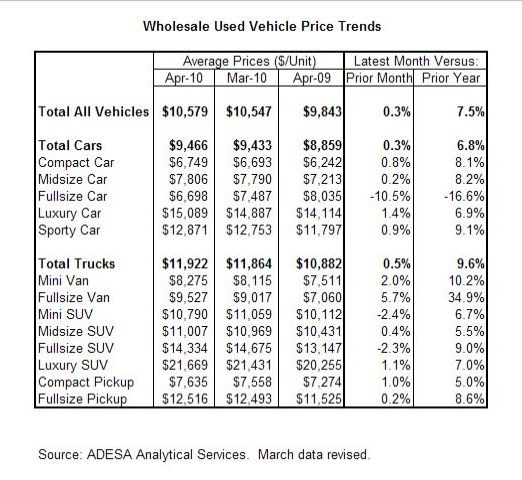
Wholesale used-vehicle price growth appeared to moderate in April, as retail used-vehicle prices started to reach levels where they become less attractive than prices of new vehicles, according to Tom Kontos in ADESA's April Current Used Vehicle Market Conditions and Outlook.
The average retail price of a used vehicle represented 58 percent of the average new-vehicle price in February, based on ADESA Analytical Services' calculations using the most recent Federal Reserve Board data.
When the average retail used-vehicle sales price exceeds 60 percent of the average new-vehicle sales price, a portion of used-vehicle demand tends to be "cannibalized" by new-vehicle sales, Kontos wrote. With wholesale prices growing 4 percent in March and 0.3 percent in April, the 60 percent used-versus-new retail price ratio may now be surpassed.
Evidence for this is that retail sales of used vehicles by franchised dealers (i.e., dealers who sell both new and used vehicles) were down 4.2 percent on a year-over-year basis in April, while new vehicle sales were up nearly 20 percent. On the other hand, independent dealers (i.e., dealers who only sell used vehicles) registered a year-on-year sales increase in April, indicating that shoppers who can only afford used vehicles are still plentiful, according to Kontos.
Moreover, tight supplies of used vehicles and the budding economic recovery continue to create upward pressure on wholesale prices, as dealers bid aggressively in-lane and online for needed inventory.
Dealers who use efficient wholesale and retail tools are able to achieve quick inventory turn and respectable grosses despite higher wholesale prices and tight used-vehicle supply. These tools include online run lists and inventory management software that allow dealers to employ just-in-time inventory practices.
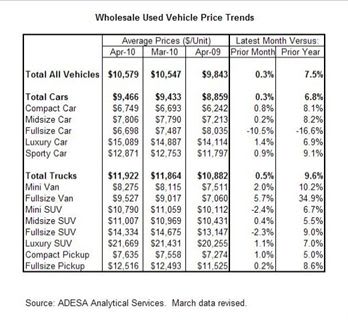
According to ADESA Analytical Services' monthly analysis of Wholesale Used Vehicle Prices by Vehicle Model Class, wholesale used-vehicle prices in April averaged $10,579 - up 0.3 percent from March and 7.5 percent versus prior year.
Full-size vans and full-size cars recorded the biggest year-over-year price gains and losses, respectively. But these segments are small and can often have volatile average price swings based on variations in such things as seller type and vehicle condition.
Prices for most segments are moving with the overall market, although mini and full-size SUV prices did take a bit of a hit in April - perhaps due to rising gas prices over the last couple of months. Minivans registered above-average price gains during the month.
Prices were up for all seller types. Manufacturers registered a 0.7 percent month-over-month price increase and a 14.1 percent year-over-year rise; fleet/lease consignors experienced a 1.1 percent sequential price increase and a 12.4 percent annual increase; and dealers saw a 0.6 percent average price increase versus March and a 13.4 percent uptick versus April 2009.
ADESA Analytical Services estimates that auction industry inventory levels stood at 31 days at month-end compared to 40 days last April - continuing to indicate tight supply and high auction throughput.
More Small Fleet

Developing Budget-Friendly Driver Safety Programs
From driver training and safety meetings to one-on-one coaching and incentive programs, several small fleets share how they have developed a safety culture with their drivers using low- to no-cost resources.
Read More →
Boosting Last-Mile Fleet Uptime, Safety, and Value with AI Vehicle Inspections
AI-powered inspections are transforming last-mile fleets by replacing manual checks with highly accurate automated scans that detect defects in seconds. By giving fleet operations visibility into the daily condition of their vehicles, you can identify trends over the vehicle’s lifecycle that enable improved procurement decisions, route management, driver training and accountability.
Read More →

Five Ways Seat Belts Help Prevent Injuries
There are five ways seat belts protect occupants from injuries, according to the Tennessee Department of Safety and Homeland Security.
Read More →
Basic Tracking vs Next Generation Fleet Technology
Fleet software is getting more sophisticated and effective than ever, tying big data models together to transform maintenance, safety, and the value of your existing tech stack. Fleet technology upgrades are undoubtedly an investment, but updated technology can offer a much higher return. Read how upgrading your fleet technology can increase the return on your investment.
Read More →
It’s here: The 2026 Fleet Technology Trends Report
What does AI mean for fleets? Get the answer — and learn other top tech trends.
Read More →
Small Fleets, Big Impact: How Independent Drivers Power Wreaths Across America
Check out how small fleets and independent drivers power Wreaths Across America each December and why their impact matters more than ever.
Read More →
VMS Survey Finds 65% of Small Fleet Managers Run Operations Alone
A new VMS survey shows small fleet managers are stretched thin, with most handling operations solo and eager to adopt digital tools for relief.
Read More →
Tips for Driving Safely on Halloween Night
This video features a reminder from the Connecticut Department of Transportation (DOT) and the Connecticut Police Chiefs Association, urging drivers to prioritize safety this Halloween.
Read More →
AI, Access, and Uptime: VMS’s Next Chapter with David Prusinski
VMS’s new Co-CEO, David Prusinski, shares how an AI-first approach will give small fleets and repair shops the tools to compete like big players.
Read More →