





Industry Analysis: A Look at Used Vehicle Market and Economy
Used Vehicle Inventory Up 30% YOY
Wholesale prices had been moving downward for most of the year and decreased 4% in August from July, widening the divergence with retail prices.
September 16, 2022
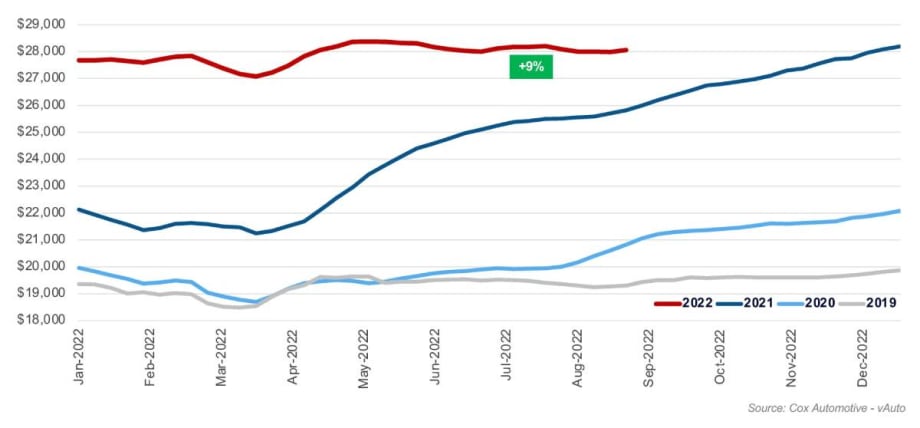
The average listing price for used vehicles continues to trend at just over $28,000, but the price growth has definitely declined since last year’s big run-up.
Graphic: Cox Automotive
3 min to read
Used-vehicle inventory volume held steady from July to August, as did prices – a sign of market stability, according to the Cox Automotive analysis of vAuto Available Inventory data released Sept. 16.
The total supply of unsold used vehicles on dealer lots, both franchised dealers and independents, across the U.S. stood at 2.46 million units at the close of August, about the same as the revised number at the end of July.
Total days’ supply at the end of August stood at 49, compared with the revised 52 days’ supply at the end of July. Days’ supply in July was 24% above year-ago levels.
“Inventory volume at the end of August was 10% above year-ago levels, so we’re seeing some improvement," said Chris Frey, Cox Automotive’s senior manager for Industry Insights, in a news release. "In fact, we’re tracking at a fairly normal pace for supply.”
The Cox Automotive days’ supply is based on the daily sales rate for the most recent 30-day period, in this case, ended Aug 29. Sales were 1.5 million, the highest for any 30-day period since May when sales were 1.53 million.
“While used-vehicle sales in total so far this year are down 16% from 2021, the year is tracking in a normal trend line,” Frey said. “The latest uptick in August suggests resilience in the used market.”
By brand, Toyota and Honda had the lowest used-vehicle inventory, with days’ supply at 42 and 41, respectively. They are near the bottom in supply of new vehicles as well.
Other Asian automakers with low used supply as well as skimpy new-vehicle inventory are Subaru and Hyundai, with used days’ supply of 43 and 44, and Kia with 46. Mazda has above-average new vehicle inventory but is on the low side at 45 days’ supply of used vehicle inventory.
By price category, the lower the price, the lower the supply. The under $10,000 segment has the lowest available supply and lowest days’ supply of 31, one point lower than a month ago. The $10,000 to $15,000 segments had days’ supply dip to 36 from 37 a month earlier. Price categories between $15,000 and $30,000, representing the bulk of available inventory, had 51 to 53 days’ supply. Above $30,000 categories had 55 to 61 days’ supply.
The used-vehicle average listing price surpassed $28,000 in mid-April and rose to a record high of $28,375 in early May. The average listing price then edged downward throughout August, closing at $28,061. That compared with a revised $28,003 at the end of July. Price growth versus the year earlier was 28% in mid-April but has been falling every week since and now stands at 9% higher than a year ago.
“The average listing price for used vehicles continues to trend at just over $28,000, but the price growth has definitely come down since we passed the anniversary of last year’s big run-up,” Frey said. “Still, prices remain above 2021 levels and will stay there as demand remains strong and until new-vehicle inventory builds.”
In terms of wholesale prices, the Manheim Used Vehicle Value Index shows prices had been moving downward for most of the year and decreased 4% in August from July. Over the last six weeks, the divergence between wholesale and retail prices has widened.
“It is unclear if the retail index will follow the wholesale index through the depreciation cycle over the next 16 weeks,” Frey said. “Regardless, wholesale has returned to depreciating after the spring.”
Originally posted on Vehicle Remarketing
More Small Fleet


Developing Budget-Friendly Driver Safety Programs
From driver training and safety meetings to one-on-one coaching and incentive programs, several small fleets share how they have developed a safety culture with their drivers using low- to no-cost resources.
Read More →
Sponsored•March 9, 2026
Boosting Last-Mile Fleet Uptime, Safety, and Value with AI Vehicle Inspections
AI-powered inspections are transforming last-mile fleets by replacing manual checks with highly accurate automated scans that detect defects in seconds. By giving fleet operations visibility into the daily condition of their vehicles, you can identify trends over the vehicle’s lifecycle that enable improved procurement decisions, route management, driver training and accountability.
Read More →
Five Ways Seat Belts Help Prevent Injuries
There are five ways seat belts protect occupants from injuries, according to the Tennessee Department of Safety and Homeland Security.
Read More →
Sponsored•January 14, 2026
It’s here: The 2026 Fleet Technology Trends Report
What does AI mean for fleets? Get the answer — and learn other top tech trends.
Read More →
Small Fleets, Big Impact: How Independent Drivers Power Wreaths Across America
Check out how small fleets and independent drivers power Wreaths Across America each December and why their impact matters more than ever.
Read More →
VMS Survey Finds 65% of Small Fleet Managers Run Operations Alone
A new VMS survey shows small fleet managers are stretched thin, with most handling operations solo and eager to adopt digital tools for relief.
Read More →
Tips for Driving Safely on Halloween Night
This video features a reminder from the Connecticut Department of Transportation (DOT) and the Connecticut Police Chiefs Association, urging drivers to prioritize safety this Halloween.
Read More →
AI, Access, and Uptime: VMS’s Next Chapter with David Prusinski
VMS’s new Co-CEO, David Prusinski, shares how an AI-first approach will give small fleets and repair shops the tools to compete like big players.
Read More →
Fleet Managers Share Winter Prep Tips: It's Never Too Early!
Three fleets share best practices to prep vehicles for winter and prevent downtime when the cold sets in.
Read More →