




Study: U.S. Has Returned to 95% Commercial Driving Activity
Driving data collated by Samsara shows that while long haul transportation and food and beverage sectors have essentially reached pre-COVID-19 commercial driving activity, other industries, like transit, education, and oil and gas are far from recovery.

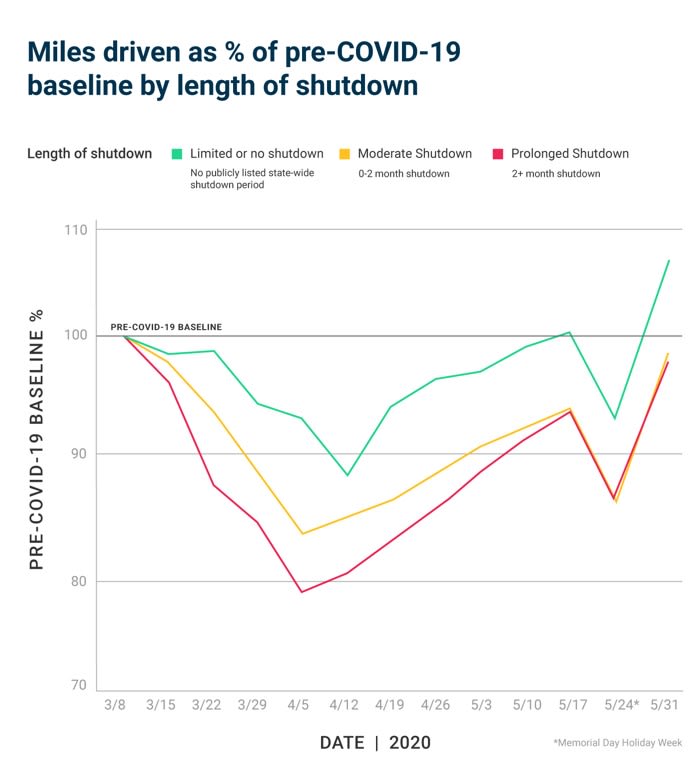
States with prolonged shutdowns are starting to reach the same level of miles driven as states with only moderate shutdowns. This is despite sharper declines in miles driven during peak periods of COVID-19.
Chart courtesy of Samsara.
In a race to stop the spread of COVID-19, millions of Americans across the country were ordered to stay home, except for essential activities. While all states have reopened in some capacity, the date they went into lockdown and the time they spent under that lockdown varies dramatically.
To see how these varying restrictions impacted commercial transportation in the United States, telematics service provider Samsara collated data from the nearly 130 million trips its 15,000 customers — operating across industries such as transportation and logistics, food production, local government, among others — have taken since the start of 2020.
Samsara analyzed transportation trends and safety incidents before, during, and after lockdowns across the United States. The data, collated in a report, outlines changes to commercial activity, industry-specific trends, and shifts in driver behavior.
Key findings
1. Commercial driving activity has returned to normal, or higher than normal, levels
On average, U.S. states have returned to be within 95% of pre-COVID-19 commercial driving activity, defined as miles driven and the number of operating vehicles on the road.
But this is not without some variation.
States that experienced limited to no lockdown restrictions are seeing a faster return to average commercial driving activity pre-pandemic. Not only have these states already seen a return to more than 100% of pre-COVID-19 commercial driving activity, but they also saw more modest declines during shutdown periods.
2. Industry impact varies widely — education most impacted, long haul and construction remain stable
Long haul transportation experienced a quick recovery from COVID-19. Food and beverage and wholesale trade transportation have also essentially reached pre-COVID-19 commercial driving activity.
This is in sharp contrast to other industries like passenger transit and education. Passenger transit activity has stabilized at around 35% of pre-COVID-19 levels and educational services activity remains below 10%.
Other industries, like oil and gas, have not yet recovered from COVID-19’s implications, operating at 60% of pre-COVID-19 commercial activity.
The construction industry, on the other hand, is starting to clock in more miles, operating at 5% above pre-COVID-19 levels in recent weeks.
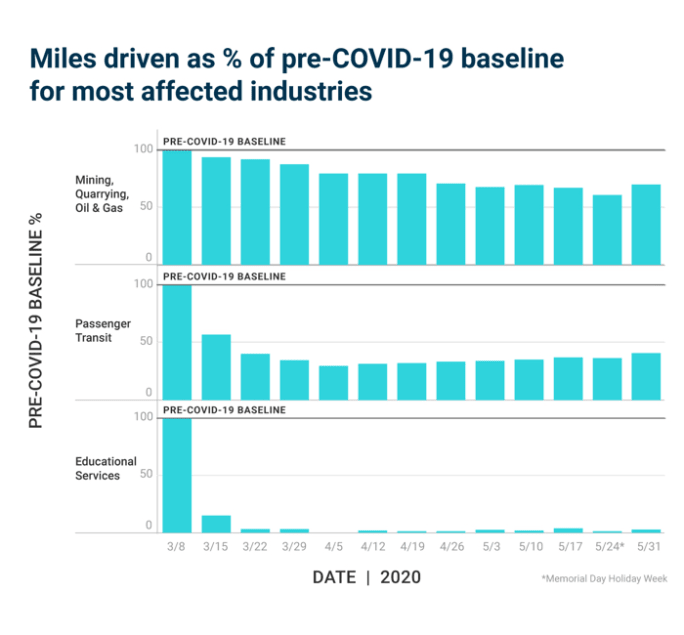
While passenger transit activity has stabilized at around 35% of pre-COVID-19 levels, educational services activity remains below 10%.
Chart courtesy of Samsara.
3. With emptier roads, harsh braking and acceleration decreased by 40%
There has been a decline in harsh braking and acceleration across all states, culminating at 40% below the pre-COVID-19 baseline.
The trend has become even more pronounced as commercial fleets are beginning to resume pre-COVID-19 levels of activity with significantly fewer passenger vehicles on the road, leading to fewer harsh braking and harsh acceleration events per 1000 miles driven.
States with comprehensive restrictions still in place are seeing even sharper declines in these behaviors.
4. Empty roads led to a 20% increase in severe speeding
With roads less congested, drivers might have been tempted to go speeds that they otherwise would not be able to reach on heavily trafficked roads.
In early April, severe speeding rose 20% above the pre-COVID-19 baseline, indicating that while there may be a decline in some risky driving behavior (like harsh braking and accelerations), there are certain driving behaviors that are making roads more dangerous too.
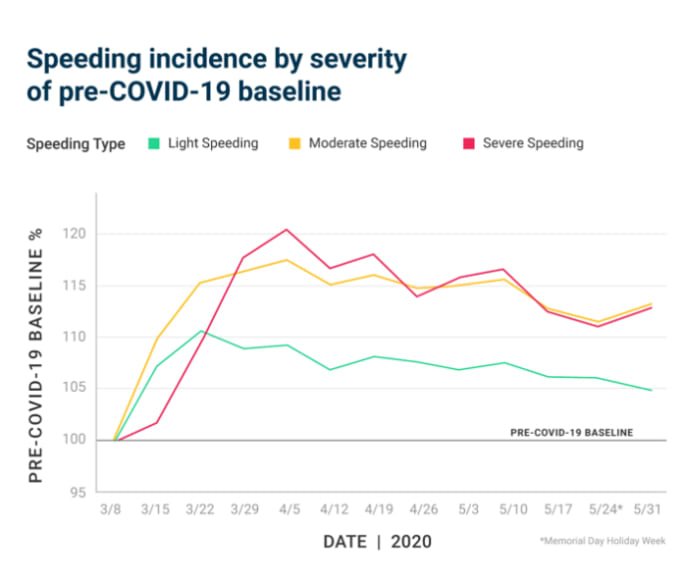
In early April, severe speeding rose 20% above the pre-COVID-19 baseline.
Chart courtesy of Samsara.
More Small Fleet


Developing Budget-Friendly Driver Safety Programs
From driver training and safety meetings to one-on-one coaching and incentive programs, several small fleets share how they have developed a safety culture with their drivers using low- to no-cost resources.
Read More →
Boosting Last-Mile Fleet Uptime, Safety, and Value with AI Vehicle Inspections
AI-powered inspections are transforming last-mile fleets by replacing manual checks with highly accurate automated scans that detect defects in seconds. By giving fleet operations visibility into the daily condition of their vehicles, you can identify trends over the vehicle’s lifecycle that enable improved procurement decisions, route management, driver training and accountability.
Read More →
Five Ways Seat Belts Help Prevent Injuries
There are five ways seat belts protect occupants from injuries, according to the Tennessee Department of Safety and Homeland Security.
Read More →
It’s here: The 2026 Fleet Technology Trends Report
What does AI mean for fleets? Get the answer — and learn other top tech trends.
Read More →
Small Fleets, Big Impact: How Independent Drivers Power Wreaths Across America
Check out how small fleets and independent drivers power Wreaths Across America each December and why their impact matters more than ever.
Read More →
VMS Survey Finds 65% of Small Fleet Managers Run Operations Alone
A new VMS survey shows small fleet managers are stretched thin, with most handling operations solo and eager to adopt digital tools for relief.
Read More →
Tips for Driving Safely on Halloween Night
This video features a reminder from the Connecticut Department of Transportation (DOT) and the Connecticut Police Chiefs Association, urging drivers to prioritize safety this Halloween.
Read More →
AI, Access, and Uptime: VMS’s Next Chapter with David Prusinski
VMS’s new Co-CEO, David Prusinski, shares how an AI-first approach will give small fleets and repair shops the tools to compete like big players.
Read More →
Fleet Managers Share Winter Prep Tips: It's Never Too Early!
Three fleets share best practices to prep vehicles for winter and prevent downtime when the cold sets in.
Read More →