




States Urged to Escalate Fight Against Drugged Driving
A new report highlights the problem’s complexity and the need for states to implement best practices.
Graphic courtesy of GHSA.
Graphic courtesy of GHSA.
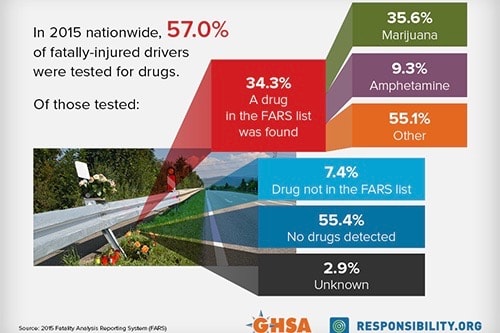
To combat the festering problem of drugged driving, the Governors Highway Safety Association (GHSA) is recommending that individual states expand special law enforcement training so officers can more readily identify and arrest drug-impaired drivers.
Additionally, GHSA recommends that each state form a task force to develop a strategic plan for battling the problem and take measures to improve data collection on drug-impaired driving. These recommendations are included in a newly released report, “Drug Impaired Driving: A Guide for States.”
GHSA produced the report — an update of a 2015 document — in conjunction with the Foundation for Advancing Alcohol Responsibility (Responsibility.org).
The fight against drug-impaired driving is much more complex than the fight against drunken driving, the report stresses. Hundreds of different drugs can impair drivers, and it’s more difficult for law enforcement to detect drugged driving during roadside stops.
Moreover, when drugs are a factor in a crash, most jurisdictions fail to adequately collect and record that data. Laws regarding drug-impaired driving also vary from state to state. Also complicating drug policy efforts is the fact that individual people differ widely in how their bodies absorb and metabolize a specific drug. The effects of alcohol are simpler to assess because alcohol is quickly absorbed into the body, and impairment can be measured by blood alcohol content (BAC).
“As states across the country continue to struggle with drug-impaired driving, it’s critical that we help them understand the current landscape and provide examples of best practices so they can craft the most effective countermeasures,” said Jonathan Adkins, GHSA executive director.
The effectiveness of specialized law enforcement training has been documented. Following four successful pilot programs in 2016, this year five states will receive grants totaling $100,000.
The Illinois, Montana, Washington, West Virginia and Wisconsin highway safety offices will each use their funding to implement advanced roadside impaired driving enforcement (ARIDE) training and drug recognition expert (DRE) programs. Sixteen states and territories applied for these competitive grants. A selection committee composed of experts from around the country reviewed the applications and determined the recipients.
“As drunk driving has declined, drugged driving has increased dramatically and many of today’s impaired drivers are combining two or more substances, which has a multiplicative effect on driver impairment,” said Ralph. S. Blackman, president and CEO of Responsibility.org. “We are pleased to partner with GHSA to fill a critical gap. These training grants will prepare law enforcement to detect drug-impaired drivers and make roads safer for us all.”
The report also shares best practices. California’s efforts to form a task force could serve as a model for other states, according to the report, and New York is at the forefront of drug-impairment data collection.
In California, a committee of stakeholders is working to develop a blueprint to guide the state’s efforts to combat drug impaired driving. The plan is expected for release by the end of this year.
New York has launched a promising new data system that takes advantage of tablet computers to help law enforcement officers record investigation data on the scene. This information is transferred into a centralized system for immediate access.
“Drugged driving is a complicated issue,” said Dr. Jim Hedlund, a former senior official with the National Highway Traffic Safety Administration and the author of the report. “The more we can synthesize the latest research and share what’s going on around the country to address drug-impaired driving, the better positioned states will be to prevent it.”
Originally posted on Automotive Fleet
More Small Fleet


Developing Budget-Friendly Driver Safety Programs
From driver training and safety meetings to one-on-one coaching and incentive programs, several small fleets share how they have developed a safety culture with their drivers using low- to no-cost resources.
Read More →
Boosting Last-Mile Fleet Uptime, Safety, and Value with AI Vehicle Inspections
AI-powered inspections are transforming last-mile fleets by replacing manual checks with highly accurate automated scans that detect defects in seconds. By giving fleet operations visibility into the daily condition of their vehicles, you can identify trends over the vehicle’s lifecycle that enable improved procurement decisions, route management, driver training and accountability.
Read More →
Five Ways Seat Belts Help Prevent Injuries
There are five ways seat belts protect occupants from injuries, according to the Tennessee Department of Safety and Homeland Security.
Read More →
It’s here: The 2026 Fleet Technology Trends Report
What does AI mean for fleets? Get the answer — and learn other top tech trends.
Read More →
Small Fleets, Big Impact: How Independent Drivers Power Wreaths Across America
Check out how small fleets and independent drivers power Wreaths Across America each December and why their impact matters more than ever.
Read More →
VMS Survey Finds 65% of Small Fleet Managers Run Operations Alone
A new VMS survey shows small fleet managers are stretched thin, with most handling operations solo and eager to adopt digital tools for relief.
Read More →
Tips for Driving Safely on Halloween Night
This video features a reminder from the Connecticut Department of Transportation (DOT) and the Connecticut Police Chiefs Association, urging drivers to prioritize safety this Halloween.
Read More →
AI, Access, and Uptime: VMS’s Next Chapter with David Prusinski
VMS’s new Co-CEO, David Prusinski, shares how an AI-first approach will give small fleets and repair shops the tools to compete like big players.
Read More →
Fleet Managers Share Winter Prep Tips: It's Never Too Early!
Three fleets share best practices to prep vehicles for winter and prevent downtime when the cold sets in.
Read More →