




States Urged to Better Prepare for Autonomous Vehicles
A new report from the Governors Highway Safety Association offers recommendations to help state agencies get ready for the future impact of self-driving cars.
Graphic courtesy of GHSA.
Graphic courtesy of GHSA.
With more vehicle manufacturers and tech companies testing self-driving cars on public roads, the Governors Highway Safety Association has opted to release a report offering state governments advice on how to prepare for the future impact of autonomous vehicles. Among the GHSA recommendations: educate the public about the technology and don't rush into adopting regulations.
“The research and media attention given to autonomous vehicles often overlooks the safety implications that a mix of driver-operated and autonomous vehicles will bring,” said James Hedlund, the report’s author. “Unfortunately, ignoring the driver side of the equation may negate many of the expected safety benefits.”
Hedlund is a former senior official with the National Highway Traffic Safety Administration.
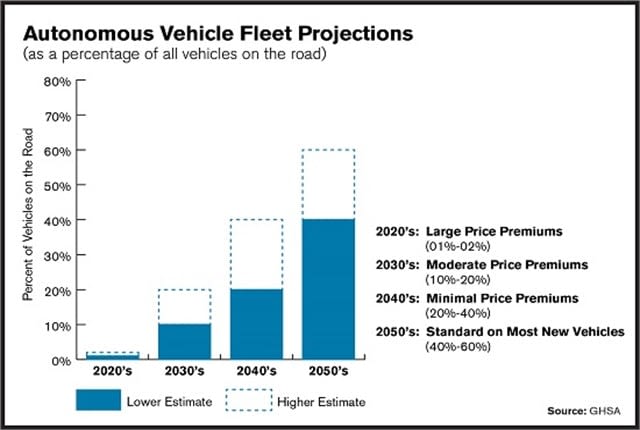
GHSA pointed out that autonomous vehicles will share the road with traditional driver-operated cars for many decades, perhaps forever. And the public remains skeptical. Polls suggest that only about one-fifth of drivers say they would buy an autonomous car as soon as one is available, and fewer than one-third say they would be comfortable riding in one. This presents a myriad of safety challenges for states, which are responsible for licensing drivers, educating the public about traffic safety, and establishing and enforcing traffic laws.
The newly released report, “Autonomous Vehicles Meet Human Drivers: Traffic Safety Issues for States,” provides an overview of the current autonomous vehicle landscape and outlines suggested priorities for state Departments of Motor Vehicles (DMVs) and Highway Safety Offices as autonomous vehicles become more widespread.
Key recommendations from the GHSA report include:
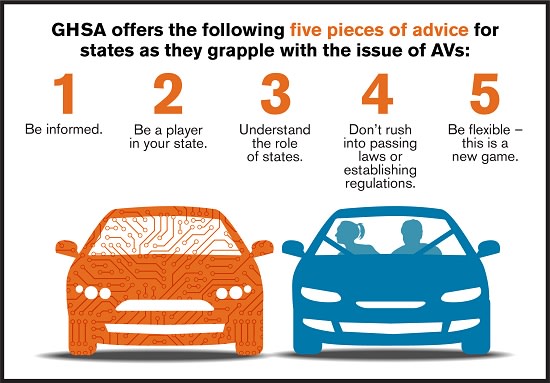
Educate the public — States should develop education campaigns on the benefits and risks of autonomous vehicles, how to operate vehicles with some autonomous features safely, and how to share the road with autonomous vehicles.
Don’t rush into passing laws — States should wait until model laws and regulations have been developed to encourage a common structure and prevent a patchwork of inconsistent laws and regulations that may delay autonomous vehicle implementation.
Capture the data — States should identify vehicle automation levels in their registration, driver licensing and crash information systems. Police crash reports should be designed to help facilitate comprehensive and accurate data collection.
Engage law enforcement — States should include law enforcement in their planning since autonomous vehicles raise a range of issues for law enforcement, including officer safety, enforcement procedures and vehicle identification.
Graphic courtesy of GHSA.
“Drivers are often forgotten as we discuss autonomous vehicles, but cars driven by humans will be on the road for at least another generation,” said Jonathan Adkins, GHSA executive director. “As human drivers begin to share the road with different levels of autonomous vehicles, states will need to stay informed, be patient and be flexible.”
To download the GHSA report, click here.
Originally posted on Automotive Fleet
More Small Fleet


Developing Budget-Friendly Driver Safety Programs
From driver training and safety meetings to one-on-one coaching and incentive programs, several small fleets share how they have developed a safety culture with their drivers using low- to no-cost resources.
Read More →
Boosting Last-Mile Fleet Uptime, Safety, and Value with AI Vehicle Inspections
AI-powered inspections are transforming last-mile fleets by replacing manual checks with highly accurate automated scans that detect defects in seconds. By giving fleet operations visibility into the daily condition of their vehicles, you can identify trends over the vehicle’s lifecycle that enable improved procurement decisions, route management, driver training and accountability.
Read More →
Five Ways Seat Belts Help Prevent Injuries
There are five ways seat belts protect occupants from injuries, according to the Tennessee Department of Safety and Homeland Security.
Read More →
It’s here: The 2026 Fleet Technology Trends Report
What does AI mean for fleets? Get the answer — and learn other top tech trends.
Read More →
Small Fleets, Big Impact: How Independent Drivers Power Wreaths Across America
Check out how small fleets and independent drivers power Wreaths Across America each December and why their impact matters more than ever.
Read More →
VMS Survey Finds 65% of Small Fleet Managers Run Operations Alone
A new VMS survey shows small fleet managers are stretched thin, with most handling operations solo and eager to adopt digital tools for relief.
Read More →
Tips for Driving Safely on Halloween Night
This video features a reminder from the Connecticut Department of Transportation (DOT) and the Connecticut Police Chiefs Association, urging drivers to prioritize safety this Halloween.
Read More →
AI, Access, and Uptime: VMS’s Next Chapter with David Prusinski
VMS’s new Co-CEO, David Prusinski, shares how an AI-first approach will give small fleets and repair shops the tools to compete like big players.
Read More →
Fleet Managers Share Winter Prep Tips: It's Never Too Early!
Three fleets share best practices to prep vehicles for winter and prevent downtime when the cold sets in.
Read More →