




Report Cites Health Impacts from Warehouse Truck Emissions
A new report from the Environment Defense Fund suggests ways to combat harmful air pollution from diesel trucks.

Transport to and from warehouses generates hundreds of truck trips every day, and those trucks can emit more pollution while idling or traveling at slow speeds to get there.
Photo: Canva/Automotive Fleet
According to new research from Environmental Defense Fund, on U.S. warehouse proliferation, 15 million people live within a half-mile of a warehouse in 10 states across the country.
The report, "Making the Invisible Visible: Shining a Light on Warehouse Truck Air Pollution," provides a look into the impact of truck-related air pollution exposure experienced by people living in close proximity to warehouses.
“As corporations taught consumers to expect just-in-time products and delivery, warehouses have moved closer to people’s homes in more communities than ever before, bringing harmful air pollution from trucks with them,” said Aileen Nowlan, EDF’s U.S. policy director, Global Clean Air Initiative. “It’s important to understand who is bearing the brunt of health burdens associated with living close to heavy truck traffic in order to develop and implement smart, targeted policies that protect public health and reduce emissions.”
Mapping Shows Unequal Burden
EDF researchers combined warehouse industry data with a Geospatial Information System (GIS) application known as Proximity Mapping, which applies areal apportionment to estimate the characteristics of populations living near specific facilities and pollution sources, using the U.S. Census Bureau’s American Community Survey Five-Year estimates.
Findings included:
Some 17,600 warehouses are located within 10 states;
More than 1 million children under five live within a half-mile of warehouses; and
Warehouse proliferation does not distribute the risk evenly. In some states like Illinois, Massachusetts and Colorado, the concentration of Black and Latino residents around warehouses is nearly double the state average.
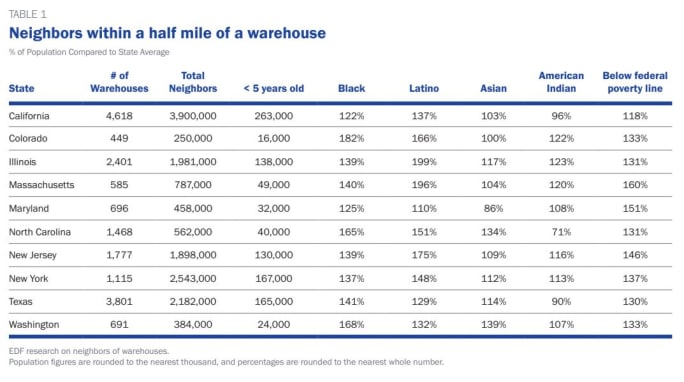
In many states, Black, Latino, Asian, American Indian communities, and areas of low wealth are disproportionately exposed to this pollution.
Photo: EDF
Diesel Trucks Bring Harmful Air Pollution
While warehouses can bring jobs and other economic growth opportunities to communities, they also attract diesel trucks and their harmful air pollution, according to the report. Each warehouse generates hundreds of truck trips every day, and trucks can emit more pollution while idling or traveling at slow speeds than while driving at faster speeds.
Exposure to air pollution from these trucks is linked to a range of health issues, including the risk of developing childhood asthma, heart disease, adverse birth outcomes like premature birth and low birth weight, cognitive decline, and stroke.
Affordable Solutions Exist
The report calls for several interventions, including increased air quality monitoring, that can provide a better understanding of air pollution around warehouses and help accelerate investments in zero-emissions goods transport.
While the Energy Information Agency maintains a database of oil and gas infrastructure, nothing similar exists for current and proposed warehouses. The report said more transparency around plans for warehouse expansion can help local leaders and communities plan for and address the challenges that come with these new facilities.
Further, zero-emission options exist for delivery vans, yard trucks and regional haul trucks, and manufacturers are investing billions to expand zero-emissions for long-haul trucking as well. States and cities can spur the transition to zero-emission trucks through policies such as the Advanced Clean Trucks rule.
Finally, EPA recently proposed tailpipe regulations designed to ensure that up to half of new urban delivery and freight vehicles sold by 2032 will be zero-emitting. Taken together with historic investments from the Inflation Reduction Act, these recent moves are turbocharging investments in clean trucks, charging infrastructure, and job creation.
“Communities deserve to know more about the businesses that operate near their homes and schools, especially if they pose a health threat,” Nowlan said. “Solutions exist today to reduce truck-related air pollution and protect public health. Greater transparency around warehouse locations and the pollution they attract is critical.”
Originally posted on Automotive Fleet
More Small Fleet


Developing Budget-Friendly Driver Safety Programs
From driver training and safety meetings to one-on-one coaching and incentive programs, several small fleets share how they have developed a safety culture with their drivers using low- to no-cost resources.
Read More →
Boosting Last-Mile Fleet Uptime, Safety, and Value with AI Vehicle Inspections
AI-powered inspections are transforming last-mile fleets by replacing manual checks with highly accurate automated scans that detect defects in seconds. By giving fleet operations visibility into the daily condition of their vehicles, you can identify trends over the vehicle’s lifecycle that enable improved procurement decisions, route management, driver training and accountability.
Read More →
Five Ways Seat Belts Help Prevent Injuries
There are five ways seat belts protect occupants from injuries, according to the Tennessee Department of Safety and Homeland Security.
Read More →
It’s here: The 2026 Fleet Technology Trends Report
What does AI mean for fleets? Get the answer — and learn other top tech trends.
Read More →
Small Fleets, Big Impact: How Independent Drivers Power Wreaths Across America
Check out how small fleets and independent drivers power Wreaths Across America each December and why their impact matters more than ever.
Read More →
VMS Survey Finds 65% of Small Fleet Managers Run Operations Alone
A new VMS survey shows small fleet managers are stretched thin, with most handling operations solo and eager to adopt digital tools for relief.
Read More →
Tips for Driving Safely on Halloween Night
This video features a reminder from the Connecticut Department of Transportation (DOT) and the Connecticut Police Chiefs Association, urging drivers to prioritize safety this Halloween.
Read More →
AI, Access, and Uptime: VMS’s Next Chapter with David Prusinski
VMS’s new Co-CEO, David Prusinski, shares how an AI-first approach will give small fleets and repair shops the tools to compete like big players.
Read More →
Fleet Managers Share Winter Prep Tips: It's Never Too Early!
Three fleets share best practices to prep vehicles for winter and prevent downtime when the cold sets in.
Read More →