




Positive Forecast for Work Truck Application Markets
Across the board, IHS Global Insight numbers can be seen as a positive for the work truck industry.
According to the NTEA - The Association for the Work Truck Industry, companies, and for that matter, the industries the companies are part of, don’t grow if their customers don’t grow.
That being said, not all customers in a specific industry have to be on a growth cycle for the industry to grow. The commercial vehicle industry has been a great example of this in the current economic expansion.
Work truck and truck equipment companies experienced positive growth cycles, despite a challenging construction sector market over the last few years. Thus, companies that were focused primarily on the construction sector did not fare as well as companies that maintained a more diversified customer base between 2010 and 2013.
For planning purposes, it is extremely valuable for your company to generate a forecast for each of the application markets you serve. By doing so, you can identify critical areas of opportunity. Generally speaking, your company’s sales forecast is a weighted average of the forecasts for the application markets you serve.
Other variables will influence the forecast generated for the company itself, such as growth in the U.S. and global economies, or changes in interest rates or commodity prices, depending on the company.
The construction and state/local government sectors of the U.S. economy account for approximately 35–40 percent of total truck and truck equipment sales. This article will focus on large blocks of the remaining 60–65 percent of U.S. sales, in order to highlight where additional opportunity may lie.
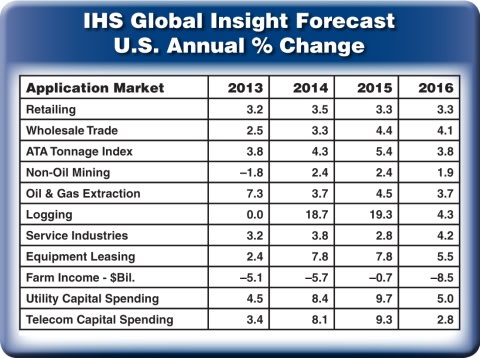
The IHS Global Insight forecast for several commercial vehicle industry application markets (see chart above) shows that growth is expected in most markets through 2016, with the retailing, wholesaling and service industries’ forecasts standing out as three of the largest markets. The sheer size of these three applicationmarkets can strongly influence growth in the economy as a whole.
Despite their similarities, their forecasts do diverge in 2015 and 2016.
Across the board, though, these numbers can be seen as a positive for the work truck industry. The retail and wholesale sectors of the economy use many types of trucks, but the majority of them have light- and medium-duty chassis with van bodies, along with tractors/semi-trailers to deliver the goods.
These are large sectors of the economy, but because of the types of trucks they tend to use, the forecasts for these economic sectors are more relevant to some work truck companies than they are to others. The service industries’ forecast applies to an even larger economic sector (roughly 70 percent of the U.S. economy) and covers a wide range of industries that includes everything from restaurants and hotels to banks and hospitals.
Since the types of trucks used in the service sector cover everything from pickups to midsize buses to armored trucks, its forecast should be factored in to most work truck companies’ market plans.
The chart above also shows that the forecast for 2014 and 2015 for the telecommunications industry is higher than most of the other application markets. According to information made available on the Telecommunications Industry Association website, driving the forecast are high expectations for VoIP (internet phone) and IPTV (internet television).
The number of Internet television users, for instance, is expected to increase from 13.6 million in 2013 to 18.5 million in 2016 — an increase of roughly 12 percent per year for the next three years. For Internet phones, the growth rate is not expected to be as high, but the number of customers is much higher. There are currently 38 million residential and business users of smartphones, and that is expected to grow to 42.6 million in 2016.
Getting all of those new customers connected will likely generate increased capital expenditures for trucks with service bodies and cranes, but growth in truck purchases could be higher or lower than the forecast for the industry as a whole. Consequently, company personnel involved in forecasting should modify the industry forecast to account for the difference between industry growth and expectations for that industry’s need for new trucks and equipment to support that growth.
This article was published in the November 2013 edition of NTEA News by Steve Latin-Kasper. There are numerous other sources of application market data. If you have questions about this article or marketdata resources in general, please contact Steve Latin-Kasper, NTEA’s director of market data and research, at (248) 479-8193 or stevelk@ntea.com.
More Operations

Think You Know Trucks? Take Our 19-Question Fleet Trivia Challenge
From chicken lights to diesel engines and trucking history, test your knowledge with 19 questions from the 2026 Work Truck Exchange and Heavy Duty Trucking Exchange.
Read More →
Where’s My Truck: Inside the Fleet Logistics Work Nobody Sees
Shades of Fleet video thumbnail featuring Lauren Fletcher beside the text “The People Behind the Process, Keeping Fleets Moving,” with fleet vehicles and logistics imagery in the background.
Read More →
Work Truck Seeks Fleet and Industry Insights on 2026 Trends and 2027 Forecasts
Work Truck is seeking insights from fleet leaders and industry partners on the trends that shaped 2026 and what commercial fleets should prepare for in 2027. Participate today!
Read More →From Our Partners
Basic Tracking vs Next Generation Fleet Technology
Sponsored by AT&T Business

5 Facts Every Fleet Manager Should Know About Embedded Telematics
Sponsored by Stellantis/Mobilisights

How AI Video Telematics Boosts Driver Safety and Helps to Avoid Unnecessary Costs
Sponsored by Verizon Connect

Charting the 8 Bottom-Line Benefits of Workforce Optimization
Sponsored by Verizon Connect


It's 10 p.m... Do You Know Who Has Access to Your Fleet?
Preventing cargo theft requires investment in technology, operational processes, and employee training. In an industry with tight margins, it can be difficult to justify investments whose value is measured by incidents that might never occur.
Read More →
GeoFencing Adds to Your Truck Security Arsenal
Geofencing is a familiar fleet tool today, but its early adoption marked a major shift in vehicle tracking, route monitoring, and the debate over employee privacy.
Read More →
Truckers’ Strike Rumors, New GM Engines, and Hidden Idling Costs Lead This Week’s News
Truckers’ strike rumors, GM’s new 2027 engines, hidden idling costs, racing lessons, IRP rules, and more headline this week’s Truck Chat Weekly Cheat Sheet.
Read More →
Shades of Fleet Wants to Hear From You About Building a Culture of Care
Fleet leaders, we want to hear from you. Share how empathy, trust, and creating space for people can strengthen your team, improve performance, and support retention.
Read More →
What Racing Can Teach Work Truck Fleets About the Work Nobody Sees
Race car driver and mechanical engineer Isaac Johnson shares practical lessons on preparation, relationships, setbacks, and building teams that perform when it counts.
Read More →
New Fleet Guides, Hidden Truck Wear, and Driver Fit Lead This Month
Our latest Truck Chat recap covers new Fleet Guides, hidden idling costs, driver fit, lighter-truck registration rules, and year-round technician appreciation.
Read More →
Work Truck Takes Fleet Rivalry Downhill to Support Skilled Trades
Team Fletcher claimed a head-to-head win and second overall as Work Truck and Automotive Fleet helped raise $22,000 for the Hourglass Foundation.
Read More →