




Peterbilt: Full Production of Medium-Duty Hybrids in 2008
Both medium-duty hybrid trucks are in limited production this year with full production expected for 2008.
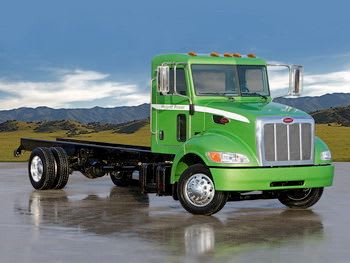
The Peterbilt Model 330 hybrid produces 300 hp and860 ft-lbs of torque with the hybrid system engaged.
Peterbilt Motors Company continues development and testing of four hybrid vehicle platforms, the company announced during its press conference at the 2007 Mid-America Trucking Show.
According to Peterbilt Chief Engineer Landon Sproull, the four hybrid vehicle platforms are:
• A hybrid electric heavy duty vehicle for long-haul applications.
• A hybrid electric medium duty vehicle for pick-up and delivery applications.
• A hybrid electric medium duty vehicle equipped for stationary PTO applications.
• And a hydraulic hybrid heavy duty vehicle for vocational and stop-and-go applications.
Heavy-Duty On-Highway Hybrid Electric Vehicle
This month, Peterbilt announced the latest of its hybrid initiatives, a hybrid electric Class 8 Model 386 configured for long-haul applications. It combines the aerodynamic efficiency of the Model 386 with a parallel-type “direct” electric hybrid system.
The heavy duty hybrid electric Model 386, configured for on-highway use, is being developed in conjunction with Eaton and Wal-Mart Stores Inc. It is currently in the testing and evaluation phase and is expected to be available in 2010.
During third-party testing, the Eaton Hybrid Power System has routinely achieved a 5-7 percent fuel savings versus comparable, non-hybrid models.
Medium-Duty Hybrid Electric Vehicles
Peterbilt has engineered a hybrid electric system, developed with Eaton, with its Class 6 Peterbilt Model 330 configured for local pick-up and delivery applications and its Class 7 Model 335 equipped with a fully integrated Terex bucket lift body.
The Model 330 is powered by the PACCAR PX-6 engine rated at 240 horsepower and 560 ft-lbs of torque. With the hybrid system engaged, horsepower increases to 300 and torque to 860 ft-lbs.
This configuration is ideal for stop-and-go use, such as urban pick-up and delivery, with the hybrid system resulting in 30 to 40 percent greater fuel savings by using electric power to accelerate the vehicle from a stop.
The Model 335 is also powered by the PACCAR PX-6 engine which regenerates lithium-ion batteries to electrically operate the PTO. This application of hybrid technology is well suited for municipal and utility applications.
Both medium duty hybrid trucks are in limited production this year with full production expected for 2008.
Heavy-Duty Vocational Hybrid Hydraulic Vehicle
The fourth area of development is hybrid Hydraulic Launch Assist (HLA) technology and is currently being evaluated for vocational and stop-and-go applications, such as refuse collection. This technology is also being jointly developed with Eaton and recycles a truck’s kinetic energy to conserve fuel and assist in acceleration.
Sproull says the versatile HLA technology can be used to considerably improve fuel efficiency in fuel economy mode or reduce cycle times in productivity mode. In both modes, reduced brake wear of more than 50 percent has been observed.
The system, currently integrated with Peterbilt’s low-cab-forward Model 320, increases brake life and reduces engine and transmission wear, potentially extending component life and lowering service costs. It is also more environmentally friendly by decreasing exhaust emissions and noise.
More Small Fleet


Developing Budget-Friendly Driver Safety Programs
From driver training and safety meetings to one-on-one coaching and incentive programs, several small fleets share how they have developed a safety culture with their drivers using low- to no-cost resources.
Read More →
Boosting Last-Mile Fleet Uptime, Safety, and Value with AI Vehicle Inspections
AI-powered inspections are transforming last-mile fleets by replacing manual checks with highly accurate automated scans that detect defects in seconds. By giving fleet operations visibility into the daily condition of their vehicles, you can identify trends over the vehicle’s lifecycle that enable improved procurement decisions, route management, driver training and accountability.
Read More →
Five Ways Seat Belts Help Prevent Injuries
There are five ways seat belts protect occupants from injuries, according to the Tennessee Department of Safety and Homeland Security.
Read More →
It’s here: The 2026 Fleet Technology Trends Report
What does AI mean for fleets? Get the answer — and learn other top tech trends.
Read More →
Small Fleets, Big Impact: How Independent Drivers Power Wreaths Across America
Check out how small fleets and independent drivers power Wreaths Across America each December and why their impact matters more than ever.
Read More →
VMS Survey Finds 65% of Small Fleet Managers Run Operations Alone
A new VMS survey shows small fleet managers are stretched thin, with most handling operations solo and eager to adopt digital tools for relief.
Read More →
Tips for Driving Safely on Halloween Night
This video features a reminder from the Connecticut Department of Transportation (DOT) and the Connecticut Police Chiefs Association, urging drivers to prioritize safety this Halloween.
Read More →
AI, Access, and Uptime: VMS’s Next Chapter with David Prusinski
VMS’s new Co-CEO, David Prusinski, shares how an AI-first approach will give small fleets and repair shops the tools to compete like big players.
Read More →
Fleet Managers Share Winter Prep Tips: It's Never Too Early!
Three fleets share best practices to prep vehicles for winter and prevent downtime when the cold sets in.
Read More →