




Pedestrian Deaths Climb a Projected 10%
Preliminary crash data for 2015 reveal a disturbing trend that’s detailed in a new report from the Governors Highway Safety Association.
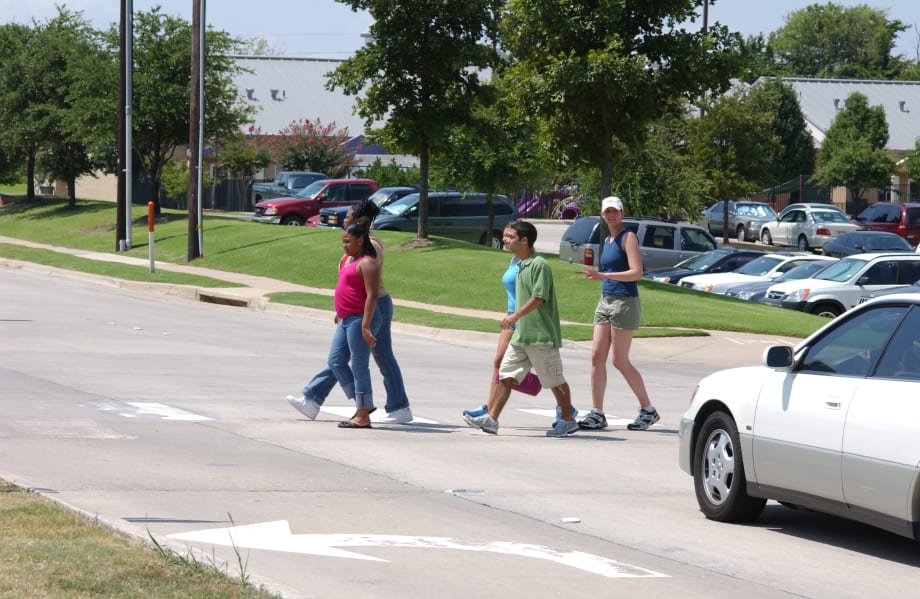
GHSA has asked its state members to share examples of strategies underway to reduce pedestrian and motor vehicle collisions. Photo courtesy of NHTSA.
GHSA has asked its state members to share examples of strategies underway to reduce pedestrian and motor vehicle collisions. Photo courtesy of NHTSA.
Pedestrian deaths resulting from traffic crashes rose a projected 10% in 2015 compared to the previous year, according to a new report based on preliminary crash data.
The Governors Highway Safety Association (GHSA) released its annual Spotlight on Highway Safety Report, which provides the first look at 2015 pedestrian fatality trends. The report is based on early figures reported by all 50 state highway safety agencies and the District of Columbia. Richard Retting and Dr. Heather Rothenberg of Sam Schwartz Consulting authored the report.
“We are projecting the largest year-to-year increase in pedestrian fatalities since national records have been kept, and therefore we are quite alarmed,” Retting said.
Since the federal Fatality Analysis Reporting System was established in 1975, the year-to-year change in the number of pedestrian fatalities has varied from a 10.5% decrease to an 8.1% increase.
“Pedestrian safety is clearly a growing problem across the country,” Retting noted. “It is important to understand the data underlying these crashes so states and localities can apply the right mix of engineering, education and enforcement to counteract this troubling trend.”
Researchers compared the number of pedestrian fatalities for the first six months of 2015 (2,368) with the same time period the previous year (2,232). They adjusted for anticipated underreporting associated with the early data, and expect the final 2015 pedestrian fatality total will be approximately 10% higher than in 2014.
Along with the increase in pedestrian fatalities, pedestrians now account for a larger share— about 15% — of all motor vehicle crash-related deaths compared with 11% a decade ago.
Many factors could be contributing to this spike. An increase in motor vehicle travel, fueled in part by improved economic conditions and lower gas prices, is one factor. Also, the growing use of cell phones among walkers and drivers may be partially to blame.
Additionally, vehicles are becoming more and more crashworthy, so the likelihood of drivers and passengers surviving a crash is improving all the time. By contrast, pedestrians remain just as susceptible to injuries when hit by a motor vehicle.
Another important factor is the increase in the number of Americans walking for health, economic or environmental reasons. This underscores the need to create safe, walkable pathways and to ensure that people who drive and people who walk both understand and follow the rules of the road, GHSA said.
States reported a wide range of increases and decreases in the number of pedestrian fatalities over the first six months of 2015. Twenty-one states had decreases, 26 states and the District of Columbia reported increases, and three states had no change.
Not surprisingly, more pedestrian fatalities tend to occur in large states with large urban centers. California, Florida, Texas and New York accounted for 42% of all pedestrian deaths in the first six months of 2015. However, when population is taken into account, the states with the highest fatality rate per 100,000 residents were all over the map. In 2014, the seven states with the highest rates were New Mexico, Florida, Delaware, Nevada, Louisiana, South Carolina and Arizona.
“GHSA and our member states will continue to make pedestrian safety a priority,” said Jonathan Adkins, GHSA executive director. “The recently passed federal surface transportation bill, the FAST Act, will give states more resources and flexibility to address their most pressing pedestrian safety problems. We look forward to working with NHTSA and our other partners to drive down these numbers and move toward zero deaths.”
GHSA has asked its state members to share examples of strategies underway to reduce pedestrian and motor vehicle collisions. Some of the most promising approaches include targeted traffic enforcement coupled with public information campaigns, data analysis and mapping to identify high-risk zones, community-based pedestrian safety assessments and road safety audits, and strategic partnerships with universities or other organizations. The report provides examples of these efforts in 28 states.
You can access the full report at www.ghsa.org.
Originally posted on Automotive Fleet
More Small Fleet


Developing Budget-Friendly Driver Safety Programs
From driver training and safety meetings to one-on-one coaching and incentive programs, several small fleets share how they have developed a safety culture with their drivers using low- to no-cost resources.
Read More →
Boosting Last-Mile Fleet Uptime, Safety, and Value with AI Vehicle Inspections
AI-powered inspections are transforming last-mile fleets by replacing manual checks with highly accurate automated scans that detect defects in seconds. By giving fleet operations visibility into the daily condition of their vehicles, you can identify trends over the vehicle’s lifecycle that enable improved procurement decisions, route management, driver training and accountability.
Read More →
Five Ways Seat Belts Help Prevent Injuries
There are five ways seat belts protect occupants from injuries, according to the Tennessee Department of Safety and Homeland Security.
Read More →
It’s here: The 2026 Fleet Technology Trends Report
What does AI mean for fleets? Get the answer — and learn other top tech trends.
Read More →
Small Fleets, Big Impact: How Independent Drivers Power Wreaths Across America
Check out how small fleets and independent drivers power Wreaths Across America each December and why their impact matters more than ever.
Read More →
VMS Survey Finds 65% of Small Fleet Managers Run Operations Alone
A new VMS survey shows small fleet managers are stretched thin, with most handling operations solo and eager to adopt digital tools for relief.
Read More →
Tips for Driving Safely on Halloween Night
This video features a reminder from the Connecticut Department of Transportation (DOT) and the Connecticut Police Chiefs Association, urging drivers to prioritize safety this Halloween.
Read More →
AI, Access, and Uptime: VMS’s Next Chapter with David Prusinski
VMS’s new Co-CEO, David Prusinski, shares how an AI-first approach will give small fleets and repair shops the tools to compete like big players.
Read More →
Fleet Managers Share Winter Prep Tips: It's Never Too Early!
Three fleets share best practices to prep vehicles for winter and prevent downtime when the cold sets in.
Read More →