





From Military Truck to Firefighting Work Truck: The Monterra 6x6
Palisades Fire Now the Largest in LA History
Firefighters continue to battle multiple wildfires across the Los Angeles area, but one in particular has become one of the largest natural disasters in LA history, according to the fire chief. The Palisades Fire has now consumed more than 17,000 acres.
January 9, 2025
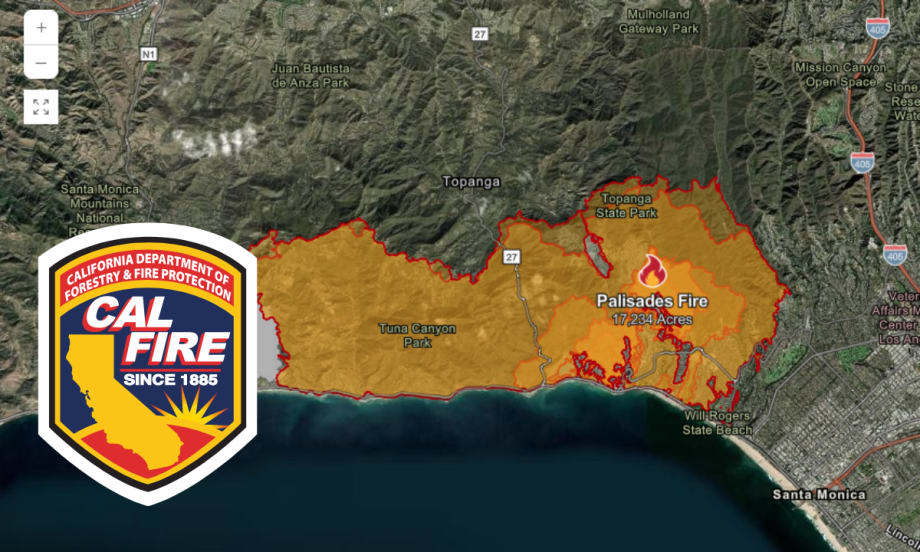
Among this week’s wildfires in Southern California, the Palisades Fire has grown to be the largest in the area’s history, reaching all the way to the coast.
Photo: CAL Fire
5 min to read
Flames continue to char areas in and around Los Angeles as firefighters battle wildfires on multiple fronts, including the areas impacted by the more than 17,000-acre Palisades Fire, which has grown to be one of the most destructive natural disasters in LA’s history.
Chief Kristin M. Crowley, of the Los Angeles Fire Department, said the number of structures damaged or destroyed by that fire alone is now in the thousands. There have been two other Palisades Fires in recent years. One in May 2021 burned 1,202 acres, and another in October 2019 impacted 42 acres.
Crowley provided updates Thursday on wildfires within the City of Los Angeles, and Chief Anthony C. Marrone, of the Los Angeles County Fire Department, updated the status of the wildfires in the county.
The multiple wind-driven wildfires have caused evacuations across the LA area.
“I have to take a moment for all the right reasons to thank the residents of Los Angeles and the surrounding areas for heeding our instructions,” Crowley said.
The Palisades Fire
Crowley said the Palisades Fire started on Jan. 7 at 10:30 a.m. and by Thursday had grown to engulf more than 17,000 acres. Multiple departments, both fire and law enforcement, are at the scene. However, the chief said containment is 0%. Firefighters and air resources continue working to contain the fire.
“Damage assessments are ongoing at the Palisades Fire. However, preliminary reports estimate the damage or destroyed structures to be in the thousands,” Crowley explained. “It is safe to say that the Palisades Fire is one of the most destructive natural disasters in the history of Los Angeles.”
The Hearst Fire
The Hearst Fire, according to Crowley, started on Jan. 7 and has grown to 855 acres. There is 0% containment, but efforts are ongoing.
“Firefighters held the fire within a planned containment area, and we have established a perimeter. Crews were able to get a handle on a few of the flare-ups over the night. We will continue to strengthen our containment lines and create a number of dozer lines to minimize the fire growth,” Crowley added.
The Woodley Fire
The Woodley Fire, which started Jan. 8, presents no current threats, according to Crowley.
She said it impacted 30 acres but now has been fully contained and is counted as a “knockdown.”
The Sunset Fire
The Sunset Fire, in the Runyon Canyon area, started on the evening of Jan. 8 and has grown to slightly more than 40 acres. Crowley said the fire was cut off, and crews are working to put out spotfires within the perimeter to keep the wind from spreading any additional embers.
“This fire was rapidly and aggressively attacked by using coordinated air and ground fire suppression efforts,” she explained.
The Sunswept Fire
The Sunswept Fire, in the Studio City area, involved two large structure fires, hillside homes, and winds caused the flames to extend into nearby brush.
“Our firefighters stopped the forward progress at just under one acre,” Crowley said.
The Eaton Fire
The Eaton Fire is estimated to be 10,600 acres, and growth has been significantly stopped, but Marrone said firefighters have 0% containment. Nearly 900 firefighters are assigned to the fire, and mutual aid resources are still arriving.
The chief said incident fatality information and reporting will be the responsibility of the Los Angeles County Sheriff’s Department.
The Lidia Fire
“The Lidia Fire that started yesterday in Acton has been 40% contained, and forward progress has been stopped. It is limited to 348 acres,” Marrone said.
He said additional resources, even from out of state, continue arriving to assist with firefighting in both the city and county.
“The number of resources assigned to this fire siege event has increased significantly, and we have a much better posture than we did on Tuesday and Wednesday,” Marrone explained.
The chief also added that the red flag warning issued by the National Weather Service is expected to continue into Friday for Los Angeles County and the majority of Ventura County.
Federal Disaster Assistance Now Available
The Federal Emergency Management Agency, FEMA, announced that federal disaster assistance is available to the state of California to supplement recovery efforts in the areas affected by wildfires and straight-line winds from Jan. 7, 2025, and continuing. Funding will be available to affected individuals in Los Angeles County.
Assistance can include grants for temporary housing and home repairs, low-cost loans to cover uninsured property losses, and other programs to help individuals and business owners recover from the effects of the disaster.
Federal funding is also available to state, tribal, and eligible local governments and certain private nonprofit organizations on a cost-sharing basis for debris removal and emergency protective measures, including direct federal assistance.
Individuals and business owners who sustained losses in the designated areas can begin applying for assistance by registering online at https://www.disasterassistance.gov/, by calling 1-800-621- 3362 or by using the FEMA App. If you use a relay service, such as video relay service (VRS), captioned telephone service, or others, give FEMA the number for that service.
LA County Natural Disaster Risk Profile
FEMA’s National Risk Index provides an in-depth view of risks for each county in the U.S., including Los Angeles County, which is at the high end of the risk chart for wildfires.
One a scale of 0 to 100, LA County has a Risk Index Score of 99.9 related to wildfires and a risk value of more than $110 million. The expected annual loss (EAL) to wildfire, according to FEMA, is nearly $109 million.
FEMA also looks at each county’s social vulnerability and its community resilience. For LA County, social vulnerability is classified as very high, while community resilience is categorized as very low.
Based on the National Risk Index score for LA County, the top five natural disaster threats typically are:
Earthquake — risk index score of 100
Wildfire — risk index score of 99.9
Heat wave — risk index score of 98.4
Tornado — risk index score of 97.6
Landslide — risk index score of 96.3
More Operations

2027 GM Trucks, Technician Retention, and Fleet Lessons Lead This Week’s News
New GM pickups, technician retention, fleet leadership lessons, winter equipment, and more headline this week’s Truck Chat Weekly Cheat Sheet.
Read More →
Family Ties Inside the Fleet Families Building Careers Across Generations
Three fleet families share what it really takes to work together, learn across generations, and keep business from following them home.
Read More →
Shades of Fleet Call for Voices: Fleet's Hidden Heroes
Fleet’s hidden heroes are often the ones keeping everything moving behind the scenes. September’s Shades of Fleet is looking for dispatchers, coordinators, parts specialists, and other support pros to share their stories.
Read More →From Our Partners




Truck Centers, Inc. Celebrates National Truck Driver Appreciation Week with $1,000 Fuel Card Giveaways
During National Truck Driver Appreciation Week, Truck Centers, Inc. is offering customers a chance to fuel up for free. Customers at all Truck Centers locations can enter to win one of four $1,000 fuel cards from Sept. 14 - 18.
Read More →
Fleet Guides, AI Time-Savers, Truck Tariffs & Fuel Strategy Lead the News
This week’s Truck Chat Cheat Sheet covers new fleet vehicle guides, practical AI use cases, U.S.-Canada truck production, mixed-energy strategy, and more.
Read More →
What Fleet Employers Are Missing When Hiring Veterans
What if some of the strongest candidates for fleet are already out there, but their experience is written in a language our industry does not always recognize?
Read More →
Teletrac Navman Promotes New CEO from Within
Teletrac Navman’s next CEO, Ricardo Buranello, has served as the company’s chief financial and operating officer. He brings deep financial and operational expertise, a strong strategic orientation, and an intimate knowledge of the business to his new role.
Read More →
Automotive Fleet Opens 2026 Personal Use Survey for Commercial Fleet Managers
Less than two weeks left! Commercial and corporate fleet managers are invited to share how their organizations handle company vehicle personal-use policies, charges, and driver eligibility.
Read More →
What Resilient Fleets Do Differently When Conditions Change
Fleet resilience is about more than reacting to disruption. Lauren Fletcher talks with AP Fleet’s Alex Coveney about flexibility, planning, scaling, and what helps fleets adapt when business conditions shift.
Read More →
Isuzu & U.S. Department of Labor Celebrate Milestone for Veterans Apprenticeship Program
The Isuzu Veterans Apprenticeship Program (IVAP) signing ceremony highlighted Isuzu’s long-term commitment to veterans, Isuzu dealers, and the skilled workforce supporting its customers and the commercial transportation industry.
Read More →