





Read More: Adapting to Economic Pressures in Fleet Truck Management
New Tariffs Start on March 4
After being put on hold for 30 days, President Donald Trump's new tariff terms will be in place starting March 4. That means surcharges of 25% on goods imported from Mexico, 10% on imports from Canada, and now 20% on those coming in from China.
February 27, 2025
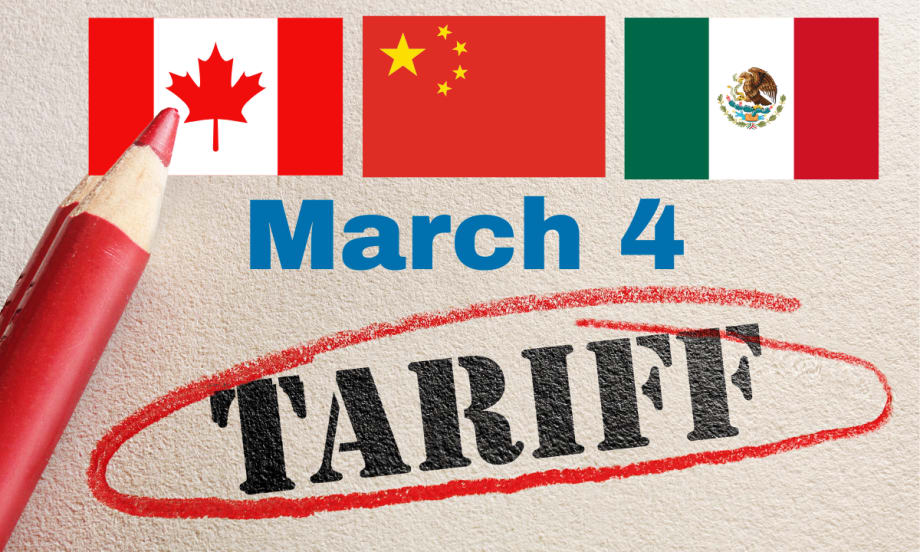
The new tariffs imposed on imports from China, Canada, and Mexico were delayed for 30 days but now will begin March 4.
Photo: Work Truck
6 min to read
The new tariffs President Donald Trump created via executive order will add surcharges of 25% on goods imported from Mexico, 10% on imports from Canada, and 10% on those coming in from China. Although the tariffs were postponed initially for 30 days, they will now go into place on March 4. The tariffs on imports from China will also be more than initially announced.
Trump announced in a post on Truth Social that he intends to implement the tariffs on that day. The president also specified that an additional 10% charge will be added to the original 10% tariff on goods imported from China.
Trucking, Manufacturing, and Transportation Leaders on Tariffs
While many business leaders in the U.S. praise the trade achievements ushered in by the 2020 United States-Mexico-Canada Agreement (USMCA), some now express concerns about the possible negative impact of the latest proposed tariffs.
The new tariffs on imports from China, Mexico, and Canada were to became effective today and potentially increase costs on a wide variety of products, but the impact to American businesses has not been determined.
However, yesterday, President Donald Trump agreed to delay implementation of the tariffs on products from Mexico and Canada for 30 days after the two counties agreed to increase border security efforts.
Whether it is reduced freight movement hitting all levels of trucking and delivery segments, or increased cost of parts and vehicles, the ultimate result is yet to be uncovered.
According to the White House, the 25% tariff on goods imported from Mexico, 10% on imports from Canada, and 10% on those coming in from China, are imposed in addition to any other duties, fees, exactions, or charges applicable to such imported articles.
The White House reported trade accounts for 67% of Canada’s gross domestic product (GDP), 73% of Mexico’s GDP, and 37% of China’s GDP. However, it accounts for only 24% of U.S. GDP and in 2023 the U.S. trade deficit in goods was the world’s largest at over $1 trillion.

Industry leaders are concerned that the new tariffs on imports from Mexico and Canada will drive the cost of automotive parts, vehicles, and products up in the U.S.
Photo: Work Truck
United States – Mexico – Canada Agreement
Jay Timmons, president and CEO of the National Association of Manufacturers pointed to manufacturing gains as a result of the United States-Mexico-Canada Agreement, a trade agreement formed during Trump’s first administration.
“Thanks to this agreement, one-third of critical U.S. manufacturing inputs now come from Canada or Mexico, rather than from competitors like China that often engage in unfair trade practices,” Timmons said in a statement.
But he also pointed out some tax reforms manufacturers needed were not passed in recent years and as a result U.S. companies “face mounting cost pressures.”
“A 25% tariff on Canada and Mexico threatens to upend the very supply chains that have made U.S. manufacturing more competitive globally. The ripple effects will be severe, particularly for small and medium-sized manufacturers that lack the flexibility and capital to rapidly find alternative suppliers or absorb skyrocketing energy costs,” Timmons said. “These businesses—employing millions of American workers—will face significant disruptions. Ultimately, manufacturers will bear the brunt of these tariffs, undermining our ability to sell our products at a competitive price and putting American jobs at risk.”
Pressure on Vehicle Suppliers Expected
The Motor & Equipment Manufacturers Association (MEMA), has voiced opposition to the tariffs, saying the tariffs will have “severe consequences” for the U.S. vehicle supplier industry.
“A 25% tariff would significantly increase the cost of essential vehicle components, with those added costs inevitably passed down to consumers. At a time when inflation remains a key concern, such tariffs would further strain household budgets and disrupt affordability in the automotive sector. North American trade is already the largest U.S. export market, supporting millions of American jobs,” MEMA said in a statement.
Despite the opposition to the tariffs, MEMA said it stands with Trump to ensure a trade strategy that will preserve the gains experienced through USMCA and help grow domestic manufacturing jobs.
Freight Concerns & Higher Prices
Chris Spear, CEO and president of the American Trucking Associations, pointed out how the trucking industry has just recovered from a multi-year freight recession, and expressed concerns that tariffs could reduce freight volumes and increase costs for motor carriers.
“A 25% tariff levied on Mexico could see the price of a new tractor increase by as much as $35,000. That is cost-prohibitive for many small carriers, and for larger fleets, it would add tens of millions of dollars in annual operating costs,” Spear said in a statement.
To put it all in perspective, Spear said trucks move 85% of goods that cross the southern border and 67% of goods that cross the northern border, and tariffs will impact a variety of goods — including food, automobiles, televisions, computers, furniture, and other key manufacturing inputs.
If motor carriers transport fewer goods as a result of the tariffs, then it would be logical to consider the impact could be felt downstream by regional and last-mile delivery fleets.
Spear, like other industry leaders, wants to preserve the economic and trade growth that was previously created under USMCA.
“The United States-Mexico-Canada Agreement was a major achievement of President Trump’s first administration,” Spear said. “The American Trucking Associations worked hand in glove with all three countries to reach this historic deal, and we look forward to doing so again during the USMCA review.”
U.S. goods and services trade with USMCA totaled an estimated $1.8 trillion in 2022, according to the Office of the United States Trade Representative. Exports were $789.7 billion; imports were $974.3 billion. The U.S. goods and services trade deficit with USMCA was $184.6 billion in 2022.
"The president is right to focus on major problems like our broken border and the scourge of fentanyl, but the imposition of tariffs under IEEPA is unprecedented, won’t solve these problems, and will only raise prices for American families and upend supply chains,” said John Murphy, U.S. Chamber of Commerce senior vice president.
Tariffs Could Increase Even More
Each of the three executive orders signed by Trump related to imposing the tariffs did specify that they could be raised.
The executive orders specified that if the government of Mexico, Canada, or China retaliates against the United States in response to this action through import duties on United States exports to their countries, or similar measures, the president may “increase or expand in scope the duties imposed under this executive order to ensure the efficacy of this action.”
The three executive orders did not detail further about increasing or expanding the tariffs.
Tariffs on Steel & Aluminum Imports
Trump also has mandated tariffs on imported steel and aluminum. The new tariff amounts begin on March 12.
In a Feb. 10 proclamation, he reinstated a 25% tariff on steel.
Later, in another proclamation, he announced that aluminum tariffs will increase from 10% to 25%.
According to the first proclamation, total steel imports as a share of U.S. consumption increased significantly in 2024, reaching nearly 30%. Steel imports from both Canada and Mexico increased overall, from 7.77 million metric tons in 2020 to 9.14 million metric tons in 2024.
This story was revised and updated on Feb. 27, 2025.
More Operations

Family Ties Inside the Fleet Families Building Careers Across Generations
Three fleet families share what it really takes to work together, learn across generations, and keep business from following them home.
Read More →
Shades of Fleet Call for Voices: Fleet's Hidden Heroes
Fleet’s hidden heroes are often the ones keeping everything moving behind the scenes. September’s Shades of Fleet is looking for dispatchers, coordinators, parts specialists, and other support pros to share their stories.
Read More →
Truck Centers, Inc. Celebrates National Truck Driver Appreciation Week with $1,000 Fuel Card Giveaways
During National Truck Driver Appreciation Week, Truck Centers, Inc. is offering customers a chance to fuel up for free. Customers at all Truck Centers locations can enter to win one of four $1,000 fuel cards from Sept. 14 - 18.
Read More →From Our Partners



Fleet Guides, AI Time-Savers, Truck Tariffs & Fuel Strategy Lead the News
This week’s Truck Chat Cheat Sheet covers new fleet vehicle guides, practical AI use cases, U.S.-Canada truck production, mixed-energy strategy, and more.
Read More →
What Fleet Employers Are Missing When Hiring Veterans
What if some of the strongest candidates for fleet are already out there, but their experience is written in a language our industry does not always recognize?
Read More →
Automotive Fleet Opens 2026 Personal Use Survey for Commercial Fleet Managers
Less than two weeks left! Commercial and corporate fleet managers are invited to share how their organizations handle company vehicle personal-use policies, charges, and driver eligibility.
Read More →
What Resilient Fleets Do Differently When Conditions Change
Fleet resilience is about more than reacting to disruption. Lauren Fletcher talks with AP Fleet’s Alex Coveney about flexibility, planning, scaling, and what helps fleets adapt when business conditions shift.
Read More →
If We Want the Next Generation in Automotive, We Have to Give Them a Reason to Care
The automotive industry talks constantly about its workforce shortage. But before we can recruit the next generation, we may need to do a better job giving kids a reason to care about automotive in the first place.
Read More →
Ram ProMaster City Under $40K, Truck Tariffs, and AI Maintenance Lead the News
A sub-$40K commercial van, tariff questions, AI-powered maintenance, and a new EV production strategy headline this week’s Truck Chat Cheat Sheet.
Read More →
Bob Adamsky Shares the Fleet Lessons You Usually Learn the Hard Way
After more than 30 years in fleet, Arrow International’s Bob Adamsky has learned that the job is about far more than vehicles. He shares the lessons he wishes every fleet manager could learn a little earlier.
Read More →