




NAFA Field Report: TCO Is Dead
In his Monday afternoon session, LeasePlan USA Senior VP of Corporate Fleet Jon Stafford made it clear how he regards total cost of ownership (TCO) as a tool to better manage his fleet, his people, and his company — he doesn’t. Because TCO is dead.

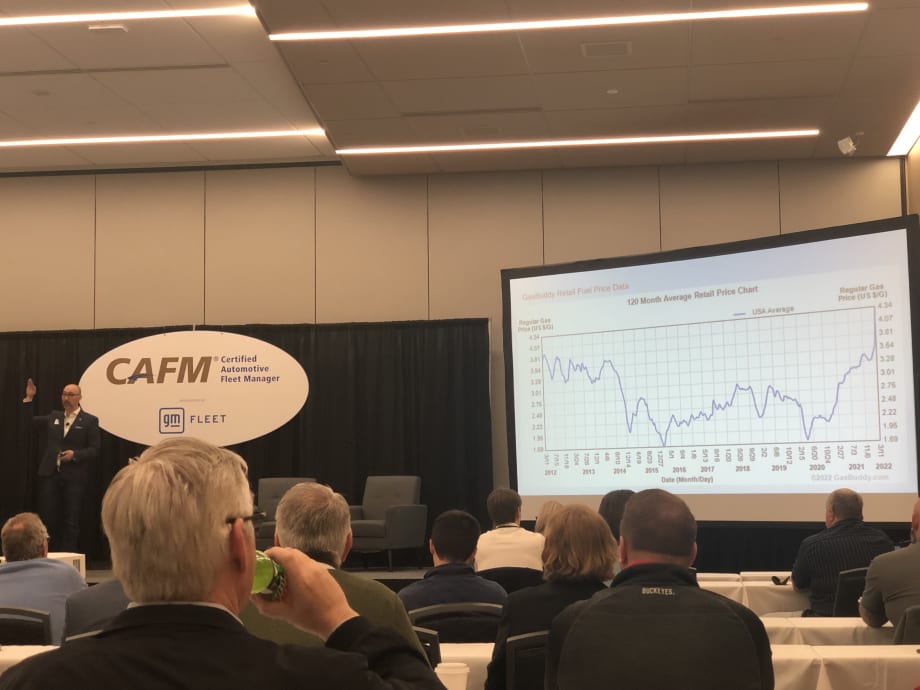
LeasePlan senior VP of corporate fleet Jon Stafford gave a compelling presentation - and challenge - about the death of total cost of ownership as a useful metric. “The data points to more,” he said.
Photo: Jordan Wiklund
Jon Stafford is an affable guy. He’s articulate, poised, casual, funny. To begin his afternoon presentation at NAFA's annual conference in Columbus, Ohio, he began by calling out Jim Petrillo in the front row, the 2021 AFLA Fleet Manager of the Year. Petrillo’s long hair flowed over a dark floral long-sleeve and a pink jacket.
“I was trying to be subtle,” Petrillo laughed.
“By sitting in the front row?” Stafford jabbed. Laughter all around, and the session began.
Stafford began with the standard Google definition of total cost of ownership (TCO). “Fine,” he said, “that’s great. Unfortunately it doesn’t begin to account for the past year or two,” referring of course to All The Things - the pandemic, the supply shortage, the worker shortage, increasing fuel costs (increasing everything costs, really). Longer lead times. Longer repair times. He noted he’d rewritten the presentation several times since 2021 when he was originally slated to present it at last year’s NAFA conference in Pittsburgh.
He cited the new vehicle shortage and jacked-up costs as the No. 1 issue facing fleet managers today. “The average cost of a new vehicle is more than $5,000 what it was just twelve months ago,” he said. Fleet managers need to get their budgets and approvals together and get in line if the goal is to flip the fleet for the 2023 model year (or beyond).
Then he switched tacts, noting that this all pretty rote; nobody in the room should be surprised by this, so what were they here for?
“Data,” he said. “Data is what can determine a better way to determine total cost of ownership, if we even want to call it that.”
In other words, how is your fleet used? Is it an urban or municipal fleet, or a sprawling work truck fleet kicking up dust all over the endless expanse of the midwest? These fleets have different needs and expectations, and comparing a 2020 Silverado to a 2020 F-150, for example, simply does not give you enough information to make an informed decision.

Stafford challenged conference-goers to use their data as an efficient tool to drive their fleets forward.
Photo: LeasePlan USA
But data is the future. Data, and the telematic backbone upon which it stands. Stafford made the point that for all the external factors a fleet manager can’t control, there are plenty of internal factors she or he can control, including a large part of what makes a fleet functional - the drivers within, their habits, and their overall safety.
“And we can control some of that,” he said, “we can control seat belt use, top speed, and more. We can monitor for safe driving habits and help incentivize better and safer drivers.”
“Too much data is not an excuse,” he said, admonishing those who throw their hands up in the air when faced with digital spreadsheets that communicate real-world circumstances of people and the sometimes dangerous machines they operate.
“We need to take ownership as an industry when we can control safety. We have a moral and ethical responsibility to do so.”
No one is persuaded by a hammer. Instead, it’s an affable and effective communicator like Stafford who can help drive real change for the fleet industry.
To close (12 minutes early!), he repeated his initial mantra.
“Total cost of ownership is not good enough. We have too much data at our fingertips. Is cost-per-mile the answer? I don’t know. I think it’s better, but I still don’t know what the answer is for our fleet, or for yours. I think it depends upon use and utilization. You need to find a utilization metric that works for your fleet.”
Stafford then gave a brief history of modern technology. Microsoft was the wealthiest corporation in 1997. Google debuted in 1998. Jeff Bezos grew Amazon to more than just books around 1999. YouTube debuted soon after, followed by Facebook and social media.
“More data was created last year than in the whole of human history before it,” he concluded.
“Data overload is coming and it must be managed. How do we collect data to inform our decisions? How do we determine the real cost of ownership of our fleets? Those who parse the data are those who will grow and prosper from it. I’d like to challenge all of you to take a better look at your data and find a different or better way to use it. Because TCO is dead.”
The audience applauded, and Stafford laughed and issued one more challenge. Or was it a decree?
“Now get the hell out of here!”
Originally posted on Automotive Fleet
More Small Fleet


Developing Budget-Friendly Driver Safety Programs
From driver training and safety meetings to one-on-one coaching and incentive programs, several small fleets share how they have developed a safety culture with their drivers using low- to no-cost resources.
Read More →
Boosting Last-Mile Fleet Uptime, Safety, and Value with AI Vehicle Inspections
AI-powered inspections are transforming last-mile fleets by replacing manual checks with highly accurate automated scans that detect defects in seconds. By giving fleet operations visibility into the daily condition of their vehicles, you can identify trends over the vehicle’s lifecycle that enable improved procurement decisions, route management, driver training and accountability.
Read More →
Five Ways Seat Belts Help Prevent Injuries
There are five ways seat belts protect occupants from injuries, according to the Tennessee Department of Safety and Homeland Security.
Read More →
It’s here: The 2026 Fleet Technology Trends Report
What does AI mean for fleets? Get the answer — and learn other top tech trends.
Read More →
Small Fleets, Big Impact: How Independent Drivers Power Wreaths Across America
Check out how small fleets and independent drivers power Wreaths Across America each December and why their impact matters more than ever.
Read More →
VMS Survey Finds 65% of Small Fleet Managers Run Operations Alone
A new VMS survey shows small fleet managers are stretched thin, with most handling operations solo and eager to adopt digital tools for relief.
Read More →
Tips for Driving Safely on Halloween Night
This video features a reminder from the Connecticut Department of Transportation (DOT) and the Connecticut Police Chiefs Association, urging drivers to prioritize safety this Halloween.
Read More →
AI, Access, and Uptime: VMS’s Next Chapter with David Prusinski
VMS’s new Co-CEO, David Prusinski, shares how an AI-first approach will give small fleets and repair shops the tools to compete like big players.
Read More →
Fleet Managers Share Winter Prep Tips: It's Never Too Early!
Three fleets share best practices to prep vehicles for winter and prevent downtime when the cold sets in.
Read More →