




Mobility Shift Will Come with Mass Autonomous Vehicle Adoption
Mass adoption of autonomous vehicles should begin ramping up in 2023 and will ultimately drive a shift in vehicle ownership from consumers to larger mobility service providers with large fleets of battery-electric, autonomous vehicles, according to a new study from Cox Automotive.

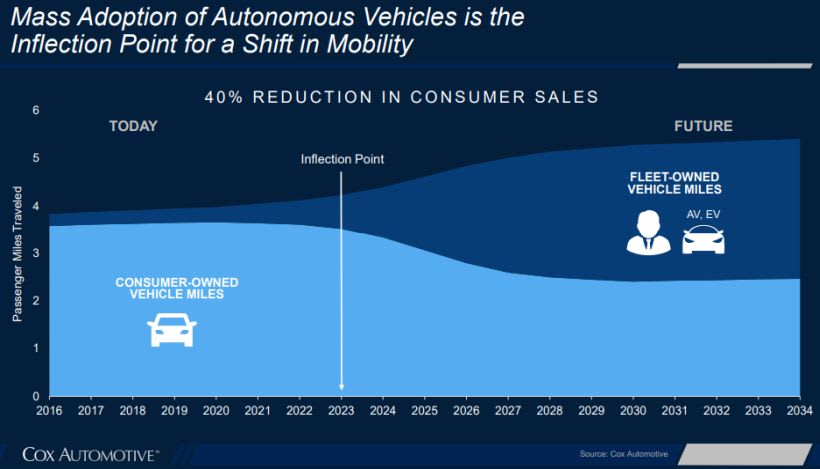
Cox Automotive sees mobility services reaching an inflection point in 2023.
Chart courtesy of Cox Automotive.
Mass adoption of autonomous vehicles should begin ramping up in 2023 and will ultimately drive a shift in vehicle ownership from consumers to larger mobility service providers with large fleets of battery-electric, autonomous vehicles, according to a new study from Cox Automotive.
This shift is expected to eventually lead to a 40% decline in consumer vehicle sales, as mobility models gain larger adoption for carsharing, ride-hailing, subscription services, and other services that gradually supplant consumers as the primary owners of vehicles by 2034.
The findings come as part of the 2018 Cox Automotive Evolution of Mobility study, which the company released on Aug. 16.
The study's findings about future trends somewhat bely current consumer attitudes about autonomous vehicles. While those who participated expressed increasing awareness of autonomy, they also expressed greater worries about their safety since the last Cox survey in 2016. The study attributed the safety worries to awareness of several high-profile accidents involving autonomous vehicles operated by Uber and Waymo. Respondents were 19% more aware of fully autonomous vehicles with or without a human operator since 2016.
Only 16% of respondents said they would feel comfortable riding in a fully autonomous vehicle without the option of being able to take control. Respondents also increasingly believe roadways wouldn't be safer with autonomous vehicles — 18% fewer said roadways would be safer if vehicles were fully autonomous.
Nearly half of respondents (a 19% increase) said they would never buy a fully autonomous vehicle, an opinion that skews older. While 71% of baby boomers said they wouldn't buy one, 56% of Gen X, 39% of millennials, and 48% of Gen Z said they wouldn't buy one. Urban dwellers are more open to autonomy than suburbanites or rural residents.
However, respondents also expressed interest in semi-autonomous features for their next vehicle purchase. They singled out collision warning and avoidance, adaptive headlights, lane keeping assist, and adaptive cruise control as the most popular driver-assisting features. Most respondents listed the features as "nice to have" rather than "must have."
Originally posted on Automotive Fleet
More Small Fleet


Developing Budget-Friendly Driver Safety Programs
From driver training and safety meetings to one-on-one coaching and incentive programs, several small fleets share how they have developed a safety culture with their drivers using low- to no-cost resources.
Read More →
Boosting Last-Mile Fleet Uptime, Safety, and Value with AI Vehicle Inspections
AI-powered inspections are transforming last-mile fleets by replacing manual checks with highly accurate automated scans that detect defects in seconds. By giving fleet operations visibility into the daily condition of their vehicles, you can identify trends over the vehicle’s lifecycle that enable improved procurement decisions, route management, driver training and accountability.
Read More →
Five Ways Seat Belts Help Prevent Injuries
There are five ways seat belts protect occupants from injuries, according to the Tennessee Department of Safety and Homeland Security.
Read More →
It’s here: The 2026 Fleet Technology Trends Report
What does AI mean for fleets? Get the answer — and learn other top tech trends.
Read More →
Small Fleets, Big Impact: How Independent Drivers Power Wreaths Across America
Check out how small fleets and independent drivers power Wreaths Across America each December and why their impact matters more than ever.
Read More →
VMS Survey Finds 65% of Small Fleet Managers Run Operations Alone
A new VMS survey shows small fleet managers are stretched thin, with most handling operations solo and eager to adopt digital tools for relief.
Read More →
Tips for Driving Safely on Halloween Night
This video features a reminder from the Connecticut Department of Transportation (DOT) and the Connecticut Police Chiefs Association, urging drivers to prioritize safety this Halloween.
Read More →
AI, Access, and Uptime: VMS’s Next Chapter with David Prusinski
VMS’s new Co-CEO, David Prusinski, shares how an AI-first approach will give small fleets and repair shops the tools to compete like big players.
Read More →
Fleet Managers Share Winter Prep Tips: It's Never Too Early!
Three fleets share best practices to prep vehicles for winter and prevent downtime when the cold sets in.
Read More →