Mercedes-Benz Vans Announces EV Architecture, Growth Plans
Starting in 2026, newly developed midsize and large vans from Mercedes-Benz will be built on the automaker’s VAN.EA architecture, a new electric-only platform that differentiates between private luxury vans and premium commercial vans.
The new EV architecture will reduce the portfolio variants by more than 50% compared to current vans with ICE engines.
Photo: Mercedes-Benz
3 min to read
Aiming to lead the light commercial vehicle industry in electric drive technology and digital experience, Mercedes-Benz Vans will introduce Van Electric Architecture (VAN.EA), on which all newly developed vans will be built beginning in 2026.
Ad Loading...
The 2026 introduction of VAN.EA, which has been developed from scratch for battery-electric vehicles (BEVs), will be part of Mercedes-Benz’s Ambition 2039 goal of achieving a net carbon neutral new-vehicle fleet. With more than 40,000 eVans already sold worldwide, Mercedes-Benz Vans is targeting an EV share of up to 20% by 2026 and more than 50% by 2030.
Ad Loading...
Van Variants Reduced 50%
All future midsize and large vans will be built on VAN.EA, for both commercial and private use. The new EV architecture will reduce the portfolio variants by more than 50% compared to current vans with an internal combustion engine (ICE).
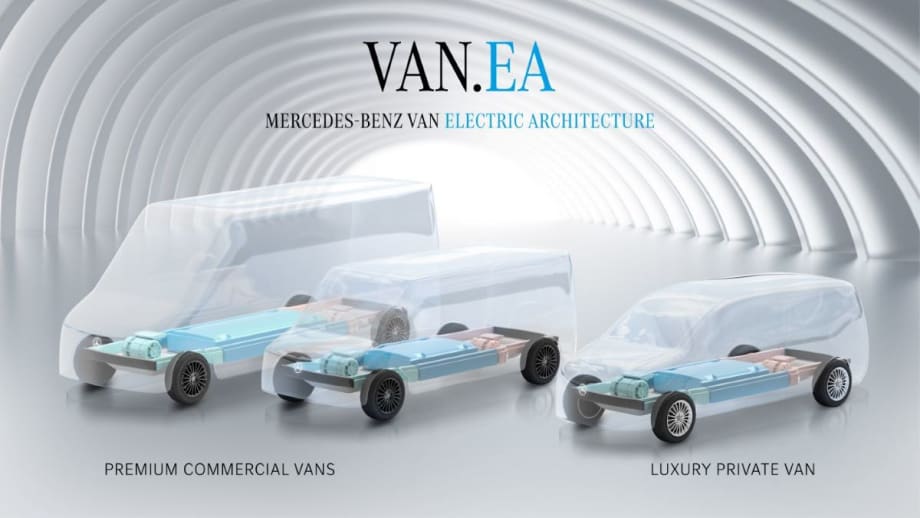
Three modules of VAN.EA will allow differentiation between private luxury vans and premium commercial vans, as well as platform synergies.
In the U.S., Mercedes-Benz Vans aims for more growth in profits and sales by 2030 as well as portfolio expansion by adding VAN.EA-based commercial vans to the lineup. For the first time, Mercedes-Benz Vans will offer a private midsize luxury van in the U.S.
Mercedes-Benz Vans will also expand the portfolio of RV vans with a new model line of “build from factory” fully electric midsize and large camper vans, based on VAN.EA.
Van Spec for Last-Mile Delivery
Focused on the upper price bands of the last-mile-delivery industry, Mercedes-Benz Vans intends to offer a VAN.EA-based last-mile-delivery-specific “build from factory” van for the first time.
Ad Loading...
In 2023, Mercedes Benz Vans offers fully electric variants in every segment in Europe and China, and recently revealed the fully electric eSprinter in North America. The new eSprinter will have access to the digital service Mercedes me connect, which currently offers more than 60,000 charging points across the U.S.
Commercial van drivers will have access to the Mercedes-Benz global charging network, which will launch starting in the U.S. and Canada this year, and will expand to 10,000 high-power chargers worldwide by the end of this decade.
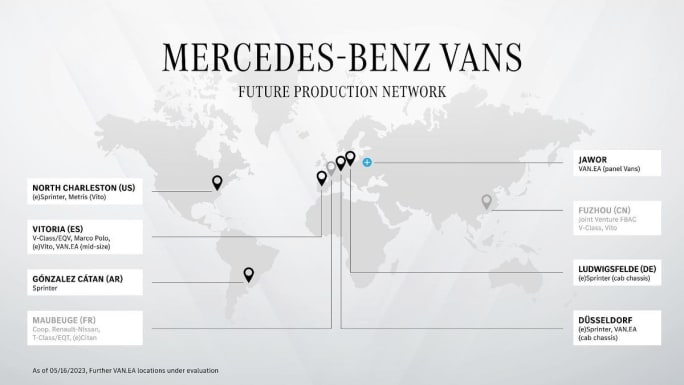
Mercedes Benz Vans has reorganized its global industrial footprint. VAN.EA vehicles will be built in the plants located in Jawor, Poland, Vitoria, Spain and Düsseldorf, Germany. The Ludwigsfelde, Germany division will continue to produce Sprinter and eSprinter.
Photo: Mercedes-Benz
Understanding 3 Blocks of VAN.EA
The goal of the VAN.EA architecture is to achieve a high range with an optimal battery capacity.
The front block consists of the electric powertrain and the front axle. The block is the same in all VAN.EA variants and resembles an optimized common parts strategy. The differentiation relevant to the customer takes place in the two other areas:
The center block scales the vehicle length. This is also the placement of the standardized battery case, in which different capacities of the high-voltage batteries are installed.
Ad Loading...
The rear module will be available in two versions: With an electric motor (along with one in the front) for the all-wheel-drive variants of VAN.EA and without electric motor for the front-wheel drive variants.
Differentiating Private & Commercial Vans
Based on these three blocks, Mercedes-Benz Vans said VAN.EA differentiates between privately and commercially used vans but allows platform synergies. VAN.EA-P stands for privately positioned vans in the midsize segment, designed for lifestyle-oriented customers, as a VIP shuttle, as a locally CO2-emissions free mobile office, or for leisure-active families.
The van has a planned range of over 310 miles. SAE Level 2 automated driving is planned for market launch, SAE Level 3 is planned to be realized by the end of the decade, Mercedes-Benz Vans said.
Premium Commercial Vans: VAN.EA-C
VAN.EA-C stands for premium commercial vans in the midsize and large segments. With its modular and scalable design, the architecture is tailored for different configurations and upfitter solutions, including Courier, Express and Parcel delivery (Last Mile Delivery) vehicles, ambulances, eGrocery vans, municipal vans, box upfits, and RVs.
From driver training and safety meetings to one-on-one coaching and incentive programs, several small fleets share how they have developed a safety culture with their drivers using low- to no-cost resources.
AI-powered inspections are transforming last-mile fleets by replacing manual checks with highly accurate automated scans that detect defects in seconds. By giving fleet operations visibility into the daily condition of their vehicles, you can identify trends over the vehicle’s lifecycle that enable improved procurement decisions, route management, driver training and accountability.
This video features a reminder from the Connecticut Department of Transportation (DOT) and the Connecticut Police Chiefs Association, urging drivers to prioritize safety this Halloween.