




Keys Left in Vehicles Spurring More Thefts
Last year, one of every eight vehicle thefts involved the driver leaving the keys or fob inside, according to the National Insurance Crime Bureau.
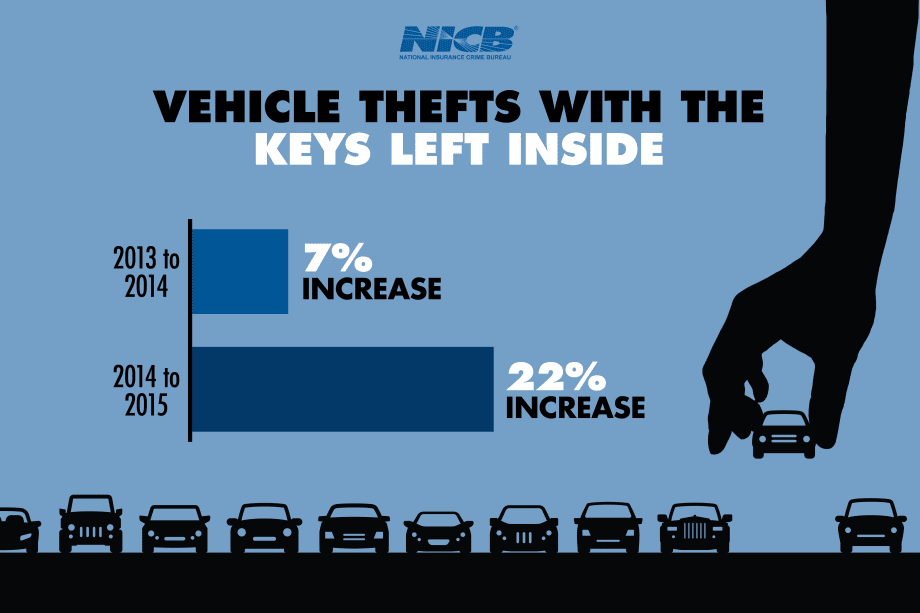
Graphic courtesy of the National Insurance Crime Bureau.
Graphic courtesy of the National Insurance Crime Bureau.
In 2015, a vehicle was reported stolen once every 45 seconds in the U.S. And there was a theft every 6.5 minutes in which the driver left the keys or fob inside the vehicle, according to the National Insurance Crime Bureau.
In fact, one out of every eight thefts was a freebie for the thief, with the keys or fob just waiting there for the taking.
It’s a growing problem, according to the latest report from the National Insurance Crime Bureau (NICB). The 57,096 thefts in 2015 amounted to a 22% increase over the previous year. Over the past three years, this kind of theft grew by 31%.
Since many people won’t admit to leaving their vehicle unlocked with the keys or fob inside, the actual numbers for these kinds of thefts may be considerably higher than the report indicates.
“Anti-theft technology has had a tremendous impact on reducing thefts over the past 25 years, but if you don’t lock it up, it’s not going to help,” said NICB President and CEO Joe Wehrle. “Complacency can lead to a huge financial loss and inconvenience for the vehicle owner. Leaving a vehicle unlocked or with the key or FOB inside gives a thief the opportunity to take not only the car, but also any possessions inside. It can also provide access to your personal information if the registration is left in the glove compartment.”
Law enforcement agencies have also reported incidents in which thieves have stolen a car, driven it to the residence, and burglarized the home before the owner even knew the vehicle was missing, Wehrle said.
NICB advises drivers to:
Lock the vehicle, set the alarm, and take all keys or fobs.
Don’t leave the garage door opener in the vehicle.
Take a photo of your registration on your cell phone and don’t leave the registration or other papers with personal information in the vehicle.
Never leave a car unlocked and running to warm it up or while stopping for a quick cup of coffee. It only takes a moment for the opportunistic thief to jump inside and drive off.
For the years 2013 through 2015, a total of 147,434 vehicles were reported stolen with the keys left inside. There were 43,643 thefts in 2013, 46,695 in 2014, and 57,096 in 2015. From 2013 to 2015, the increase was 31%.
The top five states that posted the most vehicle thefts with keys during this reporting period were California (22,580), Texas (11,003), Florida (9,952), Ohio (8,623), and Nevada (8,073).
The top five core-based statistical areas were Las Vegas-Henderson-Paradise, Nev. (7,815), Detroit-Warren-Dearborn, Mich. (4,380), Atlanta-Sandy Springs-Roswell, Ga. (4,118), Miami-Fort Lauderdale-West Palm Beach, Fla. (3,847), and Philadelphia-Camden-Wilmington, Pa.-N.J.-Del.-Md. (3,365).
One state — Hawaii — had a perfect record. There wasn't a single report of a vehicle theft with keys.
Looking at day-of-week data, NICB discovered that Saturday saw the most thefts (22,081), followed by Monday (21,851) and Friday (21,652).
Originally posted on Automotive Fleet
More Small Fleet


Developing Budget-Friendly Driver Safety Programs
From driver training and safety meetings to one-on-one coaching and incentive programs, several small fleets share how they have developed a safety culture with their drivers using low- to no-cost resources.
Read More →
Boosting Last-Mile Fleet Uptime, Safety, and Value with AI Vehicle Inspections
AI-powered inspections are transforming last-mile fleets by replacing manual checks with highly accurate automated scans that detect defects in seconds. By giving fleet operations visibility into the daily condition of their vehicles, you can identify trends over the vehicle’s lifecycle that enable improved procurement decisions, route management, driver training and accountability.
Read More →
Five Ways Seat Belts Help Prevent Injuries
There are five ways seat belts protect occupants from injuries, according to the Tennessee Department of Safety and Homeland Security.
Read More →
It’s here: The 2026 Fleet Technology Trends Report
What does AI mean for fleets? Get the answer — and learn other top tech trends.
Read More →
Small Fleets, Big Impact: How Independent Drivers Power Wreaths Across America
Check out how small fleets and independent drivers power Wreaths Across America each December and why their impact matters more than ever.
Read More →
VMS Survey Finds 65% of Small Fleet Managers Run Operations Alone
A new VMS survey shows small fleet managers are stretched thin, with most handling operations solo and eager to adopt digital tools for relief.
Read More →
Tips for Driving Safely on Halloween Night
This video features a reminder from the Connecticut Department of Transportation (DOT) and the Connecticut Police Chiefs Association, urging drivers to prioritize safety this Halloween.
Read More →
AI, Access, and Uptime: VMS’s Next Chapter with David Prusinski
VMS’s new Co-CEO, David Prusinski, shares how an AI-first approach will give small fleets and repair shops the tools to compete like big players.
Read More →
Fleet Managers Share Winter Prep Tips: It's Never Too Early!
Three fleets share best practices to prep vehicles for winter and prevent downtime when the cold sets in.
Read More →