




Human Operators Will Determine Self-Driving Vehicle Safety: Report
A new report from the Governor's Highway Safety Association (GHSA) highlights the fact that human operators will still exert significant control over autonomous vehicles (AVs) in the foreseeable future, bringing with it a host of safety issues that need to be addressed.

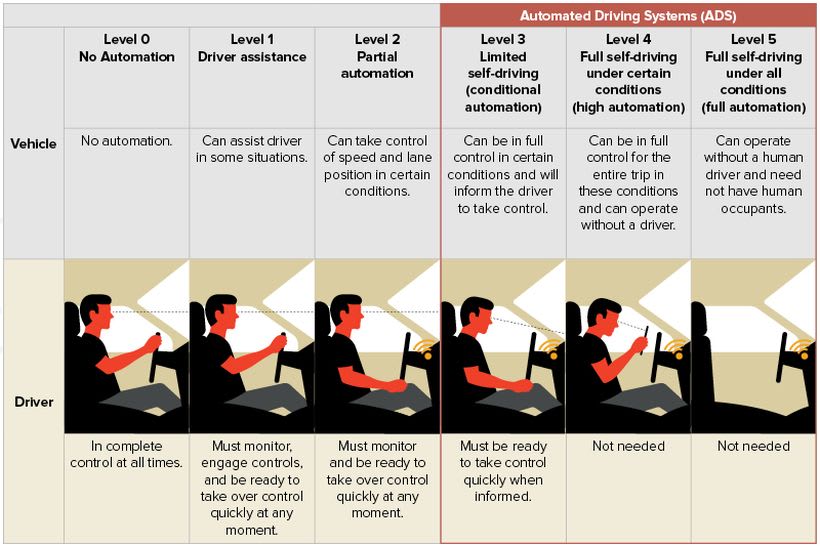
States will need to play a role in educating the public and autonomous vehicle developers about safety issues with the new technology, according to a new report.
Graphic courtesy of GHSA.
A new report from the Governor's Highway Safety Association (GHSA) highlights the fact that human operators will still exert significant control over autonomous vehicles (AVs) in the foreseeable future, bringing with it a host of safety issues that need to be addressed.
For the next several decades, most AVs will share driving responsibility with humans, according to the report, Preparing for Automated Vehicles: Traffic Safety Issues for States.
Due to this fact, autonomous technology — that is, anything short of full automation — presents numerous behavioral safety issues connected to how operators and passengers use it.
For example, inattention is a critical concern. Operators expected to monitor driving may not do so as diligently as they should. What's more, an operator who does not need to monitor the road for long periods of time may not be able to quickly re-engage if distracted.
In addition, unlicensed operators also can be hazardous, as they may be able to activate an AV but be prevented from taking over control of the vehicle if needed.
Even jaywalking could cause big problems. If people know that AVs are designed to yield to walkers in their path, pedestrians could opt to literally bring traffic to a standstill — or worse, the vehicle might not stop due to a system error or human error and ultimately, hit the pedestrian.
The report also examines questions about seat belt usage, tailgating, and other key safety issues connected with AVs.
"States need to consider a number of new issues related to the practical deployment of this technology," said report author Jim Hedlund, a former senior official with the National Highway Traffic Safety Administration (NHTSA). "One of the most important goals should be to educate the public about the benefits and risks of this technology, how to use it safely, and drive near AVs in traffic."
Imperfect drivers will continue to pose safety issues when behind the wheel of AVs, just as they presently do when driving traditional cars. In fact, according to NHTSA, approximately 94% of crashes involve driver error.
The GHSA report offers states a number of suggestions regarding developing licensing and traffic laws, establishing law enforcement policies and procedures, AV testing and AV deployment.
Read the full report here.
Originally posted on Automotive Fleet
More Small Fleet


Developing Budget-Friendly Driver Safety Programs
From driver training and safety meetings to one-on-one coaching and incentive programs, several small fleets share how they have developed a safety culture with their drivers using low- to no-cost resources.
Read More →
Boosting Last-Mile Fleet Uptime, Safety, and Value with AI Vehicle Inspections
AI-powered inspections are transforming last-mile fleets by replacing manual checks with highly accurate automated scans that detect defects in seconds. By giving fleet operations visibility into the daily condition of their vehicles, you can identify trends over the vehicle’s lifecycle that enable improved procurement decisions, route management, driver training and accountability.
Read More →
Five Ways Seat Belts Help Prevent Injuries
There are five ways seat belts protect occupants from injuries, according to the Tennessee Department of Safety and Homeland Security.
Read More →
It’s here: The 2026 Fleet Technology Trends Report
What does AI mean for fleets? Get the answer — and learn other top tech trends.
Read More →
Small Fleets, Big Impact: How Independent Drivers Power Wreaths Across America
Check out how small fleets and independent drivers power Wreaths Across America each December and why their impact matters more than ever.
Read More →
VMS Survey Finds 65% of Small Fleet Managers Run Operations Alone
A new VMS survey shows small fleet managers are stretched thin, with most handling operations solo and eager to adopt digital tools for relief.
Read More →
Tips for Driving Safely on Halloween Night
This video features a reminder from the Connecticut Department of Transportation (DOT) and the Connecticut Police Chiefs Association, urging drivers to prioritize safety this Halloween.
Read More →
AI, Access, and Uptime: VMS’s Next Chapter with David Prusinski
VMS’s new Co-CEO, David Prusinski, shares how an AI-first approach will give small fleets and repair shops the tools to compete like big players.
Read More →
Fleet Managers Share Winter Prep Tips: It's Never Too Early!
Three fleets share best practices to prep vehicles for winter and prevent downtime when the cold sets in.
Read More →