




Related: Atlanta's Spaghetti Junction Tops ATRI's List of Truck Bottlenecks for 2015
Highway Users Rank America's Worst 50 Traffic Bottlenecks
The worst traffic bottleneck in the country is in Chicago, Ill., according to a new study by the American Highway Users Alliance -- and Los Angeles owns the next six of the top 10.
by Staff
November 23, 2015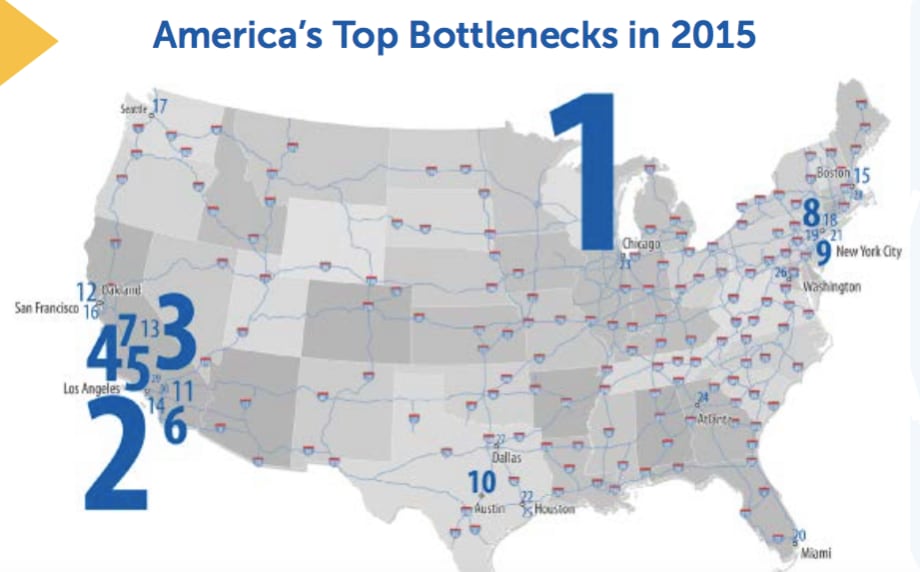
4 min to read
The worst traffic bottleneck in the country is in Chicago, Ill., according to a new study by the American Highway Users Alliance -- and Los Angeles owns the next six of the top 10.
In the top-ranked Chicago chokepoint, on the Kennedy Expressway (I-90) between the Circle Interchange (I-290) and Edens junction (I-94), the bottleneck was found to extend 12 miles, costing motorists 16.9 million hours' worth of time, equivalent to $418 million in 2014. More than 6.3 million gallons of fuel is wasted on I-90 while cars idle or crawl in traffic. By just fixing America's worst bottleneck, an annual reduction of 133 million pounds of carbon dioxide emissions would also be likely, the study found.
Besides identifying and ranking the nation's 50 worst traffic bottlenecks, the study, Unclogging America's Arteries 2015, examines the top 30 chokepoints closely and details many of the major benefits that will accrue to society by fixing them. In addition to improving mobility and quality of life for motorists, fixing the top 30 bottlenecks alone would, over 20 years:
Save $39 billion due to lost time,
Save 830 million gallons of fuel,
Reduce over 17 billion pounds of greenhouse gas emissions (CO2), and
Prevent 211,000 vehicle crashes
"This report furthers the unassailable truth that America is stuck in traffic," said Transportation Secretary Anthony Foxx, speaking at the press conference announcing the survey results. "The good news is that this problem is solvable, and Congress can be part of the solution. As a long-term surface transportation bill moves through conference, I urge our elected leaders to provide the funding growth and policies that are necessary to improve commutes, to raise the bar for safety, and to keep the country moving in the 21st century."
Bill Graves, who is chairman of the Highway Users and president and CEO of the American Trucking Associations, called the study "a huge reminder of the very high costs of neglecting our nation's transportation infrastructure. We hope this report will be one more huge wake-up call to our nation's leaders about the importance of addressing our critical highway needs.
"These bottlenecks cost our economy billions with the delays they cause moving our nation's freight. They are truckers' worst nightmares come true, but one that tens of thousands of our nation's freight haulers have to deal with daily," Graves said.
The study's top 50 list includes trouble spots in the following metropolitan areas: 12 in Los Angeles, nine in and around New York City, three in Chicago, three near Washington DC, three in Houston, three in Boston, three in Dallas, three in Miami, two in Atlanta, two in Philadelphia, and two in San Francisco/Oakland.
Surprises included Austin breaking into the top 30 list at number 10, and Norfolk, Va., and Tampa, Fla., coming in at 38th and 45th, respectively.
The study relies on the same data used by the Federal Highway Administration to pinpoint the major chokepoints, and is a follow-up to a report the Highway Users issued over 10 years ago. Bottlenecks were ranked based on backups in both directions over the entire day, not just one direction during rush hours.
The Los Angeles region had far more top bottlenecks than any other metropolitan area, claiming the 2nd through 7th worst spots, as well as the 11th, 13th, 14th, 29th, 30th and 40th. LA's worst was the 405 between SR22 and the 605, where the annual cost of delay exceeded $190 million, wasting 1.8 million gallons and 36.7 million pounds of CO2, with daily backups over 4 miles long.
Also breaking into the top 10 was New York City with the 8th and 9th worst bottleneck at the notorious Lincoln Tunnel and on I-95 from Manhattan across the Bronx. Metropolitan New York also had the 18th, 19th, 21st, 31st, 33rd, 37th, and 42nd ranked chokepoints.
The report notes that bottlenecks can be fixed and points to specific chokepoints that have been addressed and, as a result, were not included in the rankings. Projects cited include the Woodrow Wilson Bridge replacement on I-495 in the Washington, DC area, the Marquette Interchange in Milwaukee, and the Katy Freeway reconstruction in Houston.
Data for this report was gathered and analyzed by CPCS Transcom Inc., a management consulting firm specializing in transportation sector strategic, economic analysis, and policy advice. Data for the study come from the American Transportation Research Institute and HERE North America LLC GPS probes. The HERE/ATRI data set is similar to the Federal Highway Administration's National Performance Management Research Data Set. The data set allows for a rigorous estimate of delays due to congestion. The HERE /ATRI data set comes from passenger and commercial vehicles to provide actual traffic and speed measurements.
Further information about this study is available on the Highway Users website at www.highways.org.
Originally posted on Automotive Fleet
More Operations

Family Ties Inside the Fleet Families Building Careers Across Generations
Three fleet families share what it really takes to work together, learn across generations, and keep business from following them home.
Read More →
Shades of Fleet Call for Voices: Fleet's Hidden Heroes
Fleet’s hidden heroes are often the ones keeping everything moving behind the scenes. September’s Shades of Fleet is looking for dispatchers, coordinators, parts specialists, and other support pros to share their stories.
Read More →
Truck Centers, Inc. Celebrates National Truck Driver Appreciation Week with $1,000 Fuel Card Giveaways
During National Truck Driver Appreciation Week, Truck Centers, Inc. is offering customers a chance to fuel up for free. Customers at all Truck Centers locations can enter to win one of four $1,000 fuel cards from Sept. 14 - 18.
Read More →
Fleet Guides, AI Time-Savers, Truck Tariffs & Fuel Strategy Lead the News
This week’s Truck Chat Cheat Sheet covers new fleet vehicle guides, practical AI use cases, U.S.-Canada truck production, mixed-energy strategy, and more.
Read More →
What Fleet Employers Are Missing When Hiring Veterans
What if some of the strongest candidates for fleet are already out there, but their experience is written in a language our industry does not always recognize?
Read More →
Automotive Fleet Opens 2026 Personal Use Survey for Commercial Fleet Managers
Less than two weeks left! Commercial and corporate fleet managers are invited to share how their organizations handle company vehicle personal-use policies, charges, and driver eligibility.
Read More →
What Resilient Fleets Do Differently When Conditions Change
Fleet resilience is about more than reacting to disruption. Lauren Fletcher talks with AP Fleet’s Alex Coveney about flexibility, planning, scaling, and what helps fleets adapt when business conditions shift.
Read More →
If We Want the Next Generation in Automotive, We Have to Give Them a Reason to Care
The automotive industry talks constantly about its workforce shortage. But before we can recruit the next generation, we may need to do a better job giving kids a reason to care about automotive in the first place.
Read More →
Ram ProMaster City Under $40K, Truck Tariffs, and AI Maintenance Lead the News
A sub-$40K commercial van, tariff questions, AI-powered maintenance, and a new EV production strategy headline this week’s Truck Chat Cheat Sheet.
Read More →
Bob Adamsky Shares the Fleet Lessons You Usually Learn the Hard Way
After more than 30 years in fleet, Arrow International’s Bob Adamsky has learned that the job is about far more than vehicles. He shares the lessons he wishes every fleet manager could learn a little earlier.
Read More →