





Background News: The Realities Intruding on Mass Electrification
High Voltage Power Grid Vital for Future EV Charging Demand
A recent analysis of fast-charging needs provides a blueprint to ready the grid along major highways while mapping long-term charging demand will avoid duplicate infrastructure investments.
November 14, 2022
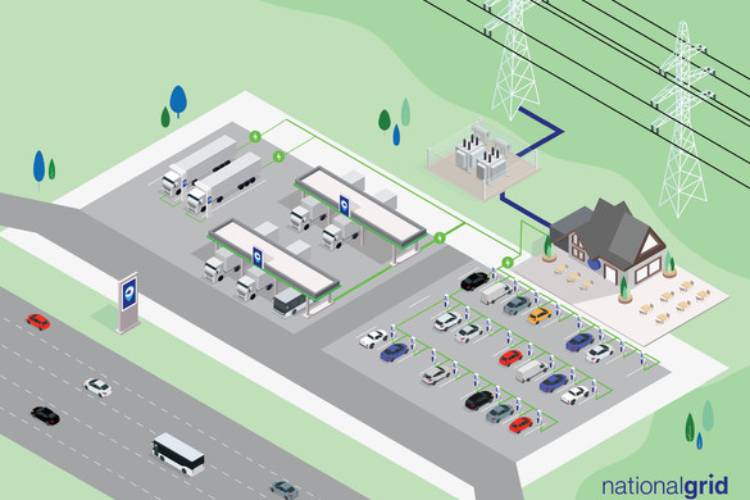
The Electric Highways Study provides a blueprint for the strategic buildout of fast-charging sites along highway corridors to meet an upcoming surge in demand from the electrification of passenger vehicles and commercial trucks.
Photo: National Grid
4 min to read
Electric vehicle (EV) charging needs along Massachusetts and New York highways will require interconnection to high-capacity transmission lines in the next decade, finds a first-in-the-nation study released Nov. 14.
The Electric Highways Study provides a blueprint for the strategic buildout of fast-charging sites along highway corridors to meet an upcoming surge in demand from the electrification of passenger vehicles and commercial trucks.
EV adoption is expected to accelerate nationwide due to market forces and federal policy changes driven by sweeping legislation. At the state level, New York's adoption of the Advanced Clean Cars II regulation and Massachusetts' passage of "An Act Driving Clean Energy and Offshore Wind" will ban the sale of gas-only passenger vehicles by 2035, following the lead of a ban in California for that same year.
National Grid, an electricity, natural gas, and clean energy delivery company serving more than 20 million people through networks in New York and Massachusetts, along with transportation analytics organizations CALSTART, RMI, Geotab, and Stable Auto, conducted the analysis to provide new insight into the future of EV highway charging in New York and Massachusetts and to better understand the effects of this transition on the grid.
The Electric Highways Study can help utilities and policymakers make smarter decisions about electric grid interconnections and infrastructure, avoiding repeated upgrades and ensuring grid readiness does not hinder the clean energy transition.
"This kind of holistic, long-term infrastructure planning will be critical to delivering a clean energy transition as efficiently as possible," said Brian Gemmell, Chief Operating Officer NY Electric, National Grid, in a news release. "We have a responsibility to make smart investments that get it right the first time and to make sure the electricity is there when drivers need it. This study will help us do that."
EV Fast-Charging Site Demand
The study examined current traffic patterns and expected charger use to forecast charging demand at 71 highway sites across New York and Massachusetts. The analysis included relevant electric vehicle sales goals and mandates in National Grid's home states — considering scenarios where all light-duty vehicle sales are electric by 2035 and all medium-and heavy-duty vehicle (MHDV) sales are electric by 2045.
According to the findings, in 10 years more than a quarter of sites studied will require the same amount of power as an outdoor sports stadium to meet charging demand, with some requiring the same power as a small town within the next two decades.
Existing transmission lines, which often mirror highway routes, provide a ready-made solution if highway charging sites can "plug-in" to the high-voltage transmission grid. Strategically future-proofing high-traffic sites will allow states to accelerate cost-effective charging deployment.
"As EV technology matures to suit more duty cycles, electrifying locations along major highways will be critical to ensuring a zero-emission transportation future, from passenger cars to long-haul trucks," said Ben Mandel, senior director for the Northeast Region, CALSTART. "Our study with National Grid and partners provides the clear insights policymakers will need to support an equitable and cost-efficient buildout of fast charging at the scale needed to meet the EV adoption targets in place for New York and Massachusetts."
Dave Mullaney, principal of Carbon Free Transportation, RM, said, "The biggest challenge to deploying those electric trucks will be finding the power to charge them. This study takes the first steps to overcoming that barrier and serves as a roadmap for the rest of the country to follow."
Added Stable co-founder and CEO Rohan Puri, "Sufficient highway charging infrastructure for light-duty vehicles is paramount to mass EV adoption in the US. Stable's predictive models use millions of geospatial data points mapped with true (usage) rates from thousands of chargers operating today to help understand today's demand and how it will grow. Forecasting future power needs informs planning and allows for the strategic deployment of charging infrastructure while maintaining a strong electric grid."
Electric Highways Study Details
To read the Electric Highways Study and learn more about the future of EV fast charging, visit nationalgrid.com/us/EVhighway. To learn more about National Grid programs which have already supported the installation of over 4,600 chargers in New York and Massachusetts, visit the EV Charging pages for New York and Massachusetts.
Topics:charging infrastructureenergyFleet electrificationEV Charging Stationselectric vehiclesSmall Fleet
Originally posted on Charged Fleet
More Small Fleet


Developing Budget-Friendly Driver Safety Programs
From driver training and safety meetings to one-on-one coaching and incentive programs, several small fleets share how they have developed a safety culture with their drivers using low- to no-cost resources.
Read More →
Sponsored•March 9, 2026
Boosting Last-Mile Fleet Uptime, Safety, and Value with AI Vehicle Inspections
AI-powered inspections are transforming last-mile fleets by replacing manual checks with highly accurate automated scans that detect defects in seconds. By giving fleet operations visibility into the daily condition of their vehicles, you can identify trends over the vehicle’s lifecycle that enable improved procurement decisions, route management, driver training and accountability.
Read More →
Five Ways Seat Belts Help Prevent Injuries
There are five ways seat belts protect occupants from injuries, according to the Tennessee Department of Safety and Homeland Security.
Read More →
Sponsored•January 14, 2026
It’s here: The 2026 Fleet Technology Trends Report
What does AI mean for fleets? Get the answer — and learn other top tech trends.
Read More →
Small Fleets, Big Impact: How Independent Drivers Power Wreaths Across America
Check out how small fleets and independent drivers power Wreaths Across America each December and why their impact matters more than ever.
Read More →
VMS Survey Finds 65% of Small Fleet Managers Run Operations Alone
A new VMS survey shows small fleet managers are stretched thin, with most handling operations solo and eager to adopt digital tools for relief.
Read More →
Tips for Driving Safely on Halloween Night
This video features a reminder from the Connecticut Department of Transportation (DOT) and the Connecticut Police Chiefs Association, urging drivers to prioritize safety this Halloween.
Read More →
AI, Access, and Uptime: VMS’s Next Chapter with David Prusinski
VMS’s new Co-CEO, David Prusinski, shares how an AI-first approach will give small fleets and repair shops the tools to compete like big players.
Read More →
Fleet Managers Share Winter Prep Tips: It's Never Too Early!
Three fleets share best practices to prep vehicles for winter and prevent downtime when the cold sets in.
Read More →