




Hawaii Hydrogen Ready by 2015?
A plan, called the Hawaii Hydrogen Initiative (H2I), aims to integrate hydrogen as an essential building block for Hawaii’s sustainable energy ecosystem.
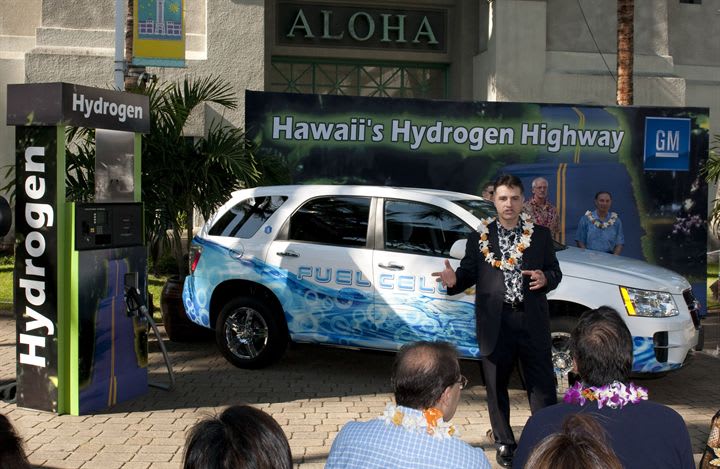
General Motors' Charlie Freese announces the formation of a 10 company, agency and university initiative that will partner with GM and The Gas Company to make hydrogen-powered vehicles and a fueling infrastructure a reality in Hawaii by 2015.
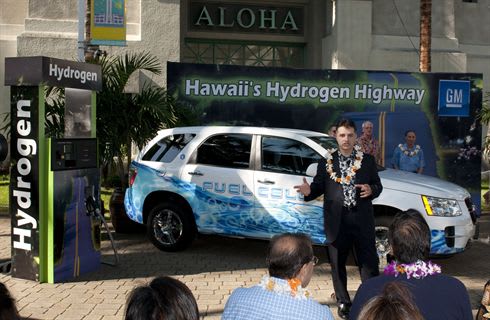
Ten companies, agencies and universities have joined an initiative between The Gas Company (TGC), and General Motors to make hydrogen-powered vehicles and a fueling infrastructure a reality in Hawaii by 2015.
The plan, called the Hawaii Hydrogen Initiative (H2I), aims to integrate hydrogen as an essential building block for Hawaii's sustainable energy ecosystem. The effort to reduce the state's 90 percent dependence on imported oil is expected to make hydrogen available to all of Oahu's 1 million residents by 2015. The goal is for 20 to 25 hydrogen stations to be installed in strategic locations around the island.
"Hydrogen, used as a fuel, will reduce our dependence on petroleum starting today," said Jeff Kissel, TGC president and CEO.
The plan builds on a May 2010 memorandum of understanding between TGC, one of Hawaii's major utilities, and GM. TGC today produces enough hydrogen to power up to 10,000 fuel cell vehicles and has the capacity to produce much more hydrogen. GM is a producer in hydrogen fuel cell vehicles and fielded the world's largest fuel cell demonstration fleet - more than 100 vehicles - beginning in 2007.
The hydrogen initiative partners are evaluating methods to distribute hydrogen through existing natural gas pipelines, addressing the long-standing problem of how to cost effectively produce and distribute hydrogen.
"In Hawaii, we want to address the proverbial chicken or egg dilemma," said Charles Freese, executive director of GM Fuel Cell Activities. "There has always been a looming issue over how to ensure that the vehicles and the necessary hydrogen refueling infrastructure are delivered to market at the same time. Our efforts in Hawaii will help us meet that challenge.
"Once the key hydrogen infrastructure elements are proven in Hawaii, other states can adopt similar approaches," Freese said. "Germany, Japan and Korea are all building hydrogen infrastructures within this same timeframe. The work in Hawaii can provide a template for other regions."
In addition to GM and TGC, the hydrogen initiative partners include the state Department of Business, Economic Development and Tourism (DBEDT); U.S. Department of Energy; FuelCell Energy; Aloha Petroleum Ltd; Louis Berger Group; U.S. Pacific Command, supported by the U.S. Pacific Fleet, U.S. Pacific Air Forces, U.S. Army Pacific, and U.S. Marine Forces, Pacific; National Renewable Energy Laboratory; the County of Hawaii; University of California - Irvine, and the University of Hawaii.
"Hawaii is on the cutting edge of developing the infrastructure for hydrogen-powered vehicles and adopting the latest clean energy technologies to move our islands toward energy independence and sustainability," said Richard Lim, acting director, state Department of Business, Economic Development and Tourism. "H2I is a unique, innovative partnership that has brought together public, private and community partners to improve the quality of life for our citizens and become a worldwide model."
In 2008, the state launched the Hawaii Clean Energy Initiative (HCEI), a partnership with the U.S. DOE with a goal of generating 70 percent or more of Hawaii's energy through energy efficiency and clean, renewable resources such as solar, wind, wave, biofuels, and geothermal.
More Small Fleet


Developing Budget-Friendly Driver Safety Programs
From driver training and safety meetings to one-on-one coaching and incentive programs, several small fleets share how they have developed a safety culture with their drivers using low- to no-cost resources.
Read More →
Boosting Last-Mile Fleet Uptime, Safety, and Value with AI Vehicle Inspections
AI-powered inspections are transforming last-mile fleets by replacing manual checks with highly accurate automated scans that detect defects in seconds. By giving fleet operations visibility into the daily condition of their vehicles, you can identify trends over the vehicle’s lifecycle that enable improved procurement decisions, route management, driver training and accountability.
Read More →
Five Ways Seat Belts Help Prevent Injuries
There are five ways seat belts protect occupants from injuries, according to the Tennessee Department of Safety and Homeland Security.
Read More →
It’s here: The 2026 Fleet Technology Trends Report
What does AI mean for fleets? Get the answer — and learn other top tech trends.
Read More →
Small Fleets, Big Impact: How Independent Drivers Power Wreaths Across America
Check out how small fleets and independent drivers power Wreaths Across America each December and why their impact matters more than ever.
Read More →
VMS Survey Finds 65% of Small Fleet Managers Run Operations Alone
A new VMS survey shows small fleet managers are stretched thin, with most handling operations solo and eager to adopt digital tools for relief.
Read More →
Tips for Driving Safely on Halloween Night
This video features a reminder from the Connecticut Department of Transportation (DOT) and the Connecticut Police Chiefs Association, urging drivers to prioritize safety this Halloween.
Read More →
AI, Access, and Uptime: VMS’s Next Chapter with David Prusinski
VMS’s new Co-CEO, David Prusinski, shares how an AI-first approach will give small fleets and repair shops the tools to compete like big players.
Read More →
Fleet Managers Share Winter Prep Tips: It's Never Too Early!
Three fleets share best practices to prep vehicles for winter and prevent downtime when the cold sets in.
Read More →