




GM, Powermat to Put Added ‘Charge’ in Chevy Volt
The automaker will invest $5 million in Powermat to help eliminate the need for charging cords. The Chevrolet Volt will be one of the first GM vehicles to offer this technology.
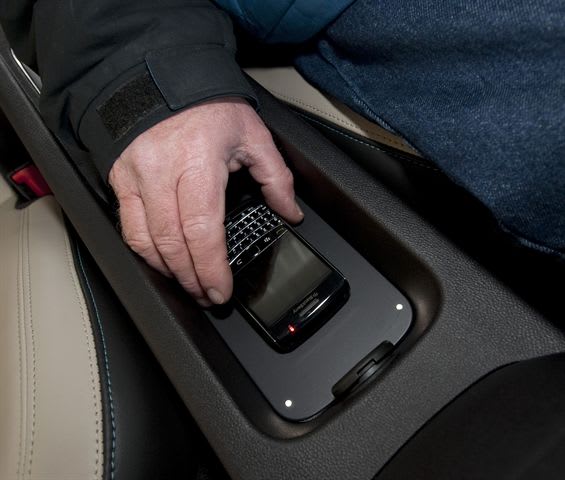
A Blackberry smartphone charges on a Powermat in the back seat of a 2011 Chevrolet Volt, which will be one of the first applications of the Powermat.
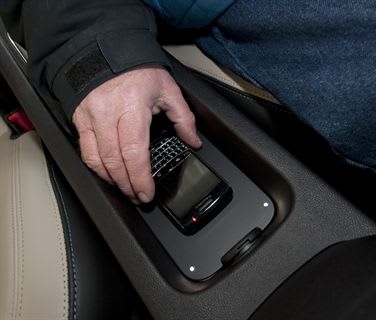
General Motors and Powermat, a provider of wireless charging technology, announced a commercial agreement today that will eliminate the need for charging cords for personal electronic devices in many future Chevrolet, Buick, GMC and Cadillac products beginning mid-2012.
GM Ventures, the company's venture capital subsidiary, will invest $5 million in Powermat to accelerate the technology's development and support efforts to grow Powermat's business globally.
Powermat's technology allows electronic devices - smart phones, MP3 players and gaming devices - to be charged safely and efficiently, according to Powermat CEO Ran Poliakine.
The Chevrolet Volt will be one of the first GM vehicles to offer this technology. The technology is expected to revolutionize how electronic devices are charged in a car.
"Imagine a mat or shelf where you could put your iPhone, your Droid or other personal device and charge it automatically while you commute to work, run errands or as you're driving on a family vacation," said Micky Bly, GM's lead electronics executive, including infotainment, hybrids and battery electric vehicles.
"The Chevy Volt will be one of the first applications, but we intend to expand it across our vehicle portfolio," Bly said.
Powermat, a private firm, was founded in 2007 and offers wireless charging products for the home in a number of retail stores, including Best Buy, Target and Wal-Mart.
Poliakine is excited to start with the Chevrolet Volt, which has swept major Car of the Year awards to date.
"GM is among the rarest of giants in today's business climate: a forward-thinking innovator with the courage and good sense to care about the well-being of the consumer and the well-being of our planet," Poliakine said.
Jon Lauckner, who helped create the Volt concept and now is president of GM Ventures, has been dreaming about a technology like Powermat for years.
"We first developed the Volt concept car in 2006," Lauckner said. "The intent was to revolutionize every aspect of the car, not just the propulsion system. We had something like this in mind even then, and we think it will have widespread appeal."
More Small Fleet

Developing Budget-Friendly Driver Safety Programs
From driver training and safety meetings to one-on-one coaching and incentive programs, several small fleets share how they have developed a safety culture with their drivers using low- to no-cost resources.
Read More →
Boosting Last-Mile Fleet Uptime, Safety, and Value with AI Vehicle Inspections
AI-powered inspections are transforming last-mile fleets by replacing manual checks with highly accurate automated scans that detect defects in seconds. By giving fleet operations visibility into the daily condition of their vehicles, you can identify trends over the vehicle’s lifecycle that enable improved procurement decisions, route management, driver training and accountability.
Read More →
Five Ways Seat Belts Help Prevent Injuries
There are five ways seat belts protect occupants from injuries, according to the Tennessee Department of Safety and Homeland Security.
Read More →
It’s here: The 2026 Fleet Technology Trends Report
What does AI mean for fleets? Get the answer — and learn other top tech trends.
Read More →
Small Fleets, Big Impact: How Independent Drivers Power Wreaths Across America
Check out how small fleets and independent drivers power Wreaths Across America each December and why their impact matters more than ever.
Read More →
VMS Survey Finds 65% of Small Fleet Managers Run Operations Alone
A new VMS survey shows small fleet managers are stretched thin, with most handling operations solo and eager to adopt digital tools for relief.
Read More →
Tips for Driving Safely on Halloween Night
This video features a reminder from the Connecticut Department of Transportation (DOT) and the Connecticut Police Chiefs Association, urging drivers to prioritize safety this Halloween.
Read More →
AI, Access, and Uptime: VMS’s Next Chapter with David Prusinski
VMS’s new Co-CEO, David Prusinski, shares how an AI-first approach will give small fleets and repair shops the tools to compete like big players.
Read More →
Fleet Managers Share Winter Prep Tips: It's Never Too Early!
Three fleets share best practices to prep vehicles for winter and prevent downtime when the cold sets in.
Read More →