




Gas Prices Fall Across Most of U.S. Since Last Week, Diesel Stays Flat
Gas prices are falling across the U.S., with the national average price for a gallon of regular unleaded gasoline at $3.57 per gallon on June 24, according to AAA’s latest Fuel Gauge Report.
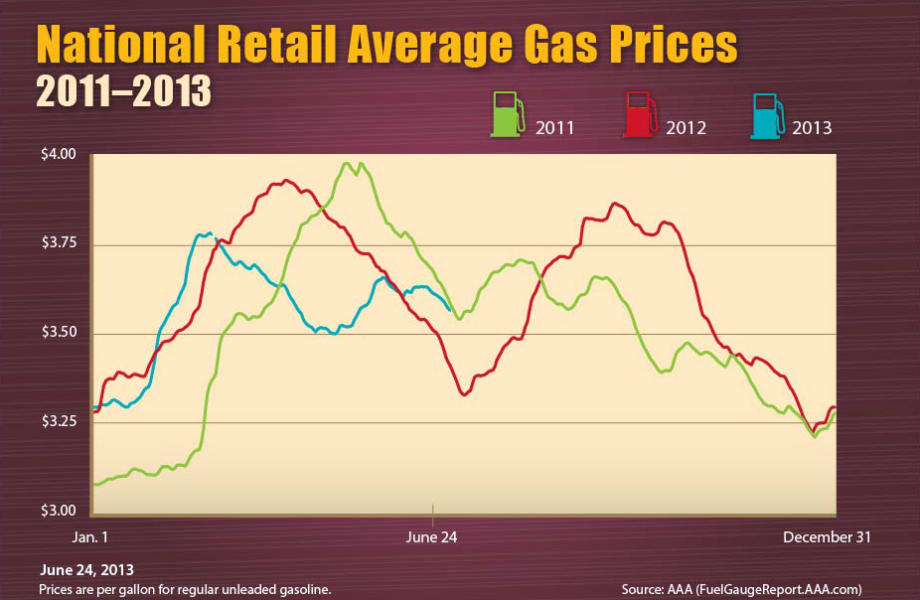
Chart courtesy AAA.
Gas prices are falling across the U.S., with the national average price for a gallon of regular unleaded gasoline at $3.57 per gallon on June 24, according to AAA’s latest Fuel Gauge Report.
This price is down four cents from the prior week, and seven cents less than the price a month ago. Despite recent declines in gas prices, this national average price is still 15 cents higher than on the same day last year.
For diesel prices, the U.S. Energy Information Administration (EIA) said the average price on June 24 was $3.83 per gallon, which is basically flat from the week before (down only 0.003 cents). This price is up 16 cents from the same day a year ago. On a regional basis, retail diesel prices are also basically flat, according to the EIA, with the largest increase being 1.3 cents in Calif. and the largest drop being 1.2 cents in the Midwest and Rocky Mountain regions.
On a regional basis, gas prices are up in 14 states and in Washington D.C., with the highest increases (more than eight cents) in California and Nevada. In the Great Lakes states, which saw much higher prices earlier this year, prices have been falling, with the average price since last week in Mich. down 30 cents, down 27 cents in Ind., and down 24 cents in Ohio, and Wis.
AAA said that although prices should keep falling through the end of June, they could increase in July as the summer driving season kicks into high gear. Last year, the national average price went up 17 cents per gallon, and 16 cents per gallon, in 2011 and 2012, respectively.
The company added that lower crude oil prices could help keep prices down. One factor influencing oil prices is the U.S. Federal Reserve, which has been purchasing bonds as part of its quantitative easing program. Since oil prices are measured in dollars, a slowing in quantitative easing would strengthen the dollar, thereby making oil a less attractive investment (more expensive for investors who hold foreign currencies). This would help push oil prices down. AAA noted that after the price of a barrel of West Texas Intermediate crude oil hit $98.44 last Tuesday, it fell to $93.69 at the end of the week after the Federal Reserve Chairman made statements regarding potentially slowing the rate of its quantitative easing program. That said, three closed pipelines in Alberta due to flooding in Canada put pressure on prices, and at the end of trading on the NYMEX, the price of a barrel of WTI had increased by $1.49 to $95.18.
The chart from AAA below shows the trend in the national average retail gas price between Jan. 1, 2011 and June 24, 2013.
Chart courtesy AAA.
Originally posted on Automotive Fleet
More Small Fleet


Developing Budget-Friendly Driver Safety Programs
From driver training and safety meetings to one-on-one coaching and incentive programs, several small fleets share how they have developed a safety culture with their drivers using low- to no-cost resources.
Read More →
Boosting Last-Mile Fleet Uptime, Safety, and Value with AI Vehicle Inspections
AI-powered inspections are transforming last-mile fleets by replacing manual checks with highly accurate automated scans that detect defects in seconds. By giving fleet operations visibility into the daily condition of their vehicles, you can identify trends over the vehicle’s lifecycle that enable improved procurement decisions, route management, driver training and accountability.
Read More →
Five Ways Seat Belts Help Prevent Injuries
There are five ways seat belts protect occupants from injuries, according to the Tennessee Department of Safety and Homeland Security.
Read More →
It’s here: The 2026 Fleet Technology Trends Report
What does AI mean for fleets? Get the answer — and learn other top tech trends.
Read More →
Small Fleets, Big Impact: How Independent Drivers Power Wreaths Across America
Check out how small fleets and independent drivers power Wreaths Across America each December and why their impact matters more than ever.
Read More →
VMS Survey Finds 65% of Small Fleet Managers Run Operations Alone
A new VMS survey shows small fleet managers are stretched thin, with most handling operations solo and eager to adopt digital tools for relief.
Read More →
Tips for Driving Safely on Halloween Night
This video features a reminder from the Connecticut Department of Transportation (DOT) and the Connecticut Police Chiefs Association, urging drivers to prioritize safety this Halloween.
Read More →
AI, Access, and Uptime: VMS’s Next Chapter with David Prusinski
VMS’s new Co-CEO, David Prusinski, shares how an AI-first approach will give small fleets and repair shops the tools to compete like big players.
Read More →
Fleet Managers Share Winter Prep Tips: It's Never Too Early!
Three fleets share best practices to prep vehicles for winter and prevent downtime when the cold sets in.
Read More →