




Fuel Prices To Rise in September But Boom Can’t Last
The national average of $3.62 per gallon is almost $1 per gallon more than a year ago.
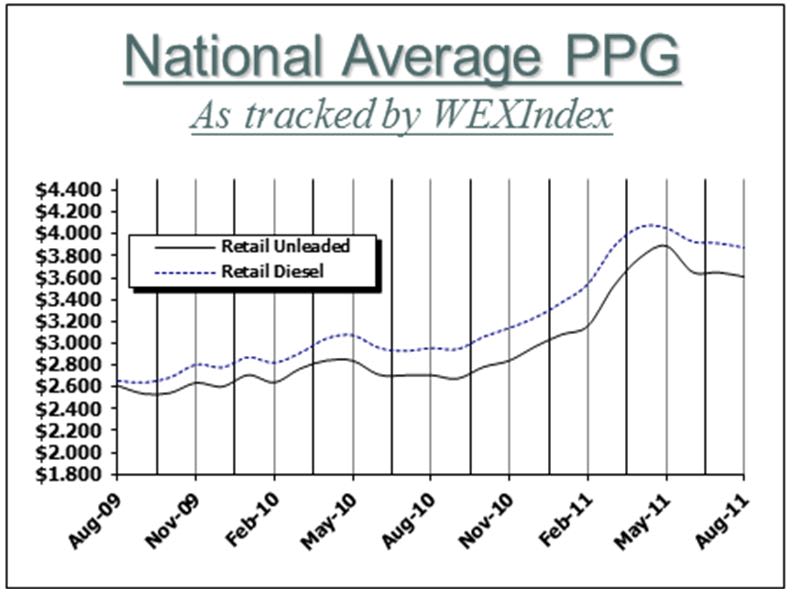
WEXIndex Retail Fuel Price Index is a monthly publication produced by Wright Express with market insights provided by OPIS Energy Group.
Wright Express Monthly Fuel Price Index Report
August 2011 — Retail prices have risen in the past week and are expected to edge higher in the first half of September. The national average of $3.62 per gallon is almost $1 per gallon more than a year ago.
Refinery issues have had an impact on the market, with the Midwest and West Coast being the hardest hit. Summer fuel, which is still mandated to be used by the EPA, is in short supply and that will keep prices strong. Once stations are able to reduce prices on the summer production in order to make the winter supply, prices should start to slide. Offshore refineries that specifically produce winter fuel blends will begin shipping fuel to the U.S.
Recent reports by the Department of Energy have shown demand to be very poor, or lower than anticipated by as much as 3 percent. Most economists expect this trend in demand to continue into winter. Income spent on gas is currently averaging 8.4 percent – a record high so far. Last year it was only 6.7 percent. Increased disposable income spent on fuel costs means less is available to be spent on other goods and services, and that consumers are cutting back on driving.
WEXIndex Retail Fuel Price Index is a monthly publication produced by Wright Express with market insights provided by OPIS Energy Group.
Diesel prices will likely follow the same path with a stronger first half of the month and a drop toward the end. While diesel is currently $3.89 per gallon, it is an increase over the $2.24 per gallon at this time last year.
WRIGHT EXPRESS MONTHLY PPG AVERAGE REPORT BY CITY
FOR 08/2011:
CITY | STATE | UNL. | DIESEL |
Atlanta | GA | $3.610 | $3.881 |
Boston | MA | $3.739 | $4.009 |
Chicago | IL | $3.922 | $3.935 |
Dallas | TX | $3.498 | $3.789 |
Denver | CO | $3.438 | $3.819 |
Detroit | MI | $3.752 | $3.922 |
Houston | TX | $3.485 | $3.745 |
Los Angeles | CA | $3.797 | $4.175 |
Memphis | TN | $3.500 | $3.809 |
Miami | FL | $3.744 | $3.948 |
Minneapolis | MN | $3.706 | $3.934 |
New Orleans | LA | $3.461 | $3.725 |
Philadelphia | PA | $3.679 | $4.051 |
Phoenix | AZ | $3.329 | $3.692 |
Portland | OR | $3.745 | $3.816 |
San Francisco | CA | $3.875 | $4.330 |
Seattle | WA | $3.824 | $4.143 |
St. Louis | MO | $3.413 | $3.708 |
Washington | DC | $3.858 | $4.147 |
National Average | USA | $3.608 | $3.875 |
More Small Fleet


Developing Budget-Friendly Driver Safety Programs
From driver training and safety meetings to one-on-one coaching and incentive programs, several small fleets share how they have developed a safety culture with their drivers using low- to no-cost resources.
Read More →
Boosting Last-Mile Fleet Uptime, Safety, and Value with AI Vehicle Inspections
AI-powered inspections are transforming last-mile fleets by replacing manual checks with highly accurate automated scans that detect defects in seconds. By giving fleet operations visibility into the daily condition of their vehicles, you can identify trends over the vehicle’s lifecycle that enable improved procurement decisions, route management, driver training and accountability.
Read More →
Five Ways Seat Belts Help Prevent Injuries
There are five ways seat belts protect occupants from injuries, according to the Tennessee Department of Safety and Homeland Security.
Read More →
It’s here: The 2026 Fleet Technology Trends Report
What does AI mean for fleets? Get the answer — and learn other top tech trends.
Read More →
Small Fleets, Big Impact: How Independent Drivers Power Wreaths Across America
Check out how small fleets and independent drivers power Wreaths Across America each December and why their impact matters more than ever.
Read More →
VMS Survey Finds 65% of Small Fleet Managers Run Operations Alone
A new VMS survey shows small fleet managers are stretched thin, with most handling operations solo and eager to adopt digital tools for relief.
Read More →
Tips for Driving Safely on Halloween Night
This video features a reminder from the Connecticut Department of Transportation (DOT) and the Connecticut Police Chiefs Association, urging drivers to prioritize safety this Halloween.
Read More →
AI, Access, and Uptime: VMS’s Next Chapter with David Prusinski
VMS’s new Co-CEO, David Prusinski, shares how an AI-first approach will give small fleets and repair shops the tools to compete like big players.
Read More →
Fleet Managers Share Winter Prep Tips: It's Never Too Early!
Three fleets share best practices to prep vehicles for winter and prevent downtime when the cold sets in.
Read More →