




Ford's Vehicle Designs Improve Visibility of Gauges, Controls
With the help of Ford’s Visual Performance Evaluation Lab, engineers ensure that drivers can easily read vehicle controls and instrument panels under a wide range of lighting conditions.
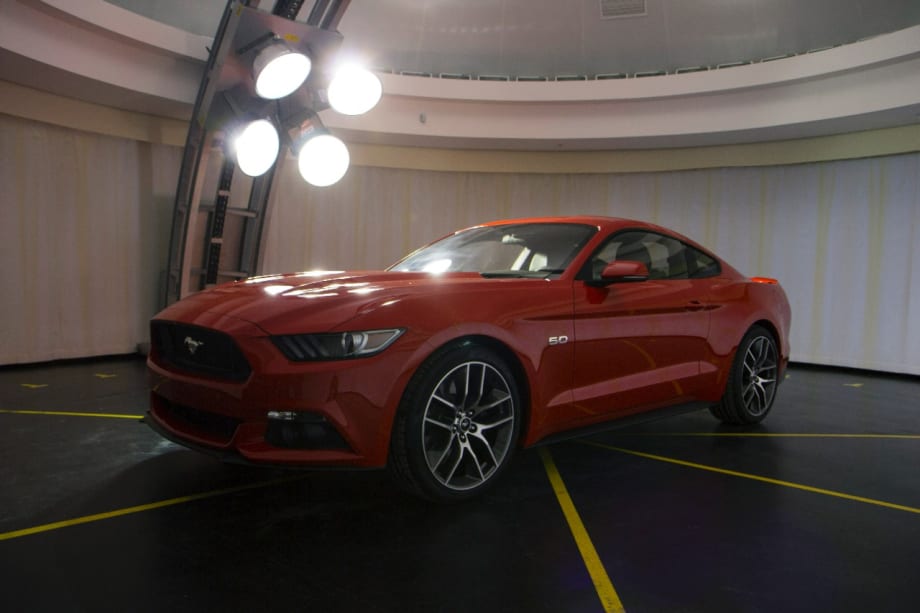
The 2015 Ford Mustang in Ford's Visual Performance Evaluation Lab in Dearborn, Mich. Photo courtesy of Ford.
The 2015 Ford Mustang in Ford's Visual Performance Evaluation Lab in Dearborn, Mich. Photo courtesy of Ford.
Sun glare can seriously compromise a driver’s ability to see vehicle controls and instrument panels, particularly during sunrise and sunset. Unfortunately, this time of year such periods of heightened sun glare coincide with morning and evening rush hours.
But the right vehicle design can mitigate this risk. At Ford Motor Co., engineers use the company’s Visual Performance Evaluation Lab – known internally as the Lighting Lab -– to re-create daylight so they can work to reduce sun glare on vehicle controls and instrument panels.
The Lighting Lab uses a planetarium-like dome to replicate sunlight conditions from dawn to dusk, simulating the phases of the earth’s revolution around the sun. Additional lights lining the perimeter of the dome can be adjusted to simulate the effects of weather conditions.
The designers behind the 2015 Ford Mustang used the Lighting Lab to ensure the car’s newly available aluminum dash panel does not cause glare to drivers under a variety of conditions, and that the instruments found in Mustang’s optional gauge pack are always legible.
“With the Lighting Lab, we can ensure that the first time a buyer sits in the 2015 Ford Mustang, that person will be able to see the interior as the designers originally envisioned it – in the best light possible,” said Mahendra Dassanayake, Ford lighting technical specialist. “Whether the car is parked outside or is sitting on an auto show floor, whether it is a bright, sunny day, or overcast and snowing, the materials and controls in the Mustang will be both visually satisfying and highly functional.”
To conduct an evaluation of switches, clusters, climate controls, navigation systems, radios or entertainment systems, the car or the individual component is first placed in the middle of a large circular space. A switch is then flipped to power on four 1,500-watt lights mounted on a moveable steel arm.
By physically pushing the arm to specific points around the circle’s edge, and adjusting the spotlights and floodlights in the ceiling, the Lighting Lab can simulate light conditions at every time of day, while the additional lighting in the dome is used to vary weather conditions from bright sun to full cloud cover.
These tools allow Ford engineers to re-create any kind of lighting condition found anywhere in the world when they're designing new vehicles. This ability is critical to the development of global products such as the 2014 Ford Fiesta, Ford said.
Originally posted on Automotive Fleet
More Small Fleet


Developing Budget-Friendly Driver Safety Programs
From driver training and safety meetings to one-on-one coaching and incentive programs, several small fleets share how they have developed a safety culture with their drivers using low- to no-cost resources.
Read More →
Boosting Last-Mile Fleet Uptime, Safety, and Value with AI Vehicle Inspections
AI-powered inspections are transforming last-mile fleets by replacing manual checks with highly accurate automated scans that detect defects in seconds. By giving fleet operations visibility into the daily condition of their vehicles, you can identify trends over the vehicle’s lifecycle that enable improved procurement decisions, route management, driver training and accountability.
Read More →
Five Ways Seat Belts Help Prevent Injuries
There are five ways seat belts protect occupants from injuries, according to the Tennessee Department of Safety and Homeland Security.
Read More →
It’s here: The 2026 Fleet Technology Trends Report
What does AI mean for fleets? Get the answer — and learn other top tech trends.
Read More →
Small Fleets, Big Impact: How Independent Drivers Power Wreaths Across America
Check out how small fleets and independent drivers power Wreaths Across America each December and why their impact matters more than ever.
Read More →
VMS Survey Finds 65% of Small Fleet Managers Run Operations Alone
A new VMS survey shows small fleet managers are stretched thin, with most handling operations solo and eager to adopt digital tools for relief.
Read More →
Tips for Driving Safely on Halloween Night
This video features a reminder from the Connecticut Department of Transportation (DOT) and the Connecticut Police Chiefs Association, urging drivers to prioritize safety this Halloween.
Read More →
AI, Access, and Uptime: VMS’s Next Chapter with David Prusinski
VMS’s new Co-CEO, David Prusinski, shares how an AI-first approach will give small fleets and repair shops the tools to compete like big players.
Read More →
Fleet Managers Share Winter Prep Tips: It's Never Too Early!
Three fleets share best practices to prep vehicles for winter and prevent downtime when the cold sets in.
Read More →