




Ford’s New Ecoboost Engines Promise More Power, Better Fuel Economy
The next generation of EcoBoost engines will move even closer to diesels as Ford introduces cooled EGR (exhaust gas recirculation), which helps enable higher compression ratios.
At the 2010 SAE World Congress this week, Dan Kapp, Ford's director of powertrain research and advanced engineering, and Bob Fascetti, director of large gas and diesel engine engineering, will detail how the next generation of the company's award-winning EcoBoost engines will further connect gasoline and diesel engine technology.
"The first generation of EcoBoost applied some of the key technologies found in powerful diesel engines - such as direct injection and turbocharging - and optimized them for the gasoline engine," said Fascetti. "The next generation of EcoBoost engines will continue that path to deliver more power and even better fuel economy with lower emissions, which are key customer benefits of EcoBoost technology."
Technologies being studied to further expand the potential of EcoBoost include cooled EGR and more advanced forms of turbocharging, which also have links to modern diesel engines. Cooled EGR as applied to an EcoBoost engine can improve efficiency and reduce the tendency for an engine to knock. Cooled EGR is exhaust gas that is cooled in a heat exchanger before being pumped back into the cylinders, where it lowers the combustion temperature.
The result: a cleaner-running engine that develops more power and delivers as much as a 5 percent gain in fuel economy over today's already efficient EcoBoost engines. Ford's current generation of 2.0-liter EcoBoost I-4 and 3.5-liter EcoBoost V-6 engines deliver between 10 and 20 percent better fuel economy than comparable normally aspirated V-6 and V-8 engines, respectively.
Ford holds more than 125 patents on its EcoBoost technology, which combines direct injection, turbocharging and variable valve timing to increase performance and reduce emissions. EcoBoost gasoline engines already use much of the same technology that is found in today's state-of-the-art turbo-diesels.
As with diesels, today's EcoBoost engines feature:
A high-pressure direct-injection fuel system fed by a common rail that delivers a precise amount of gasoline in the exact spot for fast and complete burn
Turbocharging to create a more dense mix of air and fuel in each cylinder
Special pistons with optimized bowls in the center to improve combustion efficiency. These pistons are also oil-cooled, which reduces in-cylinder temperatures
Reduced CO2 emissions and higher fuel economy
And just like diesels, Ford's EcoBoost engines deliver outstanding performance and driving enjoyment at all speeds. EcoBoost accomplishes this at less cost than a similar-displacement diesel engine.
"When it comes to smaller-displacement engines, EcoBoost is the perfect solution for most consumers," said Barb Samardzich, Ford's vice president for Powertrain Engineering. "EcoBoost delivers what customers need most - outstanding fuel economy and low-end torque."
Adapting diesel engine technology to a gasoline engine involves more than simply machining a few new parts and then just bolting them on, explained Brett Hinds, manager of Ford's advanced engine design.
"An EcoBoost engine has much higher operating temperatures than a diesel engine," said Hinds. "Many parts had to be upgraded to special metals and alloys that hold up to that environment. Our exhaust manifolds, for example, are made of stainless steel, and the turbochargers are made from high-temperature cast-iron alloy."
EcoBoost and diesel engines share higher pressures in the fuel system and higher compression ratios. For example, a regular port fuel-injected gasoline engine's fuel pressure is around 65 psi, while the pressure at which the fuel is delivered through the injectors in an EcoBoost engine can be as high as 2,250 psi.
State-of-the-art diesel engines, such as the new Ford-designed and Ford-built 6.7-liter Power Stroke V-8, have fuel pressures that are even higher. But in both engines, the fuel is delivered to almost the exact same area. With EcoBoost, the fuel is introduced directly into the cylinder head, just like a diesel, and the fuel injection tip is right in the combustion, just like a diesel.
"We're introducing about 30 powertrains over the next couple of years to power everything from small cars to large pickup trucks," said Fascetti. "Our experience with a wide range of engines allows us to take the best solutions and apply them to many platforms to benefit the customer."
More Small Fleet


Developing Budget-Friendly Driver Safety Programs
From driver training and safety meetings to one-on-one coaching and incentive programs, several small fleets share how they have developed a safety culture with their drivers using low- to no-cost resources.
Read More →
Boosting Last-Mile Fleet Uptime, Safety, and Value with AI Vehicle Inspections
AI-powered inspections are transforming last-mile fleets by replacing manual checks with highly accurate automated scans that detect defects in seconds. By giving fleet operations visibility into the daily condition of their vehicles, you can identify trends over the vehicle’s lifecycle that enable improved procurement decisions, route management, driver training and accountability.
Read More →

Five Ways Seat Belts Help Prevent Injuries
There are five ways seat belts protect occupants from injuries, according to the Tennessee Department of Safety and Homeland Security.
Read More →
Basic Tracking vs Next Generation Fleet Technology
Fleet software is getting more sophisticated and effective than ever, tying big data models together to transform maintenance, safety, and the value of your existing tech stack. Fleet technology upgrades are undoubtedly an investment, but updated technology can offer a much higher return. Read how upgrading your fleet technology can increase the return on your investment.
Read More →
It’s here: The 2026 Fleet Technology Trends Report
What does AI mean for fleets? Get the answer — and learn other top tech trends.
Read More →
Small Fleets, Big Impact: How Independent Drivers Power Wreaths Across America
Check out how small fleets and independent drivers power Wreaths Across America each December and why their impact matters more than ever.
Read More →
VMS Survey Finds 65% of Small Fleet Managers Run Operations Alone
A new VMS survey shows small fleet managers are stretched thin, with most handling operations solo and eager to adopt digital tools for relief.
Read More →
Tips for Driving Safely on Halloween Night
This video features a reminder from the Connecticut Department of Transportation (DOT) and the Connecticut Police Chiefs Association, urging drivers to prioritize safety this Halloween.
Read More →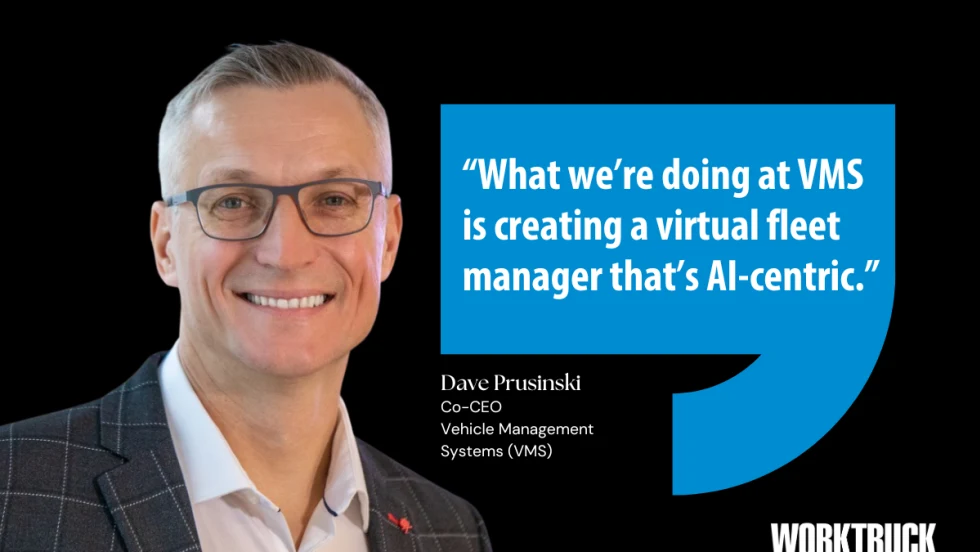
AI, Access, and Uptime: VMS’s Next Chapter with David Prusinski
VMS’s new Co-CEO, David Prusinski, shares how an AI-first approach will give small fleets and repair shops the tools to compete like big players.
Read More →