





Ford F-150 Lightning Owners to Gain Access to Tesla Superchargers
Ford F-150 Lightning Production Capacity Set To Triple
The Rogue Electric Vehicle Center, after a six-week expansion and retooling shutdown, has resumed production on the F-150 Lightning and the projected numbers have soared.
August 1, 2023
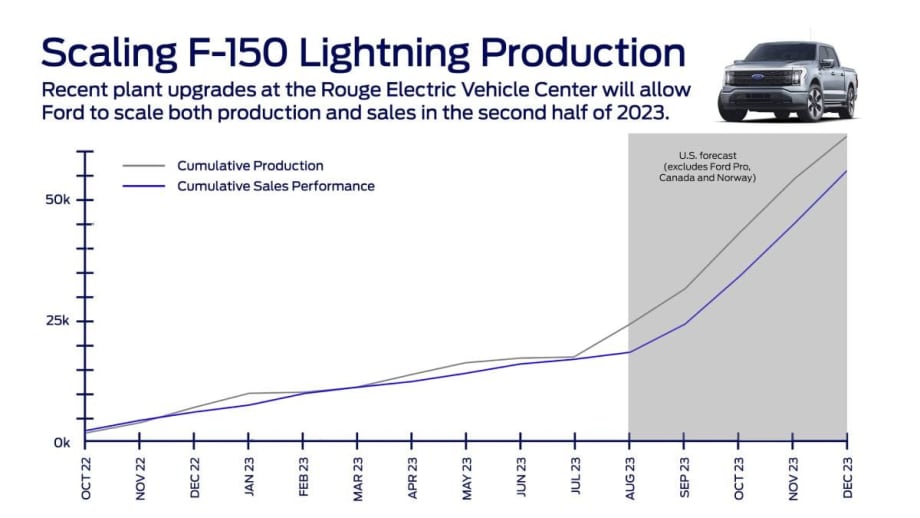
The Rouge Electric Vehicle Center is scheduled to build more than 70,000 F-150 Lightning trucks in calendar year 2023 with production for U.S. customers expected to ramp in the fall.
Photo: Ford
3 min to read
Ford Motor Company announced that it has resumed production of the F-150 Lightning following a six-week shutdown to expand and retool the Rouge Electric Vehicle Center plant to triple the manufacturing capacity of the electric truck.
With the expansion, Ford will have the ability to produce the F-150 Lightning at an annualized rate of 150,000 units by this fall.
While the temporary shutdown of the Rouge Electric Vehicle Center limited customer deliveries this summer, the facility is now ready to accelerate the ramp-up process to help meet the demand for the truck.
The Rouge Electric Vehicle Center is scheduled to build more than 70,000 F-150 Lightning trucks in calendar year 2023 with production for U.S. customers expected to ramp in the fall.
“We are all looking forward to getting these F-150 Lightning trucks into the hands of our customers – from the U.S. to Norway,” said Debbie Manzano, director of Manufacturing at Ford. “This milestone is the result of a lot of hard work and collaboration.”
The Rouge Electric Vehicle Center now uses equipment to automatically measure and validate exterior body fit for margin and flushness precision. A third station was added to validate wheel alignment and headlamp aim for driver assist technology.
Training for 1,200 additional manufacturing employees will continue for three weeks. Incoming operators are shadowing experienced employees in a buddy system for onboarding.
Battery pack production is also ramping up at the Rawsonville (Mich.) Components Plant and the Van Dyke (Mich.) Electric Powertrain Center is increasing the production of EV power units to match the scale of the F-150 Lightning assembly at the Rouge Electric Vehicle Center.
Meeting Customer Demand
The capacity increase at the Rouge Electric Vehicle Center supports shorter order-to-delivery times for customers with a focus on building trim levels like XLT, which accounts for over 50% of new orders.
Lightning Pro units are now available for retail customers in limited quantities, with these units allocated for loyal reservation holders who have been waiting to order since launch.
Recently adjusted pricing, while still above launch pricing, has helped to drive an increase in web traffic and an increase in customer orders. The increased capacity also opens up the opportunity to broaden the number of trim levels offered across the lineup, addressing customer wants since the reveal.
“We have learned a lot from our first-ever EV truck customers, including a preference for technology and visual differentiation,” said Marin Gjaja, chief customer officer for the Ford Model e. “We continue to refine the F-150 Lightning lineup to make the jump to an EV truck an easy choice for customers.”
Ford is engineering its second generation of electric vehicles, which includes the F-150 Lightning, Mustang Mach-E, and E-Transit.
Originally posted on Automotive Fleet
More Small Fleet


Developing Budget-Friendly Driver Safety Programs
From driver training and safety meetings to one-on-one coaching and incentive programs, several small fleets share how they have developed a safety culture with their drivers using low- to no-cost resources.
Read More →
Sponsored•March 9, 2026
Boosting Last-Mile Fleet Uptime, Safety, and Value with AI Vehicle Inspections
AI-powered inspections are transforming last-mile fleets by replacing manual checks with highly accurate automated scans that detect defects in seconds. By giving fleet operations visibility into the daily condition of their vehicles, you can identify trends over the vehicle’s lifecycle that enable improved procurement decisions, route management, driver training and accountability.
Read More →
Five Ways Seat Belts Help Prevent Injuries
There are five ways seat belts protect occupants from injuries, according to the Tennessee Department of Safety and Homeland Security.
Read More →
Sponsored•January 14, 2026
It’s here: The 2026 Fleet Technology Trends Report
What does AI mean for fleets? Get the answer — and learn other top tech trends.
Read More →
Small Fleets, Big Impact: How Independent Drivers Power Wreaths Across America
Check out how small fleets and independent drivers power Wreaths Across America each December and why their impact matters more than ever.
Read More →
VMS Survey Finds 65% of Small Fleet Managers Run Operations Alone
A new VMS survey shows small fleet managers are stretched thin, with most handling operations solo and eager to adopt digital tools for relief.
Read More →
Tips for Driving Safely on Halloween Night
This video features a reminder from the Connecticut Department of Transportation (DOT) and the Connecticut Police Chiefs Association, urging drivers to prioritize safety this Halloween.
Read More →
AI, Access, and Uptime: VMS’s Next Chapter with David Prusinski
VMS’s new Co-CEO, David Prusinski, shares how an AI-first approach will give small fleets and repair shops the tools to compete like big players.
Read More →
Fleet Managers Share Winter Prep Tips: It's Never Too Early!
Three fleets share best practices to prep vehicles for winter and prevent downtime when the cold sets in.
Read More →