




Ford Demonstrates Obstacle Avoidance Technology
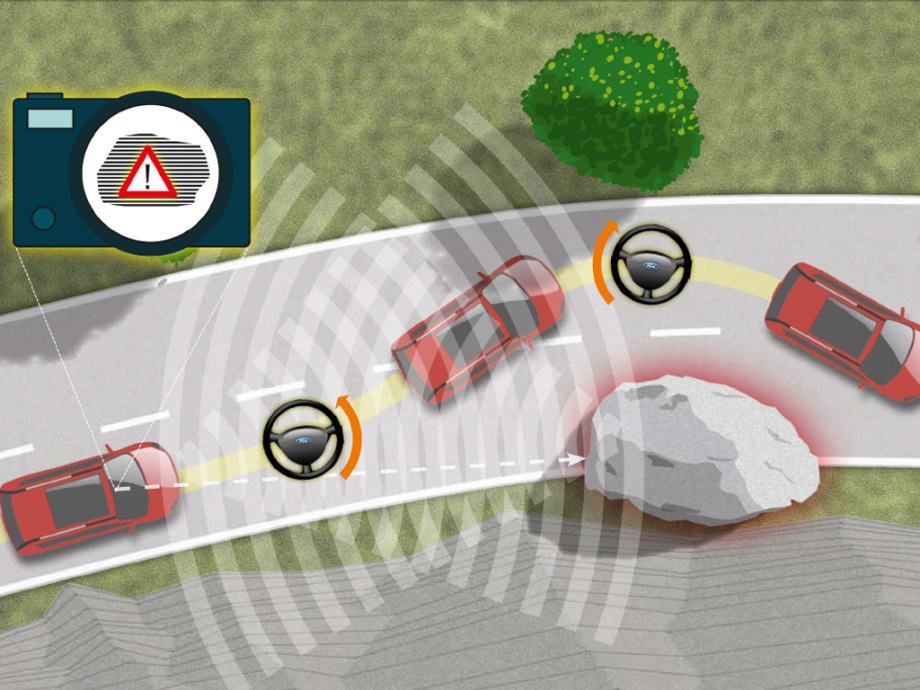
The technology uses automatic steering and braking to avoid collisions with vehicles that are stopped or slowing in the same lane ahead.
Graphic: Ford Motor Co.
Graphic: Ford Motor Co.
Ford Motor Co. last week demonstrated a test car equipped with the company’s obstacle avoidance technology, which automatically steers and brakes to direct the vehicle away from traffic if the driver fails to steer or brake following system warnings.
This prototype technology, Ford said, represents another milestone in the company’s Blueprint for Mobility, which envisions a future of automated functionality and advanced technologies to help improve safety, reduce congestion and improve the environment.
Ford conducted the obstacle avoidance demonstration for the first time in North America at the Dearborn Development Center test track in Michigan. Developed at Ford’s research facility in Aachen, Germany, obstacle avoidance is demonstrated on a Ford Focus.
The sensor-based technologies found in driver-assist and semi-automated features, including obstacle avoidance and fully assisted parking aid, form the building blocks for the future of automated driving, the automaker said.
Featured on the Ford Edge Concept that debuted last month at the Los Angeles Auto Show, Ford’s obstacle avoidance uses automatic steering and braking to avoid collisions with vehicles that are stopped or slowing in the same lane ahead. The system issues warnings first if it detects slow-moving objects or stationary obstacles ahead. If the driver fails to steer or brake following those warnings, the system will then automatically steer and brake to avoid a collision. Obstacle avoidance builds on the foundation of several driver-assist technologies now being offered in many Ford products around the world.
“The obstacle avoidance research project is a prime example of technologies we are developing to benefit drivers whose Ford vehicles are equipped with the technology and others who share the road with them,” said Paul Mascarenas, chief technical officer and vice president of Ford research and innovation. “We are optimistic that through our research and findings, we will be able to reduce these types of rear-end collisions.”
The test car is the product of a four-year research project called interactIVe (Accident Avoidance by Active Intervention of Intelligent Vehicles), a Ford-led consortium consisting of 29 partners.
Obstacle avoidance uses three radars, ultrasonic sensors and a camera to scan the road as far as 656 feet ahead. If the system detects a slow-moving or stationary object, it first displays a warning, then sounds a chime. If the driver does not steer or brake, the obstacle avoidance technology applies the brakes, scans for gaps on either side of the hazard, and takes control of the electronic power steering to avoid a collision. The technology has been tested at speeds greater than 38 mph.
Using similar sensor and automated vehicle control technology, Ford also recently unveiled fully assisted parking aid. This prototype technology lets customers park their vehicles at the touch of a button, or even by remote control. The concept builds on Ford’s current active park assist feature, which automatically steers the car into a parallel parking space while the driver controls the shifting, accelerator and brake.
Fully assisted parking aid can find a perpendicular parking space using ultrasonic sensors. From inside, the driver pushes a button to activate the system. From outside the vehicle, fully assisted parking aid can be remotely activated, allowing people to wait until the vehicle has pulled out of a tight parking spot before entering.
“Through development of obstacle avoidance and fully assisted parking aid technologies, we are building the foundation for a future of automated driving and personal mobility,” said Mascarenas.
Originally posted on Automotive Fleet
More Small Fleet


Developing Budget-Friendly Driver Safety Programs
From driver training and safety meetings to one-on-one coaching and incentive programs, several small fleets share how they have developed a safety culture with their drivers using low- to no-cost resources.
Read More →
Boosting Last-Mile Fleet Uptime, Safety, and Value with AI Vehicle Inspections
AI-powered inspections are transforming last-mile fleets by replacing manual checks with highly accurate automated scans that detect defects in seconds. By giving fleet operations visibility into the daily condition of their vehicles, you can identify trends over the vehicle’s lifecycle that enable improved procurement decisions, route management, driver training and accountability.
Read More →
Five Ways Seat Belts Help Prevent Injuries
There are five ways seat belts protect occupants from injuries, according to the Tennessee Department of Safety and Homeland Security.
Read More →
It’s here: The 2026 Fleet Technology Trends Report
What does AI mean for fleets? Get the answer — and learn other top tech trends.
Read More →
Small Fleets, Big Impact: How Independent Drivers Power Wreaths Across America
Check out how small fleets and independent drivers power Wreaths Across America each December and why their impact matters more than ever.
Read More →
VMS Survey Finds 65% of Small Fleet Managers Run Operations Alone
A new VMS survey shows small fleet managers are stretched thin, with most handling operations solo and eager to adopt digital tools for relief.
Read More →
Tips for Driving Safely on Halloween Night
This video features a reminder from the Connecticut Department of Transportation (DOT) and the Connecticut Police Chiefs Association, urging drivers to prioritize safety this Halloween.
Read More →
AI, Access, and Uptime: VMS’s Next Chapter with David Prusinski
VMS’s new Co-CEO, David Prusinski, shares how an AI-first approach will give small fleets and repair shops the tools to compete like big players.
Read More →
Fleet Managers Share Winter Prep Tips: It's Never Too Early!
Three fleets share best practices to prep vehicles for winter and prevent downtime when the cold sets in.
Read More →