




Related Photos: Ford Trucks Through the Years
Ford Celebrates 100 Years of Work Trucks
Ford is celebrating the centennial of its first purpose-built truck, the 1917 Model TT, which eventually led to the company producing many iconic work trucks, including the F-Series that has been the best-selling truck lineup for 35 years.
by Staff
July 27, 2017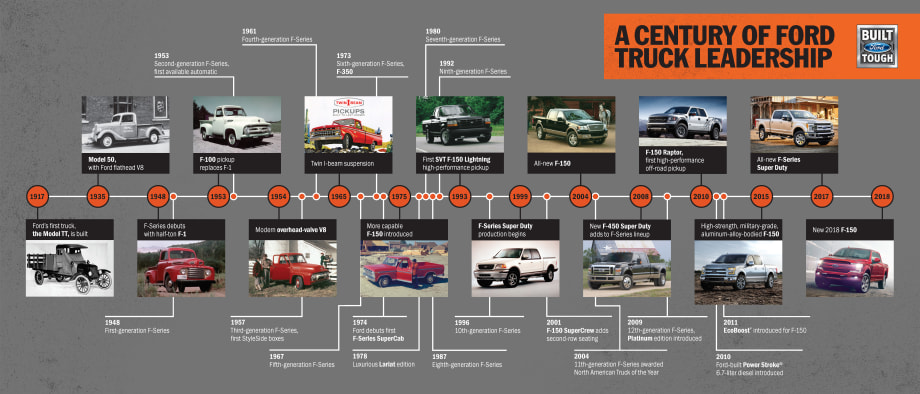
Timeline courtesy of Ford.
3 min to read
Timeline courtesy of Ford.
Ford is celebrating the centennial of its first purpose-built truck, the 1917 Model TT, which eventually led to the company producing many iconic work trucks, including the F-Series that has been the best-selling truck lineup for 35 years.
Henry Ford launched the Model TT nine years after his Model T sedan to provide a vehicle that could haul heavier loads and provide greater utility for work and deliveries, according to a Ford release. When it was introduced on July 27 of that year, it used the Model T cab and engine, but added a heavier-duty frame that could carry a 1 ton payload.
Ford sold 209 Model TT trucks in 1917 for $660 per vehicle.
At the time, Ford wanted a chassis that could accommodate third-part beds, cargo areas, and other add-ons that increased functionality for work. By 1928, Ford has sold 1.3 million Model TTs, when the company replaced the truck with the Model AA that offered a 1.5-ton chassis.
Henry Ford marketed his early trucks heavily in rural areas, said Bob Kreipke, Ford's historian.
"Model AA trucks in particular had a certain class to them," he said. "Customers could use them on the farm, yet still take them to church on Sunday."
In 1933, Ford replaced the Model AA with the Model BB that could be outfitted as a mail or freight vehicle, ambulance, or stake truck. Two years later, Ford introduced the Model 50 pickup that was powered by Ford's Flathead V-8 engine.
By 1941, Ford has sold more than 4 million trucks. The company shifted to war production and began building heavy-duty military trucks and four-wheel-drive personnel carriers.
Ford introduced its F-Series Bonus Built trucks in 1948, which offered vehicles with a range of capability from classes 2-7. The F-1 pickup was the entry model, while the F-8 arrived as a cabover. The F-1 became the F-100, while the F-2 and F-3 became the F-250. F-4 became the F-350. The Class 8 trucks were spun off into a new C-Series commercial truck unit that produced six lines, including C-, H-, L-, N-, T-, and W-Series models.
Ford began offering more features to the utilitarian trucks. In 1953, the F-100 came with armrests, dome lights, and sun visors. The truck came with integrated front fenders, a lower and wider cab, and a more aerodynamic design. In 1957, Ford tested a car-based truck known as the Falcon Ranchero.
Ford introduced the fourth-generation F-Series in 1961 with Ford's I-beam front suspension. An upscale Ranger package appeared in 1967. Ford trucks now offered power steering and brakes and a lower chassis profile. A larger SuperCab option introduced in 1974 was designed to attract dual-purpose work and family buyers.
The sixth-generation F-Series, in 1975, shed the F-100 model for the higher-capacity F-150 to better compete with General Motors' C/K trucks. In 1977, a copywriter came up with the model's now-familiar slogan, Built Ford Tough.
Ford began offering premium models in 1978 with the Lariat package, which added air conditioning, leather trim, and power windows and locks. 1982 brought Ford's compact Ranger pickup. The nameplate has been revived for 2019, seven years after it was discontinued.
Ford introduced its F-Series Super Duty trucks in 1998 for heavy-duty work use. The F-250 to F-750 provided a growing number of commercial applications.
The first EcoBoost V-6 debuted for 2011, and in 2015 Ford debuted an F-150 with a military-grade aluminum body. Two years later, Super Duty trucks arrived with aluminum-alloy bodies and reinforced frames to increase towing and hauling.
The 2017 model year also brought a redesigned Raptor, an off-road performance variant of the F-150 that has been used by the Border Patrol and several other law enforcement fleets.
"Ford trucks have carried the loads, the people and the products necessary to get the job done," Kreipke said.
Topics:Ford F-SeriesLarge PickupsFord Super DutyFordAutomotive HistoryAnniversariesFord RangerOperationsSmall Fleet
Originally posted on Automotive Fleet
More Operations
Family Ties Inside the Fleet Families Building Careers Across Generations
Three fleet families share what it really takes to work together, learn across generations, and keep business from following them home.
Read More →
Shades of Fleet Call for Voices: Fleet's Hidden Heroes
Fleet’s hidden heroes are often the ones keeping everything moving behind the scenes. September’s Shades of Fleet is looking for dispatchers, coordinators, parts specialists, and other support pros to share their stories.
Read More →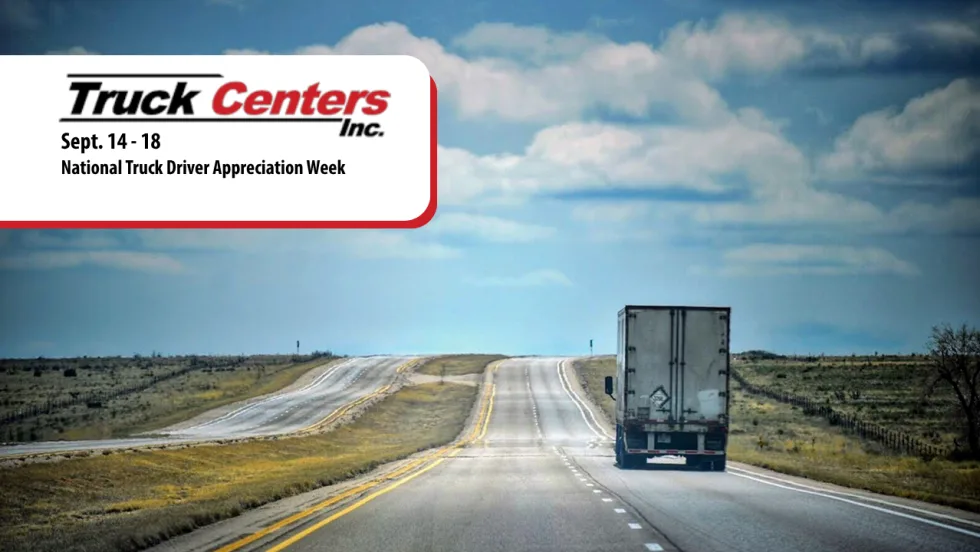
Truck Centers, Inc. Celebrates National Truck Driver Appreciation Week with $1,000 Fuel Card Giveaways
During National Truck Driver Appreciation Week, Truck Centers, Inc. is offering customers a chance to fuel up for free. Customers at all Truck Centers locations can enter to win one of four $1,000 fuel cards from Sept. 14 - 18.
Read More →
Fleet Guides, AI Time-Savers, Truck Tariffs & Fuel Strategy Lead the News
This week’s Truck Chat Cheat Sheet covers new fleet vehicle guides, practical AI use cases, U.S.-Canada truck production, mixed-energy strategy, and more.
Read More →
What Fleet Employers Are Missing When Hiring Veterans
What if some of the strongest candidates for fleet are already out there, but their experience is written in a language our industry does not always recognize?
Read More →
Automotive Fleet Opens 2026 Personal Use Survey for Commercial Fleet Managers
Less than two weeks left! Commercial and corporate fleet managers are invited to share how their organizations handle company vehicle personal-use policies, charges, and driver eligibility.
Read More →
What Resilient Fleets Do Differently When Conditions Change
Fleet resilience is about more than reacting to disruption. Lauren Fletcher talks with AP Fleet’s Alex Coveney about flexibility, planning, scaling, and what helps fleets adapt when business conditions shift.
Read More →
If We Want the Next Generation in Automotive, We Have to Give Them a Reason to Care
The automotive industry talks constantly about its workforce shortage. But before we can recruit the next generation, we may need to do a better job giving kids a reason to care about automotive in the first place.
Read More →
Ram ProMaster City Under $40K, Truck Tariffs, and AI Maintenance Lead the News
A sub-$40K commercial van, tariff questions, AI-powered maintenance, and a new EV production strategy headline this week’s Truck Chat Cheat Sheet.
Read More →
Bob Adamsky Shares the Fleet Lessons You Usually Learn the Hard Way
After more than 30 years in fleet, Arrow International’s Bob Adamsky has learned that the job is about far more than vehicles. He shares the lessons he wishes every fleet manager could learn a little earlier.
Read More →