




Feds, Automakers Reach Safety Recall Accord
Eighteen vehicle manufacturers and the U.S. Department of Transportation finalize an agreement aimed at taking a more proactive approach to identifying and fixing vehicle defects that pose safety risks.
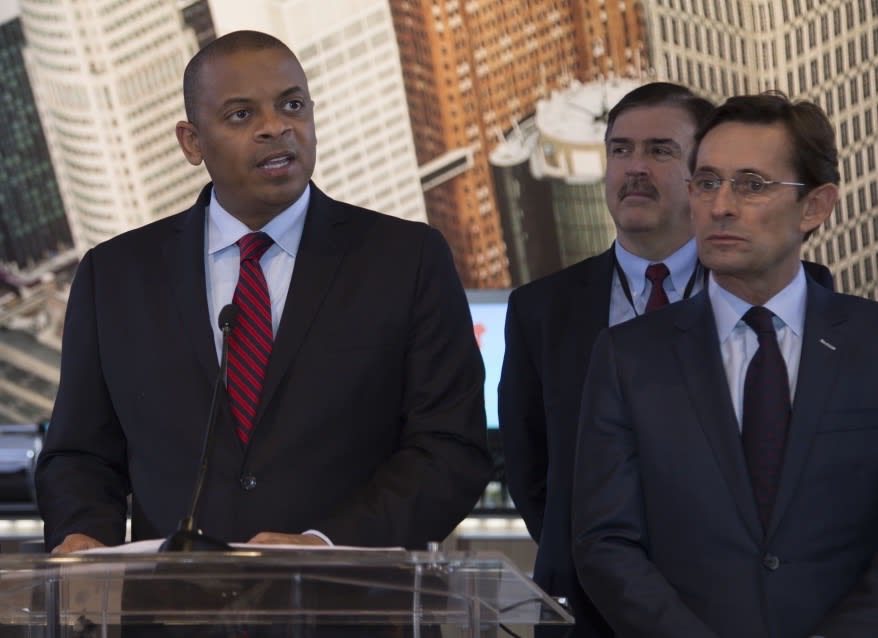
U.S. Transportation Secretary Anthony Foxx (left) at the North American International Auto Show in Detroit. Photo courtesy of U.S. DOT.
U.S. Transportation Secretary Anthony Foxx (left) at the North American International Auto Show in Detroit. Photo courtesy of U.S. DOT.
Eighteen automakers and the U.S. Department of Transportation have reached an agreement to work more closely together to identify vehicle manufacturing defects earlier and improve the overall safety recall process.
“The commitments we make today will help catch safety defects before they explode into massive recalls,” said U.S. Secretary of Transportation Anthony Foxx. “They will help improve the quality of data that automakers and NHTSA [the National Highway Traffic Safety Administration] analyze to seek defects today, and they will find ways to generate better data in the future. When recalls are necessary, they will help us reach customers and get their vehicles repaired.”
The agreement is built around four stated goals: enhance and facilitate proactive safety, enhance analysis and examination of early-warning reporting data, maximize safety recall participation rates, and enhance automotive cybersecurity.
The automakers committing to the accord are American Honda Motor Co., BMW of North America, FCA US (Fiat Chrysler Automobiles), Ford Motor Co., General Motors, Hyundai Motor America, Jaguar Land Rover North America, Kia Motors America, Mazda North American Operations, Mercedes-Benz USA, Mitsubishi Motors North America, Nissan North America, Porsche Cars North America, Subaru of America, Tesla Motors, Toyota Motor North America, Volkswagen Group of America and Volvo Cars USA.
"FCA US LLC embraces this initiative and, through our ongoing engagement with NHTSA, we are already moving in the direction outlined in the agreed-upon principles," said Sergio Marchionne, FCA CEO, in a released statement. "FCA US has more than doubled the complement of professionals assigned to its vehicle-safety organization."
The agreement’s objectives include greater reliance on advanced data analytics to more readily identify safety threats, based on early-warning reporting data. Under the Transportation Recall Enhancement, Accountability and Documentation (TREAD) Act of 2000, manufacturers must submit to NHTSA quarterly early-warning reports that include information about crashes involving death or injury, property damage claims, consumer complaints, warranty claims and field reports.
Additionally, the new agreement directs automakers to share best practices to improve recall participation rates among vehicle owners. These efforts will include exploring how car and truck dealers, insurance companies and state DMVs might assist in tracking down a vehicle’s current owner to ensure recall repairs are completed.
The accord, announced at the 2016 North American International Auto Show in Detroit, also calls for greater industry collaboration to improve automotive cybersecurity and mitigate cyber threats that pose safety risks. In this area, the agreement describes an increased role for the auto industry’s Information Sharing and Analysis Center (Auto-ISAC), an industry initiative announced in July. The Auto-ISAC serves as a hub for automotive cyber threat intelligence and analysis.
Originally posted on Automotive Fleet
More Small Fleet


Developing Budget-Friendly Driver Safety Programs
From driver training and safety meetings to one-on-one coaching and incentive programs, several small fleets share how they have developed a safety culture with their drivers using low- to no-cost resources.
Read More →
Boosting Last-Mile Fleet Uptime, Safety, and Value with AI Vehicle Inspections
AI-powered inspections are transforming last-mile fleets by replacing manual checks with highly accurate automated scans that detect defects in seconds. By giving fleet operations visibility into the daily condition of their vehicles, you can identify trends over the vehicle’s lifecycle that enable improved procurement decisions, route management, driver training and accountability.
Read More →
Five Ways Seat Belts Help Prevent Injuries
There are five ways seat belts protect occupants from injuries, according to the Tennessee Department of Safety and Homeland Security.
Read More →
It’s here: The 2026 Fleet Technology Trends Report
What does AI mean for fleets? Get the answer — and learn other top tech trends.
Read More →
Small Fleets, Big Impact: How Independent Drivers Power Wreaths Across America
Check out how small fleets and independent drivers power Wreaths Across America each December and why their impact matters more than ever.
Read More →
VMS Survey Finds 65% of Small Fleet Managers Run Operations Alone
A new VMS survey shows small fleet managers are stretched thin, with most handling operations solo and eager to adopt digital tools for relief.
Read More →
Tips for Driving Safely on Halloween Night
This video features a reminder from the Connecticut Department of Transportation (DOT) and the Connecticut Police Chiefs Association, urging drivers to prioritize safety this Halloween.
Read More →
AI, Access, and Uptime: VMS’s Next Chapter with David Prusinski
VMS’s new Co-CEO, David Prusinski, shares how an AI-first approach will give small fleets and repair shops the tools to compete like big players.
Read More →
Fleet Managers Share Winter Prep Tips: It's Never Too Early!
Three fleets share best practices to prep vehicles for winter and prevent downtime when the cold sets in.
Read More →