





Related Content: Automotive Fleet EV Buying Guide Provides Cost-Benefit Insights
EVs Can Save 30% in Costs at Three Years, Study Says
Electric vehicles may cost more upfront but then surpass their fossil-fueled counterparts in operational savings, according to findings from a predictive data analytics firm.
October 28, 2021
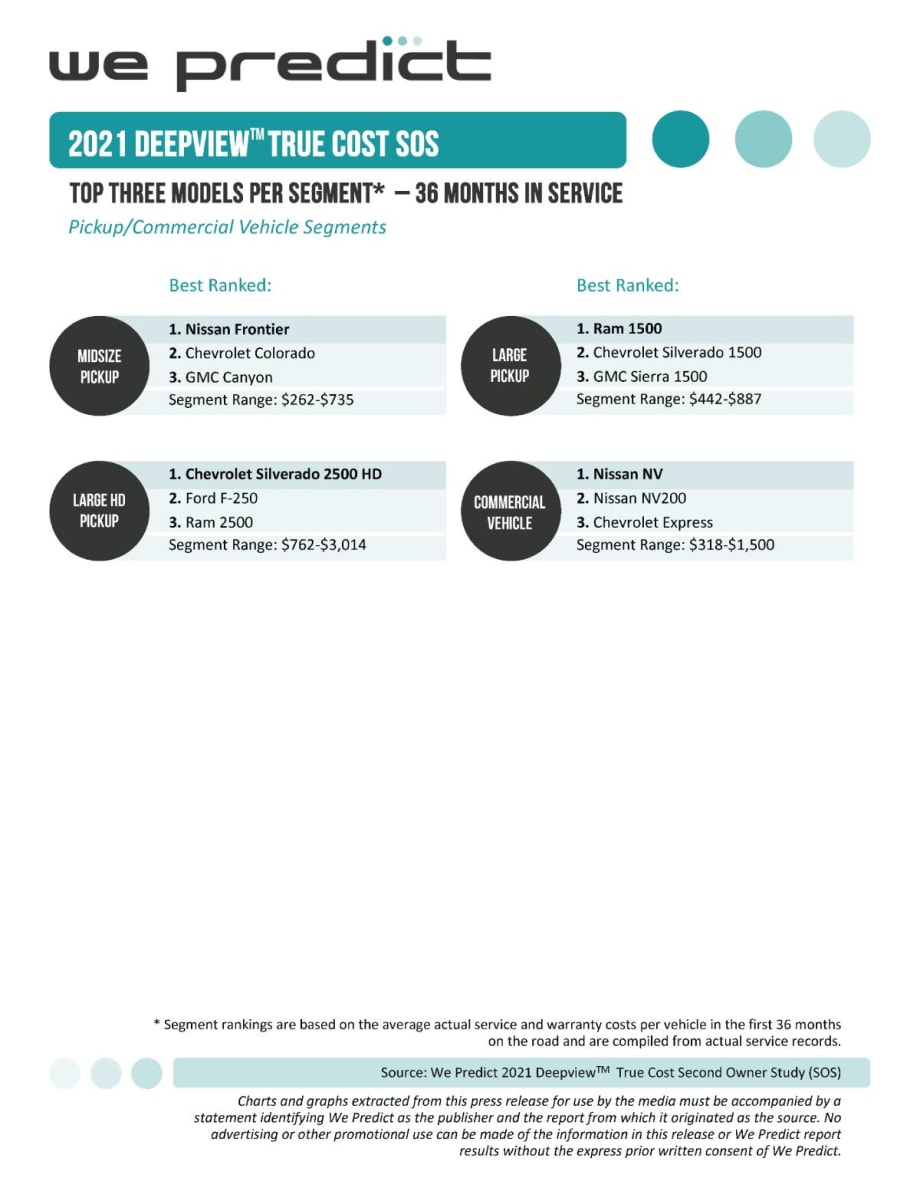
Average operatonal costs of leading commercial pickup truck and van brands after three years.
Chart: We Predict
4 min to read
Service costs for electric cars and light trucks fall to 30% lower than their gasoline-powered counterparts at three years on the road, according to the Deepview True Cost Second Owner Study (SOS) released Oct. 28 by predictive analytics and data company We Predict.
Deepview True Cost SOS measures actual money spent by owners and manufacturers of 2018-model-year vehicles during their first three years on the road. The study reveals which brands and models across 24 segments – including electric vehicles (EVs) – have the lowest average service costs at three years on the road. Deepview True Cost service costs are based on the total money spent by manufacturers and vehicle owners on repairs, maintenance, service campaigns, diagnostics, software updates, recalls, and warranty on factory-installed options.
“The data bears out what many hoped would be true,” We Predict Founder and CEO James Davies said in a news release summarizing the study. “While EV service costs are higher than their gas counterparts early in ownership, the cumulative service costs for EVs fall over time to 30% less than gas vehicles at three years on the road – primarily due to lower maintenance costs.”
At three months in service, EVs average service costs of $123; gas vehicles average $53. (EVs are 132% more)
At 1 year in service, EVs average $306 in service costs per vehicle; gas vehicles average $189. (EVs are 62% more)
At 36 months on the road, EV service costs average $514; gasoline vehicles average $749. (EVs are 31% less)
EVs have fewer mechanical parts than gasoline vehicles, contributing to 22% lower repair costs. The primary difference in cost, however, is maintenance. The average spent on maintenance per EV in the first three years is $77, significantly lower than the $228 average for gas vehicles.
“Consumers have high expectations for EVs in terms of cost of ownership,” said Renee Stephens, vice president of North American operations for We Predict. “While costs early in the ownership period are higher for EVs, they eventually become more economical – for both the owner and the manufacturer. Over time, less EV maintenance offsets the higher year-one costs for diagnosis, repair and campaigns.”
Vehicles Becoming More Costly to Service
Deepview True Cost data highlights trends that are seemingly at odds. Vehicle service costs are increasing even as industrywide vehicle quality continues to improve.
Deepview True Cost SOS reveals service costs for 2018-model-year vehicles average $731 in the first three years of service. That’s an 11% jump from 2016-model-year vehicles’ first three years on the road. The cost increase is seen across repairs (+4%), maintenance (+11%) and campaigns (+35%).
The increase is more pronounced among premium vehicles, where 2018-model-year vehicles recorded an 18% cost hike (since the 2016 model year) to $1,513 per vehicle. Non-premium vehicles recorded average service costs of $573 – a 4% increase – in the same period.
“New technologies and options tend to enter the market in premium vehicles, which means they are more costly to repair or replace,” Stephens said. “As the technologies and options move into non-premium segments, we anticipate service costs will increase for those vehicles, as well.”
The study finds that manufacturers are incurring slightly more of the burden for overall service expenses for 2018 vehicles, paying an average of $364 per vehicle, 11% more than they paid for 2016 vehicles. Meanwhile owners are spending an average of $309, just $1 more than what owners of 2016 vehicles paid during the first three years of ownership. The increased cost to manufacturers is due in large part to labor charges, which have increased to $199 per 2018 vehicle from $168 for 2016 vehicles. Campaign costs to manufacturers have also increased, rising to $105 per vehicle from $84.
“While manufacturers’ average service costs per vehicle may seem relatively small, cumulatively they add up very quickly when you consider the volume of vehicles sold per brand,” Davies said. “Having an industrywide view of the market and being able to anticipate problems, and intervene quickly, can help automakers avoid millions of dollars in repairs. Those savings can then be applied elsewhere in the company.”
About the We Predict Study
The study includes more than 13 million vehicles across 400 models, with results based on 65 million service or repair orders that totaled more than $7.7 billion in parts and $9.5 billion in labor costs. Included in the calculations are maintenance, unplanned repairs, warranty and recalls, service campaigns, diagnostics, software updates, and warranty on factory-installed options. Items such as gas, local and state inspections, seasonal tire changes, and insurance are not included.
We Predict released its first study, the Deepview True Cost Report, in May 2021. The initial study examined similar costs among 2021-model-year vehicles at three months in service.
Formed in 2009, We Predict uses machine learning and unique predictive methodologies to assist global blue-chip customers in anticipating and accelerating decisions on product, on market, as well as on financial performance. Data scientists, mathematicians, computer scientists, and industry experts work together with clients to explore and gain new insights into where a business is headed, creating the opportunity to course-correct with confidence.
Originally posted on Charged Fleet
More Small Fleet


Developing Budget-Friendly Driver Safety Programs
From driver training and safety meetings to one-on-one coaching and incentive programs, several small fleets share how they have developed a safety culture with their drivers using low- to no-cost resources.
Read More →
Sponsored•March 9, 2026
Boosting Last-Mile Fleet Uptime, Safety, and Value with AI Vehicle Inspections
AI-powered inspections are transforming last-mile fleets by replacing manual checks with highly accurate automated scans that detect defects in seconds. By giving fleet operations visibility into the daily condition of their vehicles, you can identify trends over the vehicle’s lifecycle that enable improved procurement decisions, route management, driver training and accountability.
Read More →
Five Ways Seat Belts Help Prevent Injuries
There are five ways seat belts protect occupants from injuries, according to the Tennessee Department of Safety and Homeland Security.
Read More →
Sponsored•January 14, 2026
It’s here: The 2026 Fleet Technology Trends Report
What does AI mean for fleets? Get the answer — and learn other top tech trends.
Read More →
Small Fleets, Big Impact: How Independent Drivers Power Wreaths Across America
Check out how small fleets and independent drivers power Wreaths Across America each December and why their impact matters more than ever.
Read More →
VMS Survey Finds 65% of Small Fleet Managers Run Operations Alone
A new VMS survey shows small fleet managers are stretched thin, with most handling operations solo and eager to adopt digital tools for relief.
Read More →
Tips for Driving Safely on Halloween Night
This video features a reminder from the Connecticut Department of Transportation (DOT) and the Connecticut Police Chiefs Association, urging drivers to prioritize safety this Halloween.
Read More →
AI, Access, and Uptime: VMS’s Next Chapter with David Prusinski
VMS’s new Co-CEO, David Prusinski, shares how an AI-first approach will give small fleets and repair shops the tools to compete like big players.
Read More →
Fleet Managers Share Winter Prep Tips: It's Never Too Early!
Three fleets share best practices to prep vehicles for winter and prevent downtime when the cold sets in.
Read More →