




Related: 'Cognitive Distraction' Means Hands-Free Cell Phones Aren't Any Safer
Driver Visual Awareness Slows During Conversations
Research from the University of Iowa finds that even a simple conversation creates an "attention disengagement" lag that affects a driver’s reaction time.
by Staff
June 7, 2017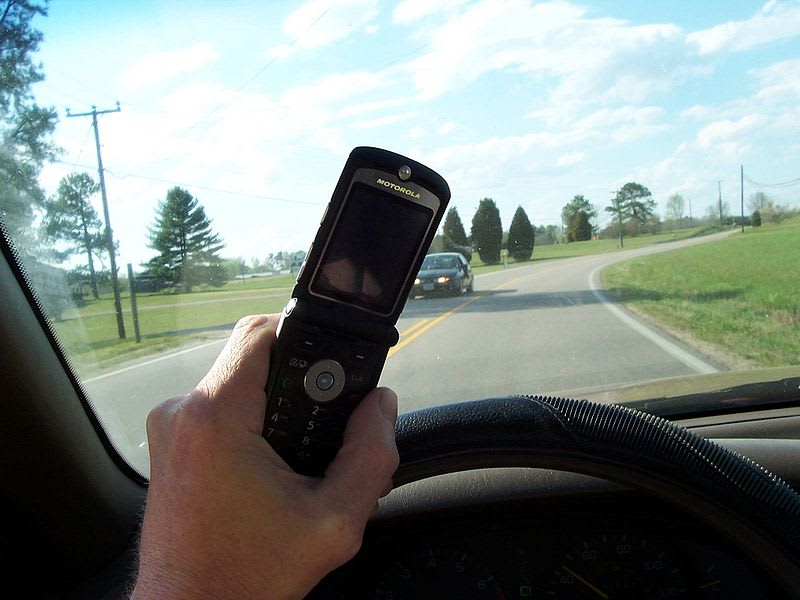
Photo by Ed Brown/Wikimedia Commons.
2 min to read
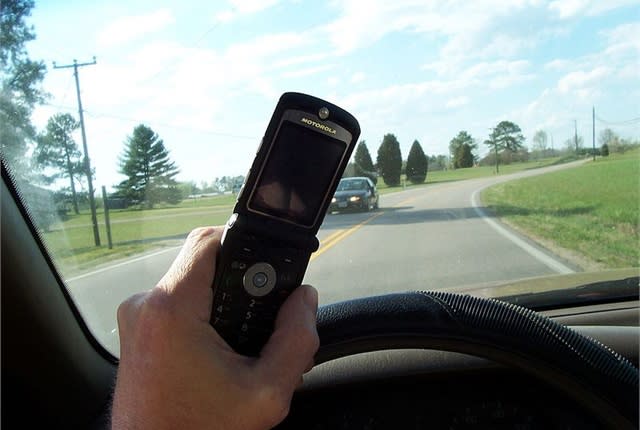
Photo by Ed Brown/Wikimedia Commons.
A new study from the University of Iowa concludes that drivers engaged in a conversation — either over the phone or with a passenger — are slower to recognize and respond to a new object in their field of view.
A conversation creates an “attention disengagement” lag, researchers found, which affects the driver’s ability to focus on the road ahead. The study was published online in the academic journal Psychonomic Bulletin and Review.
Researchers relied on computerized experiments that tracked the eye movements of test subjects while they were asked to answer true or false questions. Participants in the test took about twice as long to direct their eyes to a new object on the screen while answering the questions, compared to participants who weren’t asked any questions.
The experiments were designed to mimic a situation where a driver is having a conversation, either with someone on the phone or with a passenger, said Shaun Vecera, a professor in the University of Iowa Department of Psychological and Brain Sciences. Vecera was the research paper’s corresponding author.
The attention disengagement delay is about 40 milliseconds, or four-hundredths of a second. Though that doesn’t seem very long, the delay compounds. Each time the brain is distracted, the amount of time to disengage from one action and start another action gets longer, according to the study.
“It’s a snowball effect,” Vecera explained to Iowa Now, a website that focuses on University of Iowa news. “And that’s what contributes to the problem because eventually you’re oblivious to a lot that’s around you.”
When a driver is conversing with someone, his or her brain is taking in information, overlaying it with what’s already known, and then preparing to offer a thoughtful reply.
“Active listening delays the disengagement of attention, which must occur before attention can be moved to a new object or event,” Vecera said.
The study’s first author is Benjamin Lester, a University of Iowa graduate who majored in psychology. He is also a former post-doctoral research scholar at the university. The U.S. National Science Foundation and the Toyota Collaborative Safety Research Center funded the research.
In 2015, 3,477 people in the U.S. were killed and 391,000 were injured in motor vehicle crashes involving distracted drivers, according to the National Highway Traffic Safety Administration.
Originally posted on Automotive Fleet
More Small Fleet


Developing Budget-Friendly Driver Safety Programs
From driver training and safety meetings to one-on-one coaching and incentive programs, several small fleets share how they have developed a safety culture with their drivers using low- to no-cost resources.
Read More →
Sponsored•March 9, 2026
Boosting Last-Mile Fleet Uptime, Safety, and Value with AI Vehicle Inspections
AI-powered inspections are transforming last-mile fleets by replacing manual checks with highly accurate automated scans that detect defects in seconds. By giving fleet operations visibility into the daily condition of their vehicles, you can identify trends over the vehicle’s lifecycle that enable improved procurement decisions, route management, driver training and accountability.
Read More →
Five Ways Seat Belts Help Prevent Injuries
There are five ways seat belts protect occupants from injuries, according to the Tennessee Department of Safety and Homeland Security.
Read More →
Sponsored•January 14, 2026
It’s here: The 2026 Fleet Technology Trends Report
What does AI mean for fleets? Get the answer — and learn other top tech trends.
Read More →
Small Fleets, Big Impact: How Independent Drivers Power Wreaths Across America
Check out how small fleets and independent drivers power Wreaths Across America each December and why their impact matters more than ever.
Read More →
VMS Survey Finds 65% of Small Fleet Managers Run Operations Alone
A new VMS survey shows small fleet managers are stretched thin, with most handling operations solo and eager to adopt digital tools for relief.
Read More →
Tips for Driving Safely on Halloween Night
This video features a reminder from the Connecticut Department of Transportation (DOT) and the Connecticut Police Chiefs Association, urging drivers to prioritize safety this Halloween.
Read More →
AI, Access, and Uptime: VMS’s Next Chapter with David Prusinski
VMS’s new Co-CEO, David Prusinski, shares how an AI-first approach will give small fleets and repair shops the tools to compete like big players.
Read More →
Fleet Managers Share Winter Prep Tips: It's Never Too Early!
Three fleets share best practices to prep vehicles for winter and prevent downtime when the cold sets in.
Read More →