




Domino’s Testing Self-Driving Fusion Hybrid for Pizza Delivery
Researchers from Ford and Domino's will study how Ann Arbor, Mich., customers interact with the autonomous vehicle delivering their pizza order.
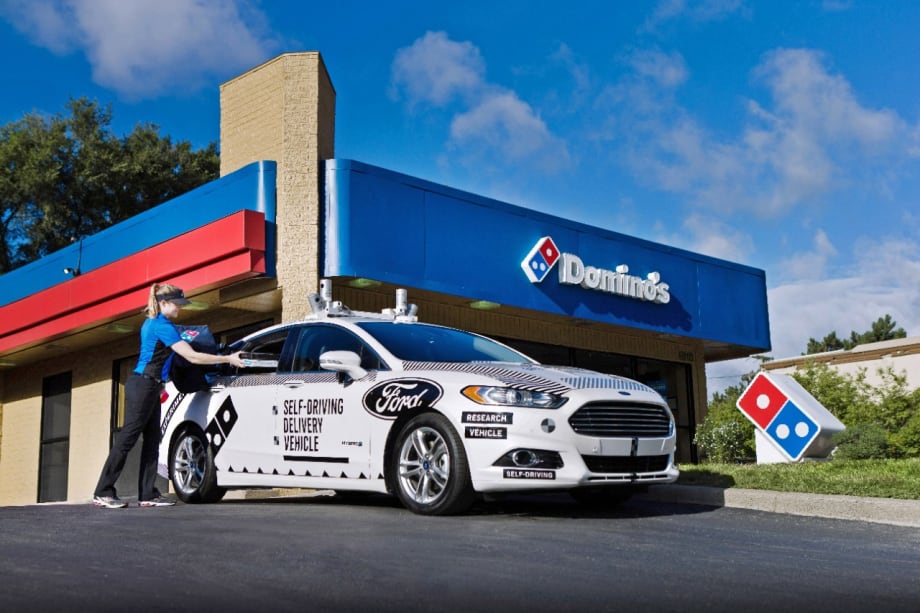
Randomly selected Domino's customers in Ann Arbor, Mich., will have the opportunity to receive their pizza order from a Ford Fusion Hybrid autonomous research vehicle. Photo courtesy of Ford.
Randomly selected Domino's customers in Ann Arbor, Mich., will have the opportunity to receive their pizza order from a Ford Fusion Hybrid autonomous research vehicle. Photo courtesy of Ford.
Domino’s Pizza is teaming with Ford Motor Co. on a research project aimed at understanding the role that self-driving vehicles can play in future pizza delivery, according to Ford.
Over the next several weeks, randomly selected Domino’s customers in Ann Arbor, Mich., will have the chance to receive their pizza order from a Ford Fusion Hybrid autonomous research vehicle. A Ford safety engineer, however, will be behind the wheel and other researchers will be on hand. Researchers from both companies will monitor customer reactions to interacting with a self-driving car as part of their delivery experience, Ford said in a released statement.
“As delivery experts, we’ve been watching the development of self-driving vehicles with great interest as we believe transportation is undergoing fundamental, dramatic change,” said Patrick Doyle, Domino’s president and CEO. “We pride ourselves on being technology leaders and are excited to help lead research into how self-driving vehicles may play a role in the future of pizza delivery. This is the first step in an ongoing process of testing that we plan to undertake with Ford.”
Research with companies like Domino’s will be crucial to ensuring that the technology is applied in ways that enhance the customer experience, Ford said. With a plan to begin production of self-driving vehicles in 2021, Ford is taking steps to design a business that meet the needs of both partner companies and their customers.
“As we increase our understanding of the business opportunity for self-driving vehicles to support the movement of people and goods, we’re pleased to have Domino’s join us in this important part of the development process,” said Sherif Marakby, Ford vice president of autonomous and electric vehicles.
Domino’s customers who agree to participate in the project will be able to track the delivery vehicle through GPS using an upgraded version of Domino’s Tracker. They will also receive text messages as the self-driving vehicle approaches, guiding them on how to retrieve their pizza using a unique code to unlock the Domino’s Heatwave Compartment inside the vehicle.
“We’re interested to learn what people think about this type of delivery,” said Russell Weiner, president of Domino’s USA. “The majority of our questions are about the last 50 feet of the delivery experience. For instance, how will customers react to coming outside to get their food? We need to make sure the interface is clear and simple. We need to understand if a customer’s experience is different if the car is parked in the driveway versus next to the curb. All of our testing research is focused on our goal to someday make deliveries with self-driving vehicles as seamless and customer-friendly as possible.”
Roush Enterprises fabricated the prototype vehicle’s pizza container, based on its experience working with Domino’s on the DXP delivery vehicle in 2015. Ford and Domino’s completed preliminary testing of the delivery process using the vehicle in self-driving mode at Mcity, the simulated urban environment on the University of Michigan’s campus.
Originally posted on Automotive Fleet
More Small Fleet


Developing Budget-Friendly Driver Safety Programs
From driver training and safety meetings to one-on-one coaching and incentive programs, several small fleets share how they have developed a safety culture with their drivers using low- to no-cost resources.
Read More →
Boosting Last-Mile Fleet Uptime, Safety, and Value with AI Vehicle Inspections
AI-powered inspections are transforming last-mile fleets by replacing manual checks with highly accurate automated scans that detect defects in seconds. By giving fleet operations visibility into the daily condition of their vehicles, you can identify trends over the vehicle’s lifecycle that enable improved procurement decisions, route management, driver training and accountability.
Read More →
Five Ways Seat Belts Help Prevent Injuries
There are five ways seat belts protect occupants from injuries, according to the Tennessee Department of Safety and Homeland Security.
Read More →
It’s here: The 2026 Fleet Technology Trends Report
What does AI mean for fleets? Get the answer — and learn other top tech trends.
Read More →
Small Fleets, Big Impact: How Independent Drivers Power Wreaths Across America
Check out how small fleets and independent drivers power Wreaths Across America each December and why their impact matters more than ever.
Read More →
VMS Survey Finds 65% of Small Fleet Managers Run Operations Alone
A new VMS survey shows small fleet managers are stretched thin, with most handling operations solo and eager to adopt digital tools for relief.
Read More →
Tips for Driving Safely on Halloween Night
This video features a reminder from the Connecticut Department of Transportation (DOT) and the Connecticut Police Chiefs Association, urging drivers to prioritize safety this Halloween.
Read More →
AI, Access, and Uptime: VMS’s Next Chapter with David Prusinski
VMS’s new Co-CEO, David Prusinski, shares how an AI-first approach will give small fleets and repair shops the tools to compete like big players.
Read More →
Fleet Managers Share Winter Prep Tips: It's Never Too Early!
Three fleets share best practices to prep vehicles for winter and prevent downtime when the cold sets in.
Read More →