




Changing to Low-Viscosity Oil Can Save Fleets Up to 5% In Fuel Costs
Royal Purple explains what oil viscosity is and why zero-weight oils help to drive new vehicle fuel economies.

Photo courtesy of Royal Purple Inc.
Royal Purple's 0W-20 synthetic oil optimizes engine performance, increases fuel efficiency and provides superior wear protection and corrosion resistance over mineral based competitors.
Manufacturers such as Toyota and Honda are building new vehicle models that now specify using zero-weight motor oil rather than the heavier 10W-30 oil. Changing to a thinner, lighter oil viscosity like 0W-20 can mean better fuel efficiency and increased savings for consumers, according to synthetic oil manufacturer Royal Purple.
Zero-Weight Motor Oil
Zero-weight motor oils are formulated to be able to lubricate the internal structures of the engine more freely, helping to extend engine life and deliver maximum fuel economy because the engine doesn't have to work as hard to move the oil around. These low viscosity oils also provide protection in low temperatures, uniform lubrication, reduced friction and help make the engine produce more power over heavier-weight oils.
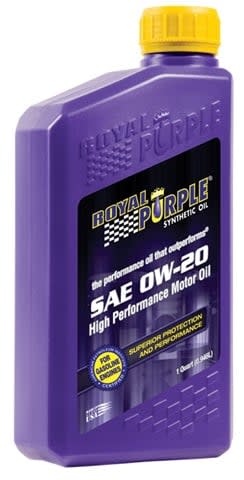
Photo courtesy of Royal Purple Inc.
Royal Purple's 0W-20 synthetic oil optimizes engine performance, increases fuel efficiency and provides superior wear protection and corrosion resistance over mineral based competitors.
According to Royal Purple, use of a synthetic oil helps conserve natural resources and can save consumers money because oil change intervals increase by as much as 5,000 miles compared to use of conventional mineral-based low viscosity oils. Between extended service intervals and fuel economy improvements, drivers may see up to a 5% improvement in fuel and maintenance costs.
0W-20 Motor Oil
To meet manufacturer and consumer demand for zero-weight viscosity oil in today’s vehicles, Royal Purple recently developed its fully-synthetic 0W-20 motor oil. Royal Purple’s low viscosity synthetic oil provides added defense against wear, maximum corrosion and extended emissions protection, optimized fuel economy, as well as increased ethanol compatibility for today's flex-fuel vehicles and automobiles running on seasonally blended gasolines.
What is Viscosity?
Viscosity is a liquid’s thickness and/or resistance to flow. In general terms, one would say molasses has a higher viscosity than honey, just as 10W-30 oil has a higher viscosity than 0W-20 oil.
To articulate this further, as you can see from the comparative viscosity chart below, water at 70 degrees Fahrenheit has an approximate viscosity of 1. Honey has a viscosity in the range of 2,000–3,000. The Society of Automotive Engineers (SAE) assists in setting the standards for motor oil performance in the United States and also set the standards for which motor oil viscosity is measured.

There are three components to a viscosity number to remember when reading an oil container. Using the 0W-20 reading as an example, the first part of the number, “10”, is an indication of how well oil flows in cold temperatures. The motor oil performs at the first number until the engine is at full operating temperature, allowing the oil to cover the operating regions of the engine, pushing toward the smaller areas. The letter “W” stands for “winter” weights. The last number, “20” which is the most important, reflects the viscosity grade of the oil at operating temperatures. The smaller the last number is the lower the viscosity when the engine is warm.
In addition to its new 0W-20 synthetic motor oil, Royal Purple manufactures a complete line of other weight oils and oil filters for a variety performance, street, marine and industrial applications. A full product catalog is available by accessing Royal Purple's website at www.royalpurple.com/rp-products.
More Small Fleet


Developing Budget-Friendly Driver Safety Programs
From driver training and safety meetings to one-on-one coaching and incentive programs, several small fleets share how they have developed a safety culture with their drivers using low- to no-cost resources.
Read More →
Boosting Last-Mile Fleet Uptime, Safety, and Value with AI Vehicle Inspections
AI-powered inspections are transforming last-mile fleets by replacing manual checks with highly accurate automated scans that detect defects in seconds. By giving fleet operations visibility into the daily condition of their vehicles, you can identify trends over the vehicle’s lifecycle that enable improved procurement decisions, route management, driver training and accountability.
Read More →
Five Ways Seat Belts Help Prevent Injuries
There are five ways seat belts protect occupants from injuries, according to the Tennessee Department of Safety and Homeland Security.
Read More →
It’s here: The 2026 Fleet Technology Trends Report
What does AI mean for fleets? Get the answer — and learn other top tech trends.
Read More →
Small Fleets, Big Impact: How Independent Drivers Power Wreaths Across America
Check out how small fleets and independent drivers power Wreaths Across America each December and why their impact matters more than ever.
Read More →
VMS Survey Finds 65% of Small Fleet Managers Run Operations Alone
A new VMS survey shows small fleet managers are stretched thin, with most handling operations solo and eager to adopt digital tools for relief.
Read More →
Tips for Driving Safely on Halloween Night
This video features a reminder from the Connecticut Department of Transportation (DOT) and the Connecticut Police Chiefs Association, urging drivers to prioritize safety this Halloween.
Read More →
AI, Access, and Uptime: VMS’s Next Chapter with David Prusinski
VMS’s new Co-CEO, David Prusinski, shares how an AI-first approach will give small fleets and repair shops the tools to compete like big players.
Read More →
Fleet Managers Share Winter Prep Tips: It's Never Too Early!
Three fleets share best practices to prep vehicles for winter and prevent downtime when the cold sets in.
Read More →