





Related news: BMW Group Increases Sourcing of Lithium Battery Cells
BMW Starts E-Drivetrain Production for iX and i4 EVs
BMW Group is expanding it manufacturing capacity to make electric drivetrains for 500,000 electrified vehicles per year from 2022 and start producing fifth-generation high-voltage batteries.
May 27, 2021
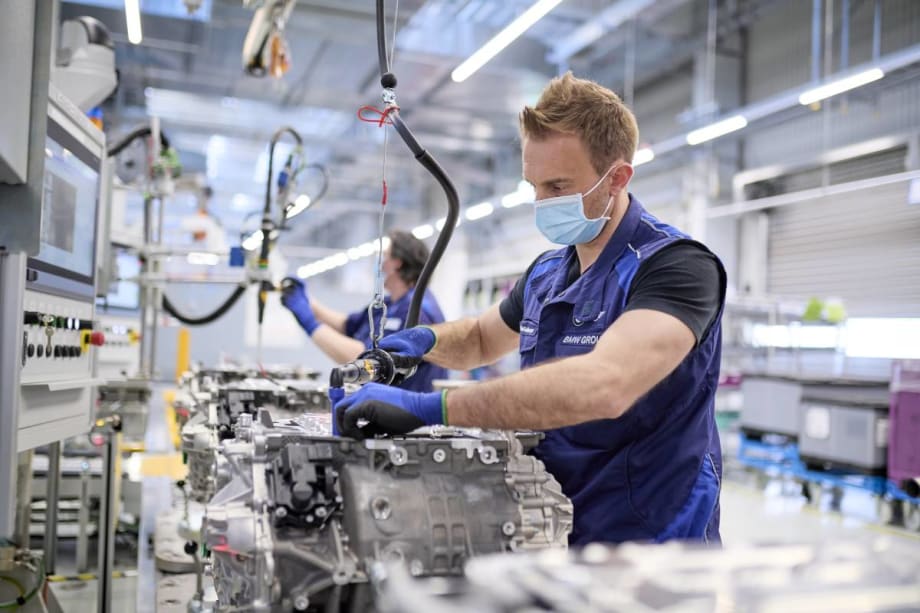
BMW Group is expanding its manufacturing capacity at the Competence Centre for E-Drive Production in Dingolfing, Germany.
Photo: BMW Group
4 min to read
BMW Group is producing fifth-generation high-voltage batteries and battery modules for use in the BMW iX and BMW i4 at its Competence Centre for E-Drive Production in Dingolfing.
Meanwhile, BMW is increasing production capacity for its fifth-generation electric motor, which has been built in Dingolfing for the BMW iX3 since 2020 and will power the BMW iX and BMW i4, the company reported May 26 in a press release.
“We expect at least 50% of the vehicles we deliver to our customers worldwide to be electrified by 2030," said Dr. Michael Nikolaides, senior vice president of production engines and e-drives for BMW Group. "To achieve this, we are relying on our extensive in-house drive train expertise: We are increasing capacity at existing drive train production locations – like here in Dingolfing – and developing capabilities at others – like recently in Regensburg and Leipzig.”
The BMW Group is investing more than $610 million in expanding production capacity for e-drives at its Dingolfing location alone between 2020 and 2022. From 2022, it will produce e-drives for more than half a million electrified vehicles. The BMW Group will invest a total of around $964 million in expanding capacity for electric powertrain components at its Dingolfing, Leipzig, Regensburg and Steyr locations between 2020 and 2022.
Standard production of the BMW iX will soon get underway at BMW Group Plant Dingolfing, followed by production of the BMW i4 at Plant Munich in the autumn. The highly integrated e-drives and high-voltage batteries for these vehicles will all be manufactured at the Competence Centre for E-Drive Production in Dingolfing. The BMW Group already began producing battery components at Plants Regensburg and Leipzig in April and May 2021. In line with growing demand for e-drives, BMW Group Plants Landshut and Steyr are also stepping up production of e-drive housings.
Production of Fifth-Generation BMW eDrive Technology
The output and energy content of drive units and high-voltage batteries with fifth-generation BMW eDrive technology can be flexibly scaled. This means they can be optimally adjusted to suit different model variants.
Each vehicle uses up to two highly integrated e-drives, which combine the electric motor, power electronics and transmission in a single housing. Based on the design principle of a current-excited rotor, the fifth-generation e-drive does not require any materials classified as rare-earth metals.
BMW eDrive technology also comprises a high-voltage battery with state-of-the-art battery cell technology. The BMW Group agreed with its suppliers that they will only use renewable green power for producing fifth-generation battery cells. The entire high-voltage battery boasts outstanding qualities in the areas of performance, charging and discharging characteristics, durability and safety. The technically standardized production process for battery modules has been further developed in such a way that different module variants can be produced on the same production line – in line with the growing range of electrified vehicle models and performance levels.
The production systems are highly flexible and scalable. Battery modules are produced from supplied prismatic battery cells at the respective BMW Group production location. A modular system developed in-house allows model-specific high-voltage batteries to be manufactured from these modules in a flexible arrangement.
The company has expertise and experience, both in the field of battery cell technology and in production of model-specific high-voltage batteries. The BMW Group conducts basic research in the fields of cell chemistry and cell design at its own Battery Cell Competence Centre. The BMW Group also produces battery cell prototypes itself. These battery cell prototypes are used in tests to validate the development maturity of battery cells and to demonstrate the effectiveness of the production processes.
In addition, the prototype production of the battery cells identifies process potentials and maximum usage of the production processes. In this way, the BMW Group gains a thorough understanding of the entire battery cell value chain and the decisive competitive advantages its chemical and technical properties offer. This enables battery cells to be manufactured to precise specifications geared towards each vehicle’s individual requirements.
2030: 50% of BMW Group Sales to be Fully Electric
The BMW Group continues to ramp up its electromobility: The company will offer five fully-electric models by the end of this year: the BMW i3, the MINI Cooper SE and the BMW iX3, as well as the two main innovation flagships, the BMW iX, and BMW i4.
Between now and 2025, the BMW Group will increase its sales of fully-electric models by an average of well over 50% per year – more than 10 times the number of units sold in 2020. Based on its current market forecast, the company also expects at least 50% of its global sales to come from fully-electric vehicles in 2030. In total, over the next 10 years or so, the BMW Group will be releasing about 10 million fully-electric vehicles onto the roads.
Originally posted on Charged Fleet
More Small Fleet


Developing Budget-Friendly Driver Safety Programs
From driver training and safety meetings to one-on-one coaching and incentive programs, several small fleets share how they have developed a safety culture with their drivers using low- to no-cost resources.
Read More →
Sponsored•March 9, 2026
Boosting Last-Mile Fleet Uptime, Safety, and Value with AI Vehicle Inspections
AI-powered inspections are transforming last-mile fleets by replacing manual checks with highly accurate automated scans that detect defects in seconds. By giving fleet operations visibility into the daily condition of their vehicles, you can identify trends over the vehicle’s lifecycle that enable improved procurement decisions, route management, driver training and accountability.
Read More →
Five Ways Seat Belts Help Prevent Injuries
There are five ways seat belts protect occupants from injuries, according to the Tennessee Department of Safety and Homeland Security.
Read More →
Sponsored•January 14, 2026
It’s here: The 2026 Fleet Technology Trends Report
What does AI mean for fleets? Get the answer — and learn other top tech trends.
Read More →
Small Fleets, Big Impact: How Independent Drivers Power Wreaths Across America
Check out how small fleets and independent drivers power Wreaths Across America each December and why their impact matters more than ever.
Read More →
VMS Survey Finds 65% of Small Fleet Managers Run Operations Alone
A new VMS survey shows small fleet managers are stretched thin, with most handling operations solo and eager to adopt digital tools for relief.
Read More →
Tips for Driving Safely on Halloween Night
This video features a reminder from the Connecticut Department of Transportation (DOT) and the Connecticut Police Chiefs Association, urging drivers to prioritize safety this Halloween.
Read More →
AI, Access, and Uptime: VMS’s Next Chapter with David Prusinski
VMS’s new Co-CEO, David Prusinski, shares how an AI-first approach will give small fleets and repair shops the tools to compete like big players.
Read More →
Fleet Managers Share Winter Prep Tips: It's Never Too Early!
Three fleets share best practices to prep vehicles for winter and prevent downtime when the cold sets in.
Read More →