




43% of Americans Admit to Risk-Raising Fatigue
A new National Safety Council Study also finds that 97% of Americans acknowledge having at least one of the nine main risk factors for fatigue.


Photo: National Safety Council
A new study from the National Safety Council concludes that 43% of Americans admit they don’t get enough sleep to mitigate safety risks at work and on the road, acknowledging that fatigue diminishes their ability to think clearly and make informed decisions.
The research project’s survey found that 97% of Americans have at least one of the nine biggest risk factors for fatigue. These factors include shift work (night, early-morning, rotating or irregular shifts), high-risk hours (even occasionally working at night or in the early morning), having a job that’s cognitively or physically demanding, long shifts (10 hours or more), long weeks (50 hours or more), sleep loss (less than seven hours a day), no rest breaks, quick shift returns (less than 12 hours between shifts), and long commutes.
A total of 76% of Americans say they feel tired at work, 53% feel less productive, and 44% have trouble focusing, the report notes. A total of 16% admit to having nodded off on the road in the previous month.
“These findings are a literal wake-up call,” said Deborah A.P. Hersman, president and CEO of the National Safety Council. “When we’re tired, we can put ourselves and others at risk. We hope Americans recognize that impairment stems not just from alcohol and drugs, but lack of restorative rest. Fitness for duty starts with getting a good night’s sleep.”
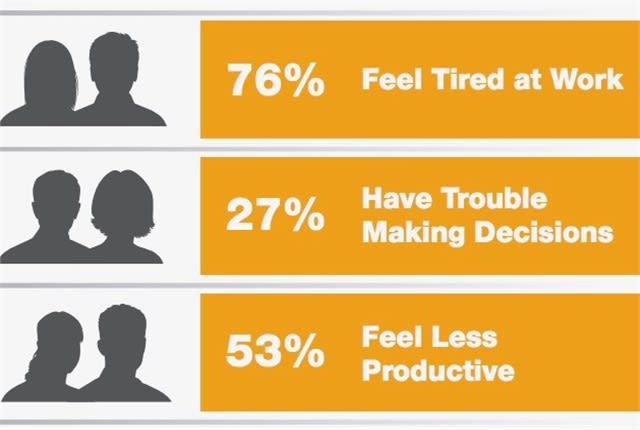
Graphic courtesy of the National Safety Council.
The survey — the entirety of which will be released in three separate reports — also found:
41% work high-risk hours, at least occasionally.
39% have trouble remembering things at work because of fatigue.
31% commute 30 minutes or more, which exacerbates the chances of falling asleep behind the wheel.
27% have trouble making decisions because of fatigue.
10% don’t get regular rest breaks.
There are also geographical trends when it comes to the number of Americans with fatigue risk factors. The National Safety Council survey identified that the South has the highest mean number of risk factors at 3.21, while the Midwest has the lowest with 2.94 risk factors.
Originally posted on Automotive Fleet
More Small Fleet


Developing Budget-Friendly Driver Safety Programs
From driver training and safety meetings to one-on-one coaching and incentive programs, several small fleets share how they have developed a safety culture with their drivers using low- to no-cost resources.
Read More →
Boosting Last-Mile Fleet Uptime, Safety, and Value with AI Vehicle Inspections
AI-powered inspections are transforming last-mile fleets by replacing manual checks with highly accurate automated scans that detect defects in seconds. By giving fleet operations visibility into the daily condition of their vehicles, you can identify trends over the vehicle’s lifecycle that enable improved procurement decisions, route management, driver training and accountability.
Read More →
Five Ways Seat Belts Help Prevent Injuries
There are five ways seat belts protect occupants from injuries, according to the Tennessee Department of Safety and Homeland Security.
Read More →
It’s here: The 2026 Fleet Technology Trends Report
What does AI mean for fleets? Get the answer — and learn other top tech trends.
Read More →
Small Fleets, Big Impact: How Independent Drivers Power Wreaths Across America
Check out how small fleets and independent drivers power Wreaths Across America each December and why their impact matters more than ever.
Read More →
VMS Survey Finds 65% of Small Fleet Managers Run Operations Alone
A new VMS survey shows small fleet managers are stretched thin, with most handling operations solo and eager to adopt digital tools for relief.
Read More →
Tips for Driving Safely on Halloween Night
This video features a reminder from the Connecticut Department of Transportation (DOT) and the Connecticut Police Chiefs Association, urging drivers to prioritize safety this Halloween.
Read More →
AI, Access, and Uptime: VMS’s Next Chapter with David Prusinski
VMS’s new Co-CEO, David Prusinski, shares how an AI-first approach will give small fleets and repair shops the tools to compete like big players.
Read More →
Fleet Managers Share Winter Prep Tips: It's Never Too Early!
Three fleets share best practices to prep vehicles for winter and prevent downtime when the cold sets in.
Read More →