




2014 Honda Accord PHEV 1st to Meet California’s Strictest Emissions Standard
This makes the Honda Accord Plug-in Hybrid the first gasoline-powered car in California to meet what is known as the SULEV20 standard, the most stringent in the nation.
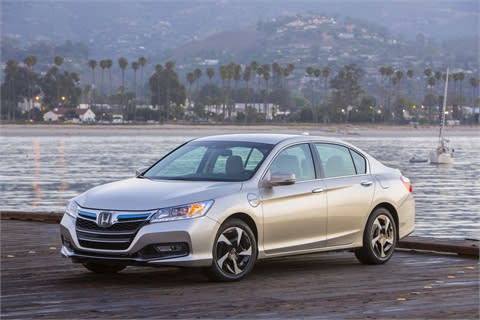
The 2014-MY Honda Accord Plug-in Hybrid.
The 2014-MY Honda Accord Plug-in Hybrid.
The California Air Resources Board (ARB) has approved the first car for sale in California that meets ARB’s most stringent smog-emission standard to date.
The 2014 Honda Plug-In Hybrid Accord produces only 20 milligrams of combined smog-forming emissions per mile. This makes it the first gasoline-powered car in California to meet what is known as the SULEV20 standard, the most stringent in the nation and one-third cleaner (in terms of smog-forming pollution) than the previous lowest state standard.
In addition, this Honda model has lower greenhouse gas emissions (GGEs) than the fleet average standard required by all cars in 2025, the equivalent of a 50% reduction from current required levels, according to the automaker.
The Executive Order allowing Honda to sell the newly certified ultra-clean cars in California was signed on Dec. 21, 2012, following a detailed examination of emissions and performance test results. Honda began production of the car that same day.
The full-size sedan model achieves 124 MPGe city/105 MPGe highway in hybrid mode, and 47 MPG city/46 MPG highway in standard (gas only) mode.
The low-emissions standards that this Honda model meets are part of the state’s Advanced Clean Cars package of regulations, adopted in January 2012, that will ensure increasingly cleaner cars for sale in the state, and provide for increased choices of zero-emission vehicles.
When fully in force in 2025, the new set of standards is expected to reduce smog-causing pollutants from low-emission vehicles 75% from current levels and greenhouse gases by 34%.
More Small Fleet


Developing Budget-Friendly Driver Safety Programs
From driver training and safety meetings to one-on-one coaching and incentive programs, several small fleets share how they have developed a safety culture with their drivers using low- to no-cost resources.
Read More →
Boosting Last-Mile Fleet Uptime, Safety, and Value with AI Vehicle Inspections
AI-powered inspections are transforming last-mile fleets by replacing manual checks with highly accurate automated scans that detect defects in seconds. By giving fleet operations visibility into the daily condition of their vehicles, you can identify trends over the vehicle’s lifecycle that enable improved procurement decisions, route management, driver training and accountability.
Read More →
Five Ways Seat Belts Help Prevent Injuries
There are five ways seat belts protect occupants from injuries, according to the Tennessee Department of Safety and Homeland Security.
Read More →
It’s here: The 2026 Fleet Technology Trends Report
What does AI mean for fleets? Get the answer — and learn other top tech trends.
Read More →
Small Fleets, Big Impact: How Independent Drivers Power Wreaths Across America
Check out how small fleets and independent drivers power Wreaths Across America each December and why their impact matters more than ever.
Read More →
VMS Survey Finds 65% of Small Fleet Managers Run Operations Alone
A new VMS survey shows small fleet managers are stretched thin, with most handling operations solo and eager to adopt digital tools for relief.
Read More →
Tips for Driving Safely on Halloween Night
This video features a reminder from the Connecticut Department of Transportation (DOT) and the Connecticut Police Chiefs Association, urging drivers to prioritize safety this Halloween.
Read More →
AI, Access, and Uptime: VMS’s Next Chapter with David Prusinski
VMS’s new Co-CEO, David Prusinski, shares how an AI-first approach will give small fleets and repair shops the tools to compete like big players.
Read More →
Fleet Managers Share Winter Prep Tips: It's Never Too Early!
Three fleets share best practices to prep vehicles for winter and prevent downtime when the cold sets in.
Read More →