




10 States Draw Top Scores for Traffic Safety Laws
A new report from Advocates for Highway and Auto Safety recommends 15 traffic safety laws and scores all 50 states based primarily on how many of these laws they've already adopted.
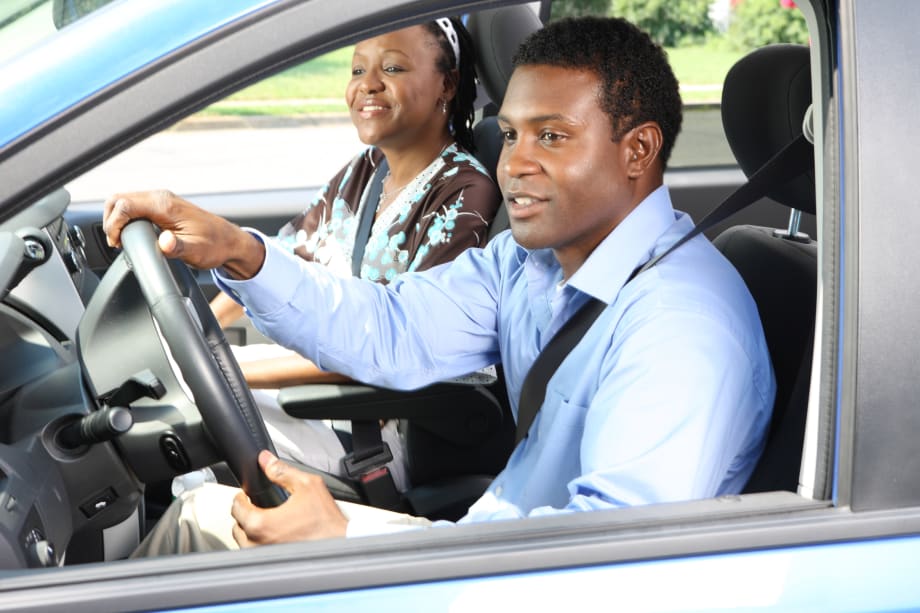
All states except New Hampshire have a seat belt law, but only 34 states and Washington, D.C., allow primary enforcement of their seat belt laws. Photo courtesy of NHTSA.

All states except New Hampshire have a seat belt law, but only 34 states and Washington, D.C., allow primary enforcement of their seat belt laws. Photo courtesy of NHTSA.
Ten states and Washington, D.C., have drawn top safety scores — "green" overall ratings — from Advocates for Highway and Auto Safety in recognition of enactment of certain traffic safety laws.
The national safety advocacy group released a new report that argues for universal adoption of 15 traffic safety laws. The report also evaluated all 50 states based on how many of those laws they've already adopted. The 10 states that came out on top were California, Delaware, Hawaii, Illinois, Indiana, Louisiana, Maine, Oregon, Rhode Island and Washington.
The nine states that scored the lowest, drawing a "red" overall rating, were Arizona, Florida, Iowa, Mississippi, Montana, Nebraska, North Dakota, South Dakota and Wyoming.
The remaining 31 states received a "yellow" rating, showing "moderately positive performance" but still having a number of gaps in their highway safety laws, according to Advocates for Highway and Auto Safety.
The 15 recommended laws include a primary-enforcement front seat belt law, a primary-enforcement rear seat belt law, an all-rider motorcycle helmet law, a booster seat law, a law setting a minimum age of 16 for a learner's permit (learner's stage), a law setting a six-month holding period during which the teen driver must be supervised by an adult licensed driver at all times (learner's stage), a law requiring 30-50 hours of supervised driving for teens (learner's stage), and a nighttime driving restriction for unsupervised teen drivers (intermediate stage).
Other recommended laws include limits for the number of teenage passengers who may legally ride with a teen driver without adult supervision (intermediate stage), a law prohibiting all use of cellular devices by beginning teen drivers (except in the case of an emergency), a law prohibiting teen drivers from obtaining an unrestricted license until age 18, a law mandating installation of ignition interlock devices for all convicted drunk driving offenders, a child endangerment law, an open container law and an all-driver text messaging restriction.
The report includes specific requirements for all 15 laws. And some laws are given special status when the group scores states. No state without a primary-enforcement seat belt law covering both front and rear seats is eligible for the advocacy group's green overall rating, no matter how many other laws it has in effect.
Also, a state is ineligible for the green overall rating if it has repealed an existing all-rider motorcycle helmet law within the previous 10 years.
The report’s introduction sharply criticized some recent state legislative efforts to relax or repeal safe driving laws already on the books.
“Last year, there were several state legislatures where bills were seriously considered to repeal or weaken laws for seatbelt and motorcycle helmet use, bans on texting while driving, as well as essential protections for novice teen drivers,” noted Jacqueline S. Gillan, president of Advocates for Highway and Auto Safety. “These efforts confound logic, commonsense and fiscal responsibility.”
But Gillan commended elected officials in Kentucky, Mississippi, Oklahoma, Texas, Utah and West Virginia for enacting safety laws meeting the group’s criteria in 2015.
To download the report, click here.
Originally posted on Automotive Fleet
More Small Fleet


Developing Budget-Friendly Driver Safety Programs
From driver training and safety meetings to one-on-one coaching and incentive programs, several small fleets share how they have developed a safety culture with their drivers using low- to no-cost resources.
Read More →
Boosting Last-Mile Fleet Uptime, Safety, and Value with AI Vehicle Inspections
AI-powered inspections are transforming last-mile fleets by replacing manual checks with highly accurate automated scans that detect defects in seconds. By giving fleet operations visibility into the daily condition of their vehicles, you can identify trends over the vehicle’s lifecycle that enable improved procurement decisions, route management, driver training and accountability.
Read More →
Five Ways Seat Belts Help Prevent Injuries
There are five ways seat belts protect occupants from injuries, according to the Tennessee Department of Safety and Homeland Security.
Read More →
It’s here: The 2026 Fleet Technology Trends Report
What does AI mean for fleets? Get the answer — and learn other top tech trends.
Read More →
Small Fleets, Big Impact: How Independent Drivers Power Wreaths Across America
Check out how small fleets and independent drivers power Wreaths Across America each December and why their impact matters more than ever.
Read More →
VMS Survey Finds 65% of Small Fleet Managers Run Operations Alone
A new VMS survey shows small fleet managers are stretched thin, with most handling operations solo and eager to adopt digital tools for relief.
Read More →
Tips for Driving Safely on Halloween Night
This video features a reminder from the Connecticut Department of Transportation (DOT) and the Connecticut Police Chiefs Association, urging drivers to prioritize safety this Halloween.
Read More →
AI, Access, and Uptime: VMS’s Next Chapter with David Prusinski
VMS’s new Co-CEO, David Prusinski, shares how an AI-first approach will give small fleets and repair shops the tools to compete like big players.
Read More →
Fleet Managers Share Winter Prep Tips: It's Never Too Early!
Three fleets share best practices to prep vehicles for winter and prevent downtime when the cold sets in.
Read More →