




Workforce Pressures Pushed Fleets to Rethink Talent, Training, and Support in 2025 [Part 6]
With tech shortages, yard gaps, and driver turnover rising in 2025, fleets rebuilt their workforce strategy around support, culture, and smarter tools.


Fleets spent 2025 strengthening their frontline teams, investing in better tools, safer work environments, and the support workers need to stay on the job.
Photo: Work Truck
Labor has been a challenge in work truck and commercial fleets for years, but 2025 brought a new level of urgency. Technician shortages, driver turnover, yard staffing issues, and rising expectations from frontline workers all hit at once.
Light- and medium-duty fleets couldn’t simply recruit their way out of it. They had to rethink how they supported people, how they structured work, and how they used technology to fill gaps when people weren’t available.
The result was a year in which workforce strategy became fleet strategy.
Yard Operations Exposed Long-Standing Labor Gaps
Matt Yearling, CEO of YMX Logistics, said the yard became a critical labor pressure point. High turnover and shallow staffing pools left operators struggling to keep dock schedules tight and keep trucks moving.
Yearling explained that for years, spotting, shuttling, and gate management roles were treated as cost centers and often outsourced with little oversight. But by 2025, companies realized this model created deeper problems: idle assets, stalled trailers, uneven safety practices, and bottlenecks that spilled over into the warehouse or production floor.
As pressure mounted, fleets and facilities turned to better tools, more structured processes, and predictive analytics to help reduce the reliance on manual intervention. Culture, tools, and worker support mattered just as much as wages in keeping experienced yard drivers on the job.
Driver Behavior Became a Coaching Conversation Instead of a Disciplinary One
Driver safety remained a top concern, but the tone shifted in 2025. Tim Mundahl, director of fleet consulting at Merchants Fleet, said fleets put more emphasis on coaching instead of reacting after the fact.
“Driver behavior impacts all areas of fleet management,” Mundahl said, noting how behavior influences net depreciation, fuel efficiency, maintenance needs, and most importantly, driver safety. Data from connected vehicles helped managers focus on course corrections and positive reinforcement instead of punitive conversations.
That shift helped fleets reduce churn by keeping coaching supportive and constructive instead of confrontational.
Driver’s also face a constantly shifting risk profile.
"The 2025 data shows increasing congestion, adverse weather, work zones, and fatigue. This has prompted fleets to seek solutions that better identify and mitigate these factors,” said Brendon Hill, senior vice president of product at Lytx. "Using data to spot patterns, such as more near misses or signs of fatigue, helped managers step in sooner and work with drivers constructively. When managers looked at the bigger picture instead of treating incidents in isolation, coaching improved and preventable accidents dropped."
Technicians Remained in Short Supply, and Fleets Adapted
The technician shortage wasn’t new in 2025, but it became more disruptive. Arnie Braun, senior director of operations management at FleetNet by Cox Automotive, said fleets increasingly evaluated maintenance partners on how they trained and supported technicians.
Kevin Clark, AVP at Fleet Services by Cox Automotive, said fleets asked more questions about:
Technician skill pipelines
Safety performance
Certification levels
First time fix rates
Support for on-site and mobile coverage
With capacity stretched, fleets gravitated toward partners who could scale technician resources regionally and balance work between mobile service, brick-and-mortar shops, and dedicated on-site techs.
Justin Lisonbee, AVP of fleet operations at Enterprise Fleet Management, said vehicle technology is evolving fast enough that it’s changing expectations for technician support and workforce planning.
“Reducing vehicle downtime will continue to be a priority,” he said. “As technology advances, fleets will gain more accurate data and visibility to improve planning and resolve issues faster.”
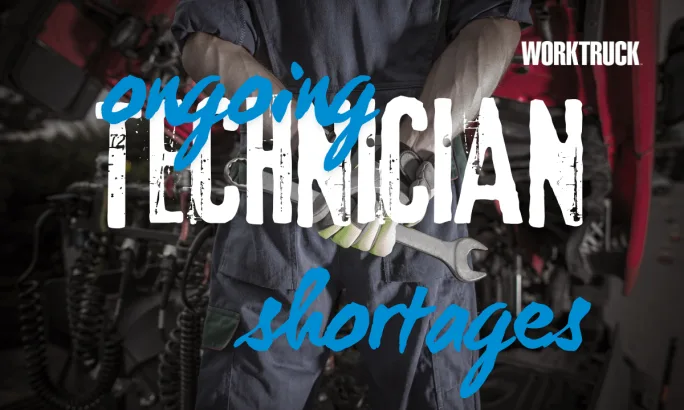
The technician shortage hit hard in 2025, pushing fleets to rethink training, support, and smarter partnerships to keep repair capacity strong.
Photo: Work Truck
Companies Focused on Culture, Support, and Flexibility
Labor shortages across industries pushed fleets to rethink how they attract and retain drivers, techs, and yard workers.
Yearling said that in yard operations, retention increasingly depended on workplace tools, schedule consistency, culture, and support. Money mattered, but workers stayed where they felt informed, equipped, and respected.
Dave Berno, transportation practice leader at Hub International, said fleet operators also leaned into formalized training programs, recruitment pipelines, and wellness initiatives.
“Fleet operators need solutions that both address the root causes of employee churn and incentivize new and existing workers to stay committed to their positions over the long term,” Berno said.
He pointed to “Total Worker Health” as a growing strategy that addressed physical, mental, and emotional well-being, something drivers increasingly expect from employers.
Technology Helped Offset Staffing Challenges
As hiring got harder, fleets turned to technology to fill operational gaps.
Abby Griffith, senior product manager at Trimble, said fleets were more willing than ever to change old processes and adopt AI tools that made day-to-day work easier.
“Now, due to the widespread availability and adoption of AI solutions, companies are looking for technology solutions first and are more willing to change their processes,” Griffith said.
This shift made tasks like scheduling, routing, service monitoring, repairs, safety analysis, and performance tracking more efficient. It also reduced administrative workload for already stretched managers.
Enterprise Fleet Management emphasized the same need for integrated, cross-platform data. Lisonbee noted that fleet managers want a seamless view across mixed-OEM fleets to maximize value and make faster, better decisions.
“Easy access to data and insights across the entire fleet is becoming essential,” he said.
With technicians in short supply, Kevin Chan, director of product marketing at Fleetio, said better digital workflows helped technicians make the most of their time, stay organized, and avoid wasted effort caused by parts delays or incomplete information.
Better visibility across sites also helped companies allocate technicians more effectively, especially in operations with multiple branches or rotating assignments.
Lytx saw fleets adopt AI to relieve workloads, too.
“Fleets began adopting AI in targeted, purposeful ways, using it to solve real problems rather than chase the latest shiny object,” said Rajesh Rudraradhya, CTO at Lytx. He added that responsible AI, lower-latency edge processing, and human-in-the-loop coaching will become core to workforce optimization in 2026 as fleets look to automate decisions that balance safety, uptime, and cost.
Workforce Strategy Became Part of Fleet Strategy
What stood out most in 2025 was how fleet leaders connected the dots. Workforce challenges weren’t siloed from maintenance, safety, or productivity. They were tied to every operational outcome.
Fleets leaned on technology where staffing was thin. They invested in driver and technician support where turnover was high. They embedded coaching into safety programs instead of relying on punitive measures. They restructured yard operations around data instead of bodies alone.
Rudraradhya said the biggest shift coming in 2026 is trust: fleets will expect AI systems to provide audit trails, explainable insights, and real financial outcomes such as fewer breakdowns, safer yards, faster claims, and lower premiums.
Heading into 2026, work truck fleets know workforce pressure isn’t going away, but they’re better equipped to manage it. The fleets that succeed will be the ones that support people with the right tools, the right culture, and the right technology to keep every role — from yard to cab to shop — running strong.
Explore the Rest of the 2025 Work Truck Trends Series
This chapter is part of our full breakdown of how 2025 transformed fleet operations. Check out the others:
Part 1: How Rising Costs Reshaped Work Truck Fleets: rising expenses pushed fleets toward tighter financial decisions.
Part 2: Data Became the Backbone of Fleet Decisions: fleets used data to coach earlier and prevent downtime.
Part 3: Maintenance and Uptime Took Center Stage: predictive tools and mobile service helped keep trucks moving.
Part 4: Safety, Security, and Risk Became Non-Negotiable: fleets battled fraud, cyber threats, and rising insurance.
Part 5: Energy Strategies Shifted as Fleets Rebalanced Options: hybrid growth, EV planning, and propane autogas offered stability.
Part 7: Vehicle Availability and Market Shifts Shaped Decisions: inventory changes and van shortages pushed fleets to adapt.
More Operations
Family Ties Inside the Fleet Families Building Careers Across Generations
Three fleet families share what it really takes to work together, learn across generations, and keep business from following them home.
Read More →
Shades of Fleet Call for Voices: Fleet's Hidden Heroes
Fleet’s hidden heroes are often the ones keeping everything moving behind the scenes. September’s Shades of Fleet is looking for dispatchers, coordinators, parts specialists, and other support pros to share their stories.
Read More →
Truck Centers, Inc. Celebrates National Truck Driver Appreciation Week with $1,000 Fuel Card Giveaways
During National Truck Driver Appreciation Week, Truck Centers, Inc. is offering customers a chance to fuel up for free. Customers at all Truck Centers locations can enter to win one of four $1,000 fuel cards from Sept. 14 - 18.
Read More →
Fleet Guides, AI Time-Savers, Truck Tariffs & Fuel Strategy Lead the News
This week’s Truck Chat Cheat Sheet covers new fleet vehicle guides, practical AI use cases, U.S.-Canada truck production, mixed-energy strategy, and more.
Read More →
What Fleet Employers Are Missing When Hiring Veterans
What if some of the strongest candidates for fleet are already out there, but their experience is written in a language our industry does not always recognize?
Read More →
Automotive Fleet Opens 2026 Personal Use Survey for Commercial Fleet Managers
Less than two weeks left! Commercial and corporate fleet managers are invited to share how their organizations handle company vehicle personal-use policies, charges, and driver eligibility.
Read More →
What Resilient Fleets Do Differently When Conditions Change
Fleet resilience is about more than reacting to disruption. Lauren Fletcher talks with AP Fleet’s Alex Coveney about flexibility, planning, scaling, and what helps fleets adapt when business conditions shift.
Read More →
If We Want the Next Generation in Automotive, We Have to Give Them a Reason to Care
The automotive industry talks constantly about its workforce shortage. But before we can recruit the next generation, we may need to do a better job giving kids a reason to care about automotive in the first place.
Read More →
Ram ProMaster City Under $40K, Truck Tariffs, and AI Maintenance Lead the News
A sub-$40K commercial van, tariff questions, AI-powered maintenance, and a new EV production strategy headline this week’s Truck Chat Cheat Sheet.
Read More →
Bob Adamsky Shares the Fleet Lessons You Usually Learn the Hard Way
After more than 30 years in fleet, Arrow International’s Bob Adamsky has learned that the job is about far more than vehicles. He shares the lessons he wishes every fleet manager could learn a little earlier.
Read More →