




Truck Fleet Targets Niche Filming Market
New York City-based Angel Aerial rents its diverse fleet of trucks and equipment to the film and TV industries — and has used its fleet to help the city in times of need, including after the 9/11 attacks.

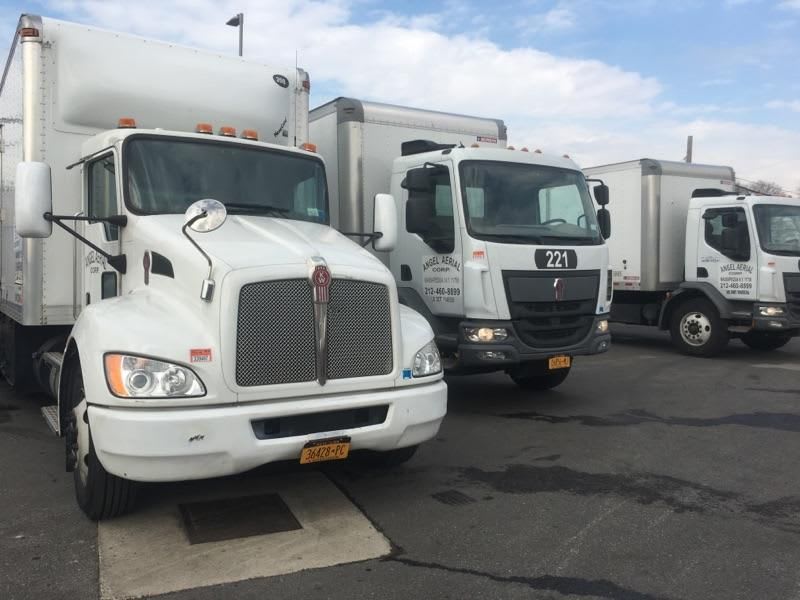
Angel Aerial's fleet includes Kenworth box trucks. Photo by James Miller
Angel Aerial's fleet includes Kenworth box trucks. Photo by James Miller
Running a diverse fleet of trucks and equipment, James Miller caters his company to the film and television production industries shooting in and around New York City. “We used to be the largest New York-based company that supplied the film industry with vehicles,” says Miller, owner of Angel Aerial.
Before 2008, Miller maintained a fleet of 300 vehicles. Due to the slowdown of the movie industry in New York, Miller was forced to greatly downsize his fleet.
Tax incentives for film were victims of the 2008 budget in New York, according to Miller. “There was no film work in New York until several months later when the budget was signed by the new governor,” he says. “This, plus the financial crisis, was devastating to my company.”
Today in New York City, the movie and film production industry has rebounded and is a $9 billion per-year industry. Still serving this niche market, Miller is working toward a fleet of 50 trucks, which includes water trucks and box trucks. According to Miller, his goal is to maintain a fleet of newer vehicles (2012 and newer). He also offers equipment such as generators and lifts.
Specialized Fleet
Unlike his competitors, Miller buys new trucks and equipment for his film industry clients.
“Most of my competitors are maintaining older trucks so they can keep their rates lower and still make a profit,” he says. “To compete, I’m getting the rates that are closer to companies with older trucks. My goal is to have the best equipment that everyone wants.”
For Miller, he values buying American-made vehicles; his preferred truck brand is Kenworth. He purchases his box trucks and water trucks from local dealer Gabrielli Truck Sales.
When looking for his newest water truck, Miller chose a Class 8 Kenworth truck on a T880S cabin chassis. This water truck is registered at 46,000 lbs. GVWR and holds a 4,000-gallon water tank — to fulfill every director’s desire to have that wet street look for filming.
“I used to spend $50,000 on a new truck and now I try to stay at $100,000 for a new truck,” says Miller. “To build my brand-new water truck, it will cost over $200,000.”
The film industry companies use the box trucks to haul their equipment to the sets. Not only does Miller offer new box trucks; he also customizes them. To fit through most of the tunnels in New York City, Miller orders trucks at a 12-foot height.
“If the truck can’t fit in the tunnels, the driver will have to drive out of the way to one of the bridges,” says Miller. “A trip that might take 20 minutes could then take closer to 90 minutes.”
He also adds aluminum tailgates to his box trucks instead of steel tailgates. In addition to being lighter than steel, the aluminum tailgate is bigger and covers the whole back of the truck when closed — it isn’t as risky for workers to stand and hold the inventory on the aluminum tailgate, according to Miller.
Due to New York’s truck regulations, a truck box must be less than 35 feet. Therefore, Miller takes advantage of every inch of the truck for storing items. To create more storage room, Preuss Truck Body designed specialized underbody boxes for Miller’s trucks.
“The underbody boxes are oversized and made with a heavier dimension of steel,” says Miller. “Film crews will put items like sandbags and clamps in the underbody box — all things that need to be accessible so they don’t have to keep climbing into the back of the truck to get supplies.”
On-Demand Maintenance
Due to the fast pace of the film industry, Miller has set up a maintenance plan to get his trucks up and running as soon as possible. For lube and oil changes and other smaller repairs, Angel Aerial has an on-site shop set up. For bigger maintenance repairs, Miller works with a local dealership that prioritizes his trucks, as well as a tire store that can turn around a job in 20 minutes.
According to Miller, the film hiatus — from around Dec. 18th until the end of the year — gives his mechanics more time to work on serving all of the vehicles.
Most of his trucks and equipment will be rented for around 10 months to film a TV show, but about 80% of Miller’s fleet will be parked on-site nightly at his two-acre parking facility.
“This way, we don’t have to go out to the filming location to service the vehicles too often,” he says.
Special Projects
In addition to the film industry, Miller’s unique fleet of vehicles and equipment has been used to help the city of New York — particularly after the 9/11 terrorist attacks.
“We pulled together people from the film industry to help out,” says Miller. “For example, since GPS systems hardly existed at that time, we had a transportation coordinator track out the driving routes for the trucks to reduce the amount of time on the road. He knew which roads were open and closed at the time.”
Miller’s “special projects” team also moved heavy pieces of debris, provided emergency lighting, and helped to get rid of dust at the disaster site.
Those same hoses that soaked the streets on film shoots were this time used in an advanced form of dust suppression, with hoses hooked up to Angel Aerial’s water trucks feeding into fire hoses.
A pipe from Miller’s dust suppression apparatus was wired to the last beam standing at the World Trade Center. “It was one of the most amazing things I have participated in,” he says.
More Small Fleet


Developing Budget-Friendly Driver Safety Programs
From driver training and safety meetings to one-on-one coaching and incentive programs, several small fleets share how they have developed a safety culture with their drivers using low- to no-cost resources.
Read More →
Boosting Last-Mile Fleet Uptime, Safety, and Value with AI Vehicle Inspections
AI-powered inspections are transforming last-mile fleets by replacing manual checks with highly accurate automated scans that detect defects in seconds. By giving fleet operations visibility into the daily condition of their vehicles, you can identify trends over the vehicle’s lifecycle that enable improved procurement decisions, route management, driver training and accountability.
Read More →
Five Ways Seat Belts Help Prevent Injuries
There are five ways seat belts protect occupants from injuries, according to the Tennessee Department of Safety and Homeland Security.
Read More →
It’s here: The 2026 Fleet Technology Trends Report
What does AI mean for fleets? Get the answer — and learn other top tech trends.
Read More →
Small Fleets, Big Impact: How Independent Drivers Power Wreaths Across America
Check out how small fleets and independent drivers power Wreaths Across America each December and why their impact matters more than ever.
Read More →
VMS Survey Finds 65% of Small Fleet Managers Run Operations Alone
A new VMS survey shows small fleet managers are stretched thin, with most handling operations solo and eager to adopt digital tools for relief.
Read More →
Tips for Driving Safely on Halloween Night
This video features a reminder from the Connecticut Department of Transportation (DOT) and the Connecticut Police Chiefs Association, urging drivers to prioritize safety this Halloween.
Read More →
AI, Access, and Uptime: VMS’s Next Chapter with David Prusinski
VMS’s new Co-CEO, David Prusinski, shares how an AI-first approach will give small fleets and repair shops the tools to compete like big players.
Read More →
Fleet Managers Share Winter Prep Tips: It's Never Too Early!
Three fleets share best practices to prep vehicles for winter and prevent downtime when the cold sets in.
Read More →