



About the Author
Les Smart is president of Smart Fleet Management, a small and medium fleet consulting company. He can be reached at smart5010@atlasok.com.
 MENU
MENU SEARCH
For proper tire care, it’s also important to make sure that each tire has adequate tire tread left and to check that the sidewalls have no cuts or damage.
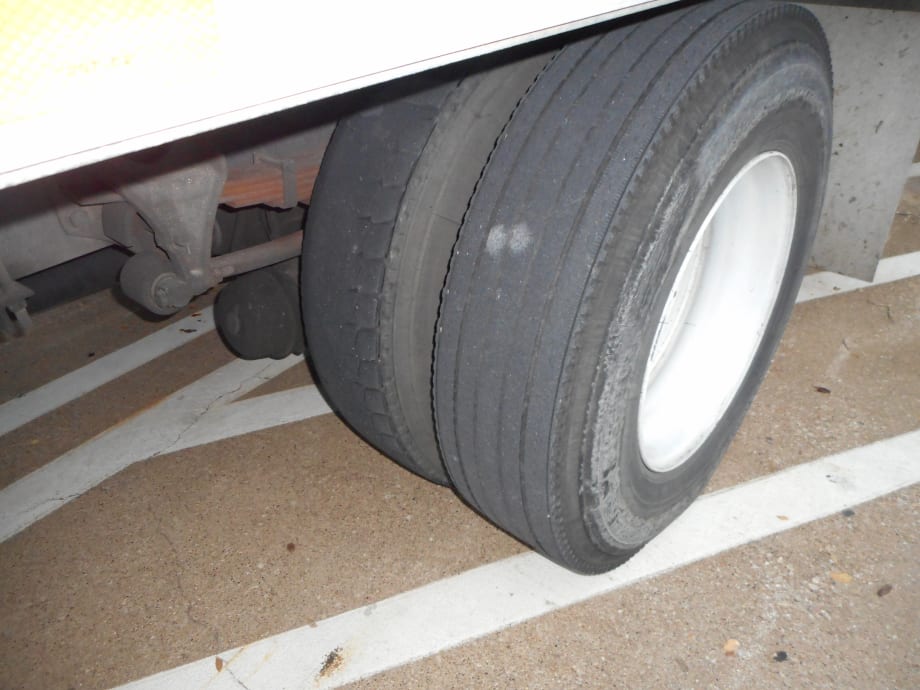
This truck demonstrates uneven treads on dual tires. Photo by Les Smart.
This truck demonstrates uneven treads on dual tires. Photo by Les Smart.
Have you read articles on tires until you are blue in the face? Perhaps there will be a nugget or two in this article that you haven’t thought of. Or maybe you are putting off tire maintenance because it’s too costly, too much trouble, or any number of excuses.
I will go into some of the usual topics like tire pressure and tread wear, but first …
You have built a $3 to $30 million business over one or more generations, and you are making an appropriate profit most years. Do you think about liability? I bet you do, but do you relate that to tire failures and more specifically to catastrophic tire failures? What happens to your business if a worn, damaged tire fails at speed — it doesn’t even have to be high speed — and your driver loses control of your fleet vehicle and it plows into another vehicle?
If one or more of the occupants is a young to middle-aged passenger, especially a working mother or father, your liability skyrockets. I like to call this the $5 million accident. You don’t want to lose your business in the event of one of these failures just because you were lax in making sure that your tires were in good condition. Let’s see what you can do to avoid this type of situation where your tires are concerned.
This one seems obvious, but do you (or your supervisor) check each tire’s pressure periodically? Or do you leave it up to your maintenance provider? Buy a decent tire gauge and use it. There are two types of gauges. Make sure that the tire gauges read truck tire pressures and aren’t only for passenger car tires, which operate at lower pressures. If properly equipped, even vans and SUVs run on light truck or LT tires.
One of the gauges reads to 100 psi while the other gauge reads to 150 psi. Make sure the gauge will read to the pressure needed for your tires. There is a decal on the door jamb or “B” pillar that tells you what to inflate your tires to; it should be in every light truck and van. If it’s not there or is illegible, then go to the manufacturer’s website to look for the data. There is also a maximum load/pressure embedded in the tire’s sidewall.
Tire pressure needs to be consistent on dual-wheeled vehicles. If the inside dual is underinflated (and this isn’t easily seen), the majority of the load is being carried by one tire, not both.
Don’t mix treads on rear axle(s) on dual-wheeled vehicles. This can result in uneven wear at a minimum and a loss of traction at the most unfortunate time.
You can also add valve stem extenders (see photo below). That way, with a dual wheel vehicle, the inside dual is easier to access when adding air. I highly recommend these; they work and are inexpensive.
Additionally, you can add a central tire inflation system for units equipped with air brakes. These are expensive (approximately $1,500 or more), but are worth it, especially on trailers (see photo below) in some regions where the weather inhibits regular tire inspection/ inflation (except when the vehicle is in the shop for maintenance).
Make sure there is adequate tread left on ALL tires. Some passenger tires have wear bars in the tread. Replace when your tires have the wear bars, even with the rest of the tread.
Most maintenance providers will not replace a tire prior to being worn down to 4/32 inches. Ideally, I like to have then replaced before that. Never let them get bald or thread bare! Remember your families, drivers, and other lives depend on you keeping your tire fleet in good shape.
If there is a mismatch in tread designs on the rear of dual-wheeled vehicles (see photo below) due to a failure replacement while in route, make sure your tire provider corrects this at its earliest opportunity. The new replacement tire can always be matched with others of the same design and used in the future.
Check that the tires are wearing smoothly.
Check your sidewalls for cuts and damage (bulges). A tire can be cut on the side and appear to be serviceable, yet rain and standing water can penetrate to the steel belts and corrode the belts. This will lead to a failure of the tire.
The photo (above) with the depth gauge (showing how deep the cut was) was on an operational truck at a location that I had come to audit. Needless to say, I red-tagged that truck right then and the rear tires were replaced the next morning. This is a good example of how the $5 million accident happens.
Pay attention to your tires. If more people did, I wouldn’t be able to take all the photos you see here.


From driver training and safety meetings to one-on-one coaching and incentive programs, several small fleets share how they have developed a safety culture with their drivers using low- to no-cost resources.
Read More →
AI-powered inspections are transforming last-mile fleets by replacing manual checks with highly accurate automated scans that detect defects in seconds. By giving fleet operations visibility into the daily condition of their vehicles, you can identify trends over the vehicle’s lifecycle that enable improved procurement decisions, route management, driver training and accountability.
Read More →
There are five ways seat belts protect occupants from injuries, according to the Tennessee Department of Safety and Homeland Security.
Read More →
What does AI mean for fleets? Get the answer — and learn other top tech trends.
Read More →
Check out how small fleets and independent drivers power Wreaths Across America each December and why their impact matters more than ever.
Read More →
A new VMS survey shows small fleet managers are stretched thin, with most handling operations solo and eager to adopt digital tools for relief.
Read More →
This video features a reminder from the Connecticut Department of Transportation (DOT) and the Connecticut Police Chiefs Association, urging drivers to prioritize safety this Halloween.
Read More →
VMS’s new Co-CEO, David Prusinski, shares how an AI-first approach will give small fleets and repair shops the tools to compete like big players.
Read More →
Three fleets share best practices to prep vehicles for winter and prevent downtime when the cold sets in.
Read More →