




TCO Champs: Crossovers or Sedans?
As consumers and automakers continue to migrate away from sedans toward crossovers, there are no clear winners when analyzing total cost of ownership of individual models.

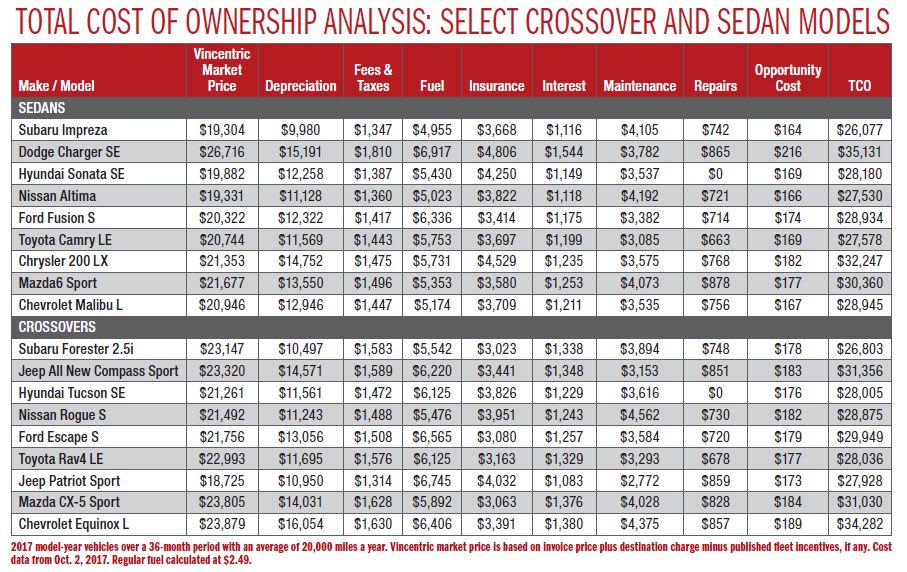
2017 model-year vehicles over a 36-month period with an average of 20,000 miles a year. Vincentric market price is based on invoice price plus destination charge minus published fleet incentives, if any. Cost data from Oct. 2, 2017. Regular fuel calculated at $2.49.
The inflection point came near the end of the 2014 calendar year, when sales of crossover utility vehicles surpassed compact and midsize car sales in the U.S. We’ve never looked back.
Analysts say consumers prefer crossovers for their high stature, roominess, car-like ride, and (relatively) good fuel economy. As fleet drivers are consumers themselves, fleet selectors have migrated toward crossovers as well.
Automakers have responded with more crossover model choices, while used sedans have not fared well recently in the secondary market. However, this doesn’t complete the total cost of ownership (TCO) picture.
For actual fleet acquisitions, a model-to-model analysis that takes into account all costs is more beneficial.
With the help of Vincentric, we compared TCO for popular midsize sedan and compact crossover fleet models.
For the analysis, Vincentric calculated its standard eight cost elements: depreciation, financing, fees and taxes, fuel, insurance, maintenance, opportunity cost, and repairs. This analysis covers a 36-month period with an average of 20,000 miles a year.
Cost Breakdowns
Each of the models chosen had an initial capitalized cost of $18,725 to $26,716 based on Vincentric’s Market Price, which calculates initial cost as invoice price plus destination charge minus fleet incentives. An analysis of these individual costs provided some interesting insights.
With the obvious popularity of crossovers, total depreciation — the largest single cost — did not favor crossovers over sedans.
Equinox, Escape, CX-5, Rogue, Forester, and RAV4 models depreciated more than their sedan counterparts, while Charger, 200, and Sonata depreciated more than their crossover colleagues.
Not surprisingly, the models that depreciated more carry a higher initial cost, except in one instance: The
Hyundai Tucson has a higher initial cost yet depreciates less than the Sonata sedan.
Total fuel costs are uniformly in favor of the sedans in our analysis, with one exception: The 2017 Dodge Charger will cost the user close to $700 more in fuel over a three-year period than its crossover comparison, the 2017 Jeep (“All New”) Compass.
Interestingly, total insurance costs favored the crossovers, with the exception of the Nissan Altima, which beats the Nissan Rogue in the category.
Maintenance costs are almost evenly split. Five crossover models (Equinox, Escape, Tucson, Rogue, and RAV4) are projected to cost more in maintenance, while four sedan models (200, Charger, Mazda6, and Impreza) are projected to cost more than their crossover counterparts.
TCO Winners
When it comes to overall total cost of ownership in this analysis, there is no clear winner between the crossover and sedan segments.
The Subaru Impreza sedan takes the lowest TCO prize, followed by Subaru Forester, a crossover. From there, two more sedans — Altima and Camry — come in third and fourth, followed by three crossovers — Patriot, Tucson, and RAV4 — in the fifth, sixth, and seventh spots.
After Subaru’s claiming of the first and second spots, the ranking is also not necessarily skewed toward certain manufacturers.
Not accounted for in this analysis are additional unpublished incentives available on many of these models. Though impossible to capture here, additional incentives skew overall ownership costs.
This analysis also clarifies a general rule of thumb that is worth reiterating, especially for smaller fleet operators — vehicles with lower initial costs do not necessarily correlate to a lower overall TCO. The 18 models analyzed here show that choosing the lowest cost out the door is not better on your fleet pocketbook in the long run.
Finally, while analyzing total cost of ownership is essential, it’s still a numbers analysis. The so-called “soft benefits” of crossovers — their ride, roominess, and overall appeal — may well be enough to tip the scales to acquiring them instead of sedans.
2017 model-year vehicles over a 36-month period with an average of 20,000 miles a year. Vincentric market price is based on invoice price plus destination charge minus published fleet incentives, if any. Cost data from Oct. 2, 2017. Regular fuel calculated at $2.49.
More Small Fleet


Developing Budget-Friendly Driver Safety Programs
From driver training and safety meetings to one-on-one coaching and incentive programs, several small fleets share how they have developed a safety culture with their drivers using low- to no-cost resources.
Read More →
Boosting Last-Mile Fleet Uptime, Safety, and Value with AI Vehicle Inspections
AI-powered inspections are transforming last-mile fleets by replacing manual checks with highly accurate automated scans that detect defects in seconds. By giving fleet operations visibility into the daily condition of their vehicles, you can identify trends over the vehicle’s lifecycle that enable improved procurement decisions, route management, driver training and accountability.
Read More →
Five Ways Seat Belts Help Prevent Injuries
There are five ways seat belts protect occupants from injuries, according to the Tennessee Department of Safety and Homeland Security.
Read More →
It’s here: The 2026 Fleet Technology Trends Report
What does AI mean for fleets? Get the answer — and learn other top tech trends.
Read More →
Small Fleets, Big Impact: How Independent Drivers Power Wreaths Across America
Check out how small fleets and independent drivers power Wreaths Across America each December and why their impact matters more than ever.
Read More →
VMS Survey Finds 65% of Small Fleet Managers Run Operations Alone
A new VMS survey shows small fleet managers are stretched thin, with most handling operations solo and eager to adopt digital tools for relief.
Read More →
Tips for Driving Safely on Halloween Night
This video features a reminder from the Connecticut Department of Transportation (DOT) and the Connecticut Police Chiefs Association, urging drivers to prioritize safety this Halloween.
Read More →
AI, Access, and Uptime: VMS’s Next Chapter with David Prusinski
VMS’s new Co-CEO, David Prusinski, shares how an AI-first approach will give small fleets and repair shops the tools to compete like big players.
Read More →
Fleet Managers Share Winter Prep Tips: It's Never Too Early!
Three fleets share best practices to prep vehicles for winter and prevent downtime when the cold sets in.
Read More →