





Related: Cox Automotive Update: August Sales Pace Forecast to be Year's Slowest
Supply Chain Strain: Fleets Manage in the New Normal
With vehicle supply constraints and inflated prices now forecast through 2023, fleet operators are adjusting their duty cycles, fleet plans, and job management.
August 26, 2021
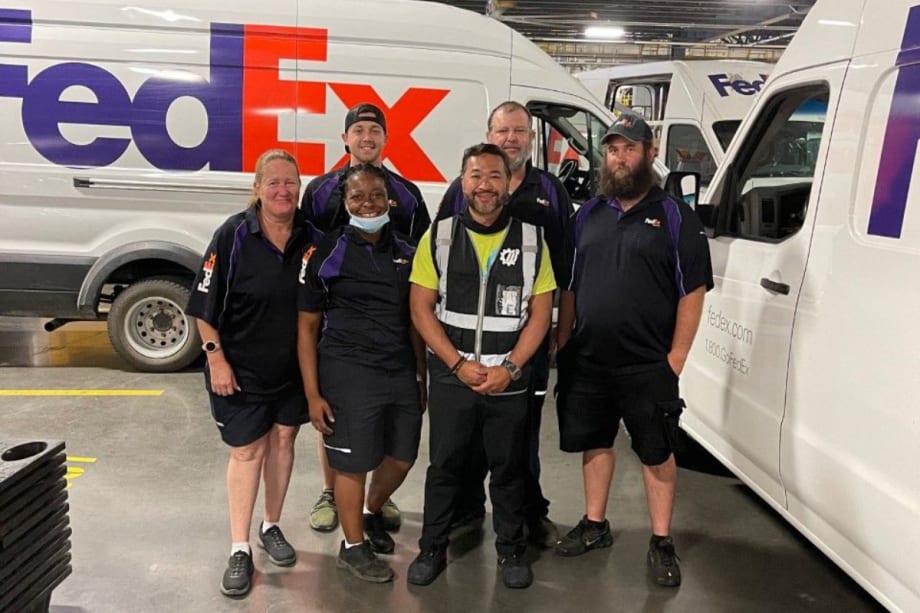
Jeb Lopez (center) congregates with his team at Wheelz Up, a last-mile delivery service that has contracts with FedEx and Amazon. Lopez, who has over 200 vehicles in his fleet, just bought four new Nissan NV 2500 cargo vans. He says there were six other buyers waiting for those units and they were willing to pay an additional $1,000 to $2,000 more.
Photo: Jeb Lopez, Wheelz Up
7 min to read
This is the first of two articles on how the fleet industry is managing the severe vehicle supply crisis brought on by the semiconductor chip shortage and pandemic-related disruptions.
Who would’ve thought that a semiconductor chip — the tiniest component of the automotive supply chain — could cause this much disruption?
Jeb Lopez of Wheelz Up, a last-mile delivery service that has contracts with FedEx and Amazon, has never paid over MSRP. He didn’t when he started in 2010 delivering auto parts with a handful of vans in metro D.C., and he didn’t during the growth of his fleet to hundreds of vehicles making deliveries along the eastern seaboard. Today, it’s different.
“When you purchase a fleet vehicle right now, it's no longer MSRP — it's even higher, it could be a thousand or two thousand more than MSRP,” he says, after just purchasing four new Nissan NV 2500 cargo vans. “When I signed the paperwork, there were literally six other clients who wanted those units, and they were willing to pay an additional $1,000 to $2,000 more.”
Like many operators, Lopez is running his fleet longer to compensate for the inability to fleet new units, but that has spill-off effects. “The dealerships and aftermarket service centers, they are so packed,” he says. “They can't turn around these vehicles quick enough, for warranty work or even basic preventive maintenance.”
Lopez was doubly smart, in hindsight, to have built his own garage to service his metro D.C. fleet. But his technicians are having a hard time sourcing parts like everyone else. With OEM parts scarce, he’s had to stock up on aftermarket parts well in advance — and in some instances, hoping those generic parts will work for his vehicles.
Lopez will need to expand his fleet soon to cover peak delivery season. With the vehicle shortage, he is increasingly turning to commercial truck rental, and sees it as a growing segment. Those providers include traditional players such as Enterprise and Hertz as well as new business models such as Fluid Truck, which rents privately owned trucks and vans on an app-based platform like Turo.
Lopez says he needs to plan his rentals months in advance and put in an allocation with the rental company. “We don’t rent for a day, a week, or a month, because they won’t rent for shorter periods anymore. We rent for multi months — that’s actually a term, ‘multi months.’”
Lopez says the rental companies he works with haven’t raised his rates too much, even though they’re under the same vehicle supply constraints as everyone else.
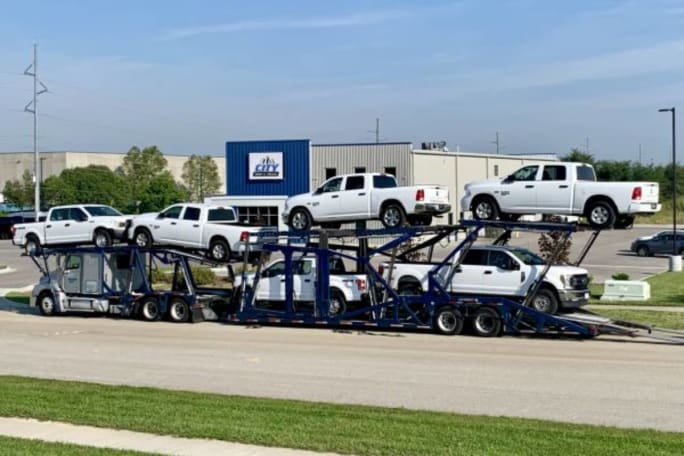
City Rent a Truck, a national fleet supplier headquartered in Kansas City, takes delivery of new pickups. James McKinley, director of operations, says the company needs to balance the needs of longtime customers. “[The situation of] little inventory and high rates won’t last forever,” he says.
Photo: City Rent A Truck
In the Cold
City Rent a Truck, a national commercial fleet rental service headquartered in Kansas City, doesn’t work with Lopez. But James McKinley, director of operations, understands Lopez’s situation from the other side of the fence. “We have to balance capitalizing on the situation and not take our customers to the cleaners,” he says. “[The situation of] little inventory and high rates won’t last forever, and we want to keep those customers.”
City Rent a Truck is also feeling the supply constraint pain.
“We've punched hundreds of orders over the past few months, and none of them are scheduled,” McKinley says. “We're just out in the cold on when we’ll get anything and some of those were ordered in November and December of 2020.”
McKinley has even had to cancel a large batch of passenger van orders because the delay in production would put them in fleet past peak season for those units. He “wouldn’t be shocked” if some 2020-MY van orders arrive in January 2022.
Like Lopez, circumstances are forcing City Rent a Truck to hold trucks beyond their normal cycle, which is usually before the factory warranty runs out. “We would love to sell these assets, as they're worth more than they ever have been, but we don’t want to cut off recurring revenue,” McKinley says. “Especially with new ones hard to come by.”
Some of McKinley’s commercial fleet clients are biting the bullet and paying thousands over MSRP for a truck. But others are balking, as the cost of new fleet cuts too deep into profitability. “They’re renting instead until the situation corrects, or they’re even putting jobs on pause or walking away,” he says.
Fleet operators aren’t only impacted by high vehicle and parts costs — workers come at a premium now too. “Just trying to get the proper staffing has been so difficult,” Lopez says. “We're having to pay drivers a higher hourly rate. (But) the retention is very limited. The turnover has been pretty high.”

There are 200 to 250 semiconductor chips in an average car and 800 to 1,000 chips in most luxury car. The amount of chips in electric vehicles varies by architecture, but the count is generally much lower, 75 to 100 chips.
Photo: Wikimedia Commons
Supply Pressures
By mid-July of this year, industry consensus was that the worst of the semiconductor chip supply imbalance had passed, though some manufacturers were still only working their way back to 50% to 85% of planned production at the time.
Automakers were cautious in their earnings reports among new supply pressures, such as the delta-variant Covid outbreak in Malaysia that drove closures of semiconductor processing plants.
During Ford’s second quarter conference call on July 28, CFO John Lawler said the chip issue will run through this year and potentially bleed into the first part of next year. “We need to see the release (of chips) coming through before we can really feel comfortable that we're out of the woods here,” Lawler said in response to an analyst’s question.
“This remains, as we said, a fluid and rapidly changing environment,” said General Motors’ CEO Mary Barra during the company’s second quarter conference call on Aug. 4.
And then a new wave of intermingled chip supply issues and Covid-related shutdowns hit. The announcement in mid-August that Toyota needed to cut global output by 40% in September exacerbates an already fragile situation. Toyota, which had been able to avoid other automakers’ supply chain woes, said its North American operations will lose about 80,000 vehicles as a result. The Malaysian Covid outbreak was still worsening as of late August.
The immediate effect was palpable: Cox Automotive reported on Aug. 25 that the seasonally adjusted annual rate (SAAR) for August is expected to finish near 14.3 million, the slowest sales pace this year. SAAR had averaged nearly 17.0 million a month through May.
Through 2023
While more chips make their way into new vehicles, the effects down the supply chain will be felt much longer.
“We are assuming that suppliers are constrained through 2023,” says Jonathan Smoke, chief economist for Cox Automotive. “We don't see new vehicle sales getting back to 2019 levels at least through 2022 and probably until 2023.”
Smoke sees a prioritization of retail during this era of acute inventory restrictions, which poses pricing challenges that are already coming to pass. The average transaction price (ATP) for a new light-duty auto in the U.S. reached a record high in July at $42,736, according to Kelley Blue Book. At the same time, incentives amounted to just 5.9% of ATP, the lowest amount in more than a decade.
“We're anticipating significant inflation in MSRPs later this year, especially when the 2022 models start coming out,” he says.
Smoke points to the OEMs’ need to maintain profit margins amidst cost pressures in materials and labor, which could be exacerbated by prolonged inflation — and, of course, new supply disruptions. “It’s a logical move to take advantage of the extreme pricing power that has resulted in higher margins for dealers on both new and used units,” he says.
Smoke joined the rest of the automotive industry in watching the Manheim Index’s meteoric rise, though the market has cooled since its June peak. Though fleet buyers are indeed facing higher costs, he believes that those assets will maintain their value.
Another factor to keep in mind, Smoke says, is the industry standstill in March, April, and May of last year. The lack of production during this time will work through the wholesale market starting at the end of 2022 and continue through 2023. This undersupply will further buoy pricing of available units.
“We're going to see some additional appreciation this fall as a result of the worsening new supply conditions, and after then we are expecting a fairly normal depreciation pattern to follow. The market dynamics will not produce an environment where prices correct, so we don't see values falling to pre-Covid levels, even on a simple inflation-adjusted basis,” he says.
“Fleet buyers should not be concerned about a major (wholesale) price correction because of this backdrop of a strong macro environment, continued supply constraints, and plenty of demand for both new and used vehicles.”
Check out Part 2 of this article, where fleet dealers, fleet management companies, and other parts of the automotive ecosystem weigh in on how fleets can cope and how the supply chain may change as a result of the current crisis.
Originally posted on Automotive Fleet
Subscribe to Our Newsletter
More Small Fleet


Developing Budget-Friendly Driver Safety Programs
From driver training and safety meetings to one-on-one coaching and incentive programs, several small fleets share how they have developed a safety culture with their drivers using low- to no-cost resources.
Read More →
Sponsored•March 9, 2026
Boosting Last-Mile Fleet Uptime, Safety, and Value with AI Vehicle Inspections
AI-powered inspections are transforming last-mile fleets by replacing manual checks with highly accurate automated scans that detect defects in seconds. By giving fleet operations visibility into the daily condition of their vehicles, you can identify trends over the vehicle’s lifecycle that enable improved procurement decisions, route management, driver training and accountability.
Read More →
Five Ways Seat Belts Help Prevent Injuries
There are five ways seat belts protect occupants from injuries, according to the Tennessee Department of Safety and Homeland Security.
Read More →
Sponsored•January 14, 2026
It’s here: The 2026 Fleet Technology Trends Report
What does AI mean for fleets? Get the answer — and learn other top tech trends.
Read More →
Small Fleets, Big Impact: How Independent Drivers Power Wreaths Across America
Check out how small fleets and independent drivers power Wreaths Across America each December and why their impact matters more than ever.
Read More →
VMS Survey Finds 65% of Small Fleet Managers Run Operations Alone
A new VMS survey shows small fleet managers are stretched thin, with most handling operations solo and eager to adopt digital tools for relief.
Read More →
Tips for Driving Safely on Halloween Night
This video features a reminder from the Connecticut Department of Transportation (DOT) and the Connecticut Police Chiefs Association, urging drivers to prioritize safety this Halloween.
Read More →
AI, Access, and Uptime: VMS’s Next Chapter with David Prusinski
VMS’s new Co-CEO, David Prusinski, shares how an AI-first approach will give small fleets and repair shops the tools to compete like big players.
Read More →
Fleet Managers Share Winter Prep Tips: It's Never Too Early!
Three fleets share best practices to prep vehicles for winter and prevent downtime when the cold sets in.
Read More →