




Spec'ing the Extra Mile with Do-It-Yourself Modifications
This sales fleet used some do-it-yourself modifications on the Isuzu Reach to create the optimal operating environment for its drivers.

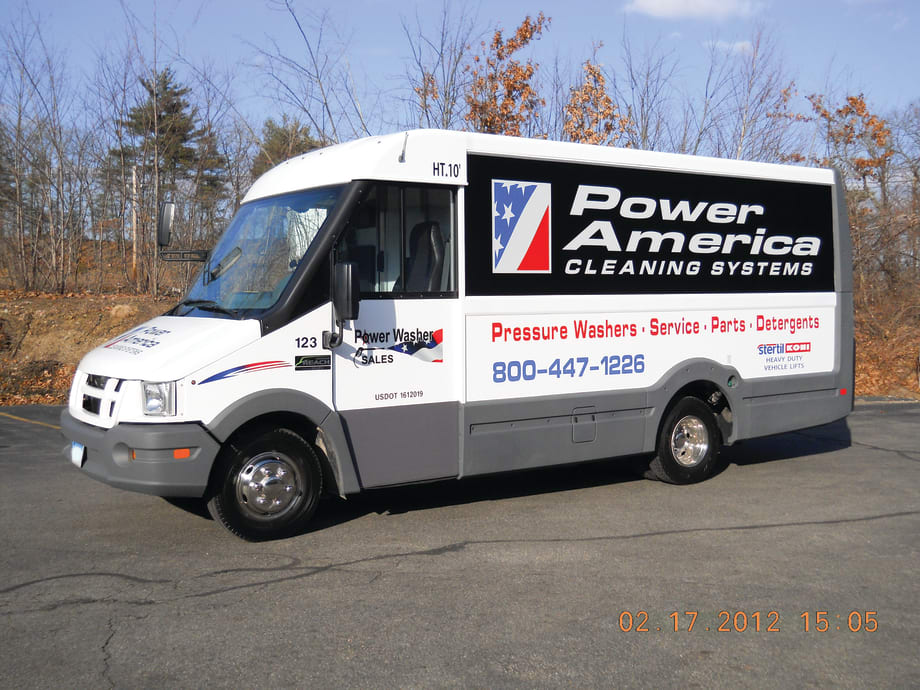
Photos courtesy of Power Washer Sales.
This fleet modified Reach vans with a winch to aid loading, as well as e-track in the box to secure the equipment, and a file cabinet for parts storage and desk space.
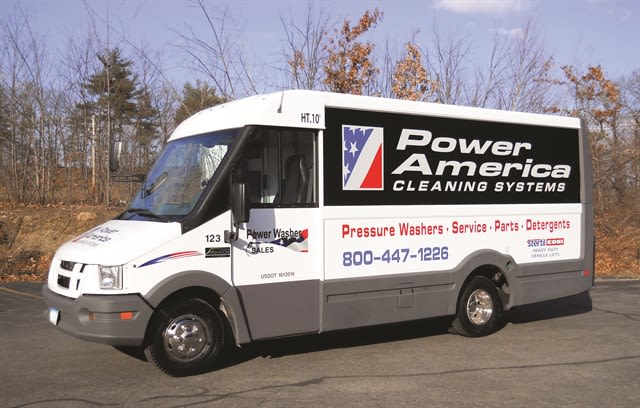
Photos courtesy of Power Washer Sales.
This fleet modified Reach vans with a winch to aid loading, as well as e-track in the box to secure the equipment, and a file cabinet for parts storage and desk space.
Jim Coleman has been buying trucks for 55 years, but when he was ready to replace in spring 2011, he couldn’t seem to find a model that fit his exact specifications to accommodate his portable cleaning equipment.
“The problem with everything I had seen up to that point was the inside dimensions weren’t wide enough for me,” says Coleman, owner of Power Washer Sales of Massachusetts, though he notes that he didn’t want a truck as big as a traditional UPS step van.
Then Coleman saw a blurb in a truck magazine about a new type of walk-in commercial van called the Reach from Isuzu and Utilimaster. As part of his research, Coleman actually flew to the van’s production plant in Indiana and even ended up meeting with the president of Utilimaster and the company’s head engineer.
Back home, Coleman made a floor plan in masking tape based on the truck’s dimensions and rolled the company’s portable cleaning equipment inside the lines to make sure it all fit. “Everything seemed to work, except for the access,” Coleman says, referring to the fact that he anticipated difficulty in loading and unloading the equipment — weighing 200-400 lbs.
For years Coleman used Ford E-350 cube vans and loaded equipment with large rail gates, but those couldn’t be utilized on the new van.
Instead, he bought a metal ramp that folded into the back of the truck, though he found that the ramp alone didn’t quite support the weight of the equipment. In addition, the truck’s tailgate iced up in the winter, causing a dangerous condition during loading.
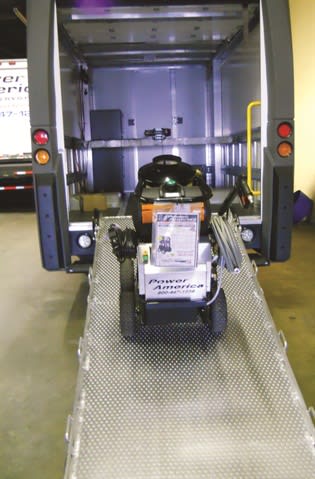
The winch to aid with loading.
Getting Resourceful
The solution was to put a small winch on a crossbar inside the truck that ran off the truck’s electrical system. The winch helps to pull the equipment up the ramp. “It’s as easy as pushing a button and up comes the equipment inside the truck,” Coleman says. “It works out extremely well.”
Inside, Coleman installed e-track to secure the equipment. Behind the partition to the cab he added a small file cabinet to store parts and hoses and use as a writing desk. He added air ride seats in the cab for driver comfort.
Coleman needed to make sure the vehicle signage reflected the company’s image, especially on the back door, where other drivers actually have time to read a message. He used vinyl reflective lettering that stands out and doesn’t peel.
“I’ve instructed my guys, either at the end of the day or beginning, to wash that back door, even out of a rainstorm,” Coleman says. “I want them clean and presentable, so by golly, everyone knows who we are.”
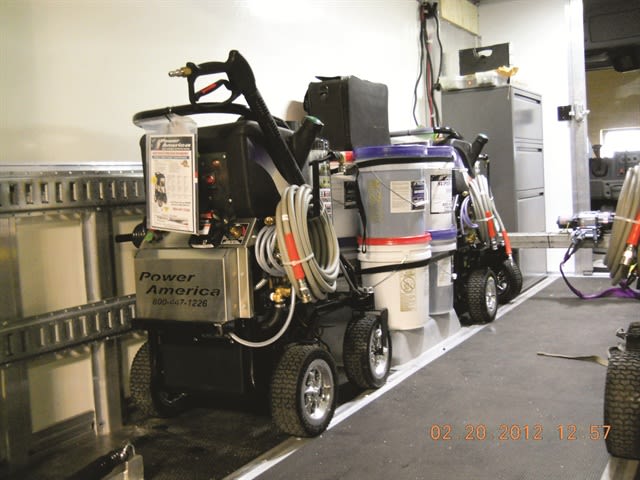
Inside the modified Isuzu Reach vans.
Fleet Factors
Power Washer Sales runs four Reach vans, five Hino 268 models with custom bodies by Morgan and four GMC ¾-ton pickups that pull trailers.
The company puts 25,000-35,000 miles a year on the Hinos, sometimes 400-500 miles a day. Through an agreement with his Hino dealer, Coleman swaps into a new Hino chassis at 70,000-90,000 miles while keeping the body. “[The dealer has] already got that chassis sold to another customer,” Coleman says.
Coleman expects to put 20,000-30,000 miles a year on the Reach vans, which are used for sales calls. “These vehicles are rolling representatives of our company,” he says, “and they tell the story without having to blink.”
Coleman figures he’s spending $20,000 more on the Reach than he would a typical cube van. But over an expected five-year service life, “the difference is pennies a day.” And with better fuel economy, less maintenance and more driver satisfaction, he says the extra money is well worth it.
More features from Business Fleet's January/February magazine issue can be read here.
You can also read more small fleet profiles by go to www.businessfleet.com/profiles.
More Small Fleet


Developing Budget-Friendly Driver Safety Programs
From driver training and safety meetings to one-on-one coaching and incentive programs, several small fleets share how they have developed a safety culture with their drivers using low- to no-cost resources.
Read More →
Boosting Last-Mile Fleet Uptime, Safety, and Value with AI Vehicle Inspections
AI-powered inspections are transforming last-mile fleets by replacing manual checks with highly accurate automated scans that detect defects in seconds. By giving fleet operations visibility into the daily condition of their vehicles, you can identify trends over the vehicle’s lifecycle that enable improved procurement decisions, route management, driver training and accountability.
Read More →
Five Ways Seat Belts Help Prevent Injuries
There are five ways seat belts protect occupants from injuries, according to the Tennessee Department of Safety and Homeland Security.
Read More →
It’s here: The 2026 Fleet Technology Trends Report
What does AI mean for fleets? Get the answer — and learn other top tech trends.
Read More →
Small Fleets, Big Impact: How Independent Drivers Power Wreaths Across America
Check out how small fleets and independent drivers power Wreaths Across America each December and why their impact matters more than ever.
Read More →
VMS Survey Finds 65% of Small Fleet Managers Run Operations Alone
A new VMS survey shows small fleet managers are stretched thin, with most handling operations solo and eager to adopt digital tools for relief.
Read More →
Tips for Driving Safely on Halloween Night
This video features a reminder from the Connecticut Department of Transportation (DOT) and the Connecticut Police Chiefs Association, urging drivers to prioritize safety this Halloween.
Read More →
AI, Access, and Uptime: VMS’s Next Chapter with David Prusinski
VMS’s new Co-CEO, David Prusinski, shares how an AI-first approach will give small fleets and repair shops the tools to compete like big players.
Read More →
Fleet Managers Share Winter Prep Tips: It's Never Too Early!
Three fleets share best practices to prep vehicles for winter and prevent downtime when the cold sets in.
Read More →