




Service Fleet's Van Expands Capabilities
When looking to replace its cargo vans, this office supply company needed a new model with expanded cargo space and improved ergonomics to handle heavy use and high daily miles.

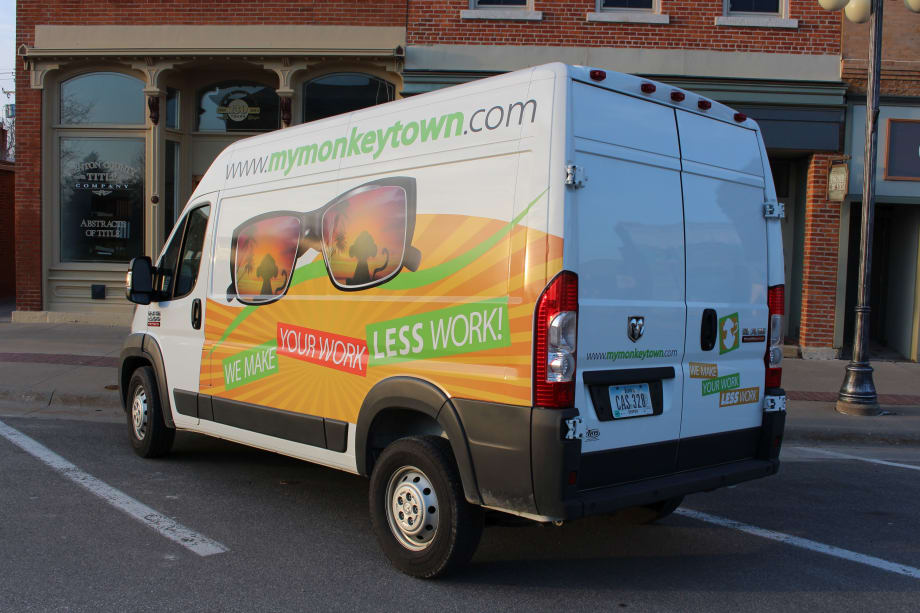
The Ram ProMaster cargo van provides more space for vehicle graphics, logos, and contact information.
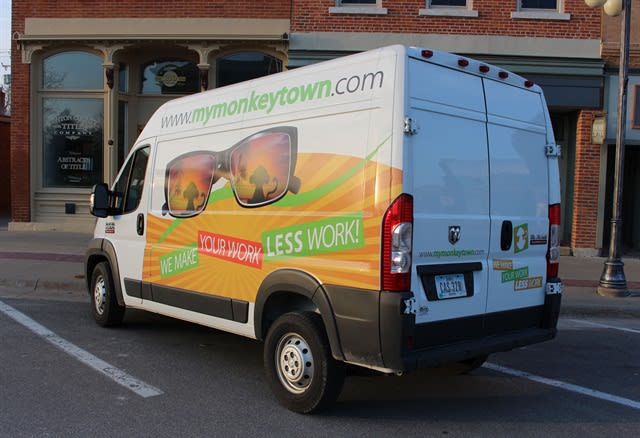
The Ram ProMaster cargo van provides more space for vehicle graphics, logos, and contact information.
As top banana at his office supply business, Kurt Karr doesn’t monkey around when it comes to getting Monkeytown’s products to the customers.
“We supply businesses with what they need to keep their businesses running,” says Karr, owner of Iowa-based Monkeytown. This includes everything from ink and toner to paper to cleaning supplies to break-room materials.
After running Ford E-series vans for several years, Karr was looking to replace the cargo vans in his delivery fleet. “I eyed the Sprinter for many years but couldn’t justify the price tag here in rural Iowa, and I had concerns about service availability with a Mercedes product.”
When the Ram ProMaster arrived at dealerships, Karr contacted his local BusinessLink dealer to purchase the new full-size cargo van. Chrysler’s BusinessLink program specializes in providing vehicle needs for small- to medium-sized businesses.
“It was a no-brainer for me; the ProMaster had the features I needed in the Sprinter but at a lower price point,” says Karr.
Based in Vinton, Monkeytown’s vans cover an area of 5,800 square miles in eastern Iowa. Each day, a van travels approximately 250 to 300 miles. In the past two years, Karr has added three ProMaster vans and hopes to replace the remaining two Ford E-Series vans in the next few years.
The Right Fit
So far, the ProMaster cargo vans have proved to be a good fit for Monkeytown’s fleet.
One of the first things that Karr noticed was the fuel economy. Hauling the same materials on the same route, each ProMaster van saves 3 to 4 gallons of fuel per day compared to the E-series van, according to Karr. “That’s a big deal for me,” he says, especially when each van is driving around 55,000 miles per year.
Monkeytown’s drivers also like the ProMasters. According to Karr, the drivers love the ProMaster’s turning radius, driver visibility, and comfortable seating. “We installed solid partitions, which isolate the cab from noise, extreme temperatures, and dust,” he says.
The ProMaster’s low step height has made it easier to get the products out of the van and to the customer. Prior to the ProMaster, drivers had to crawl on their knees to get packages out of the vans, according to Karr. Also, the rear doors — which fold against the van — allow more space for maneuvering the boxes.
Additionally, the expanded cargo space has enabled drivers to carry more boxes at a time. And the ProMaster’s extended height allows drivers to walk upright in the cargo area, says Karr.
To help with scheduling, Karr’s fleet uses routing software to improve time management.
“We put the deliveries for the next day into the system and allocate those across the delivery routes,” he says. “It helps give a good estimate for how long it will take for a driver to finish his deliveries.”
Real Estate Space
With its new ProMaster vans, Monkeytown now has more room for vehicle graphics. “The ProMaster vans provide more real estate space to tell a story of your business,” says Karr.
Acting as moving billboards, each ProMaster van contains graphics on each side of the van, Monkeytown’s website, as well as its slogan “We Make Your Work Less Work!”
And of course, each van features a monkey graphic.
“I wanted a name that people would remember,” says Karr. “People remember the name ‘Monkeytown.’”
More Small Fleet


Developing Budget-Friendly Driver Safety Programs
From driver training and safety meetings to one-on-one coaching and incentive programs, several small fleets share how they have developed a safety culture with their drivers using low- to no-cost resources.
Read More →
Boosting Last-Mile Fleet Uptime, Safety, and Value with AI Vehicle Inspections
AI-powered inspections are transforming last-mile fleets by replacing manual checks with highly accurate automated scans that detect defects in seconds. By giving fleet operations visibility into the daily condition of their vehicles, you can identify trends over the vehicle’s lifecycle that enable improved procurement decisions, route management, driver training and accountability.
Read More →
Five Ways Seat Belts Help Prevent Injuries
There are five ways seat belts protect occupants from injuries, according to the Tennessee Department of Safety and Homeland Security.
Read More →
It’s here: The 2026 Fleet Technology Trends Report
What does AI mean for fleets? Get the answer — and learn other top tech trends.
Read More →
Small Fleets, Big Impact: How Independent Drivers Power Wreaths Across America
Check out how small fleets and independent drivers power Wreaths Across America each December and why their impact matters more than ever.
Read More →
VMS Survey Finds 65% of Small Fleet Managers Run Operations Alone
A new VMS survey shows small fleet managers are stretched thin, with most handling operations solo and eager to adopt digital tools for relief.
Read More →
Tips for Driving Safely on Halloween Night
This video features a reminder from the Connecticut Department of Transportation (DOT) and the Connecticut Police Chiefs Association, urging drivers to prioritize safety this Halloween.
Read More →
AI, Access, and Uptime: VMS’s Next Chapter with David Prusinski
VMS’s new Co-CEO, David Prusinski, shares how an AI-first approach will give small fleets and repair shops the tools to compete like big players.
Read More →
Fleet Managers Share Winter Prep Tips: It's Never Too Early!
Three fleets share best practices to prep vehicles for winter and prevent downtime when the cold sets in.
Read More →