




Related: U.S. Postal Service Contractor to Use Propane-Fueled Ford Trucks
Roush: Why Propane Autogas Fleet Vehicles Match up to Electric
When comparing propane to electric, fleets should examine factors around emissions, economics, and fueling.
by Todd Mouw
July 20, 2020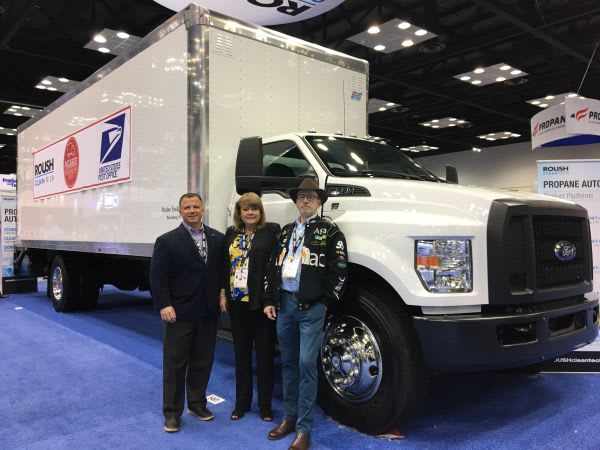
Todd Mouw (left) stands with Lisa McAbee of McAbee Trucking; and a McAbee truck driver at the 2020 Work Truck Show. McAbee purchased eight Roush propane Ford F-750 delivery trucks.
Photo by Chris Brown.
3 min to read
It’s easy to see why electric vehicles are perceived to be the future of automotive technology. They’re better for the environment and require less maintenance, which can save money for fleet owners. But they aren’t the only progressive fuel option available with those benefits.
Propane autogas is one of the most popular automotive fuels in the world, with more than 27 million vehicles on the road across the globe.
When comparing propane to electric, fleets should examine factors around emissions, economics, and fueling.
Reduced Emissions for Fleet Operators
Electric vehicles are known to eliminate tailpipe emissions. Although electric vehicles don’t produce emissions from the tailpipe, there are lifecycle emissions connected to fuel and battery production and disposal.
Propane vehicles reduce smog-producing emissions, eliminate particulate matter, and substantially lower nitrogen oxides (NOx). NOx emissions are federally regulated due to their negative impact on human health and the environment. According to the EPA, they can trigger health problems, such as asthma, bronchitis, and other respiratory issues.
Recent research from the West Virginia University’s Center of Alternative Fuels, Engines, and Emissions showed that NOx is reduced by 95% with propane compared with diesel.
Roush CleanTech developed the first propane autogas engine certified to California Air Resources Board’s optional lowest oxides of nitrogen emissions standard for heavy-duty engines (0.02 grams per brake horsepower-hour). The engine is 90% cleaner than the strictest EPA standard and is the cleanest of all class 4-7 engines available.
Positive Economics of Propane Autogas
When it comes to cost, propane has positive economics. Over the past 30 years, the fuel has cost about 50% less than diesel and up to 40% less than gasoline. Rates for electricity can change depending on the weather.
Just like electric vehicles, propane vehicles save on maintenance since they don’t require costly and complex after treatment systems.
Plus, propane fleet vehicles cost three to four times less than electric. Fleets can transition to propane without incentives but will further their savings when funding is available.

Todd Mouw, president of Roush CleanTech.
Photo courtesy of Roush CleanTech.
Fueling Time is Reduced
Fueling for propane autogas takes minutes. Recharging EVs take hours. Class 4-7 propane autogas vehicles can reach a range of up to 350 miles on a single fueling. EVs ready to deploy in the commercial market have a range of about 100 miles today.
Propane autogas has an established fueling infrastructure across the nation. Additionally, propane providers will install a propane station at low or even zero cost with a fuel contract.
Outside of routine station maintenance, there aren’t additional costs after installation. For electric vehicles, there may be additional costs for charging stations to meet power requirements and use a management software.
Bottom Line
Bottom line? Both electric and propane vehicles are leaders in the alternative fuel space, replacing diesel emissions and improving human health and air quality.
Electric growth and innovation will continue in the future, but today, propane autogas’ advantages are its “shovel-ready” availability and its ability to stand on its own with limited or no subsidy. And with the 0.02g NOx engine, its vehicles are near-zero emissions.
About the Author: Todd Mouw is president of Roush CleanTech, an industry provider of alternative fuel vehicle technology. Mouw has more than two decades of experience in the automotive and high-tech industries. He is former president of the NTEA Green Truck Association.
Subscribe to Our Newsletter
More Small Fleet


Developing Budget-Friendly Driver Safety Programs
From driver training and safety meetings to one-on-one coaching and incentive programs, several small fleets share how they have developed a safety culture with their drivers using low- to no-cost resources.
Read More →
Sponsored•March 9, 2026
Boosting Last-Mile Fleet Uptime, Safety, and Value with AI Vehicle Inspections
AI-powered inspections are transforming last-mile fleets by replacing manual checks with highly accurate automated scans that detect defects in seconds. By giving fleet operations visibility into the daily condition of their vehicles, you can identify trends over the vehicle’s lifecycle that enable improved procurement decisions, route management, driver training and accountability.
Read More →
Five Ways Seat Belts Help Prevent Injuries
There are five ways seat belts protect occupants from injuries, according to the Tennessee Department of Safety and Homeland Security.
Read More →
Sponsored•January 14, 2026
It’s here: The 2026 Fleet Technology Trends Report
What does AI mean for fleets? Get the answer — and learn other top tech trends.
Read More →
Small Fleets, Big Impact: How Independent Drivers Power Wreaths Across America
Check out how small fleets and independent drivers power Wreaths Across America each December and why their impact matters more than ever.
Read More →
VMS Survey Finds 65% of Small Fleet Managers Run Operations Alone
A new VMS survey shows small fleet managers are stretched thin, with most handling operations solo and eager to adopt digital tools for relief.
Read More →
Tips for Driving Safely on Halloween Night
This video features a reminder from the Connecticut Department of Transportation (DOT) and the Connecticut Police Chiefs Association, urging drivers to prioritize safety this Halloween.
Read More →
AI, Access, and Uptime: VMS’s Next Chapter with David Prusinski
VMS’s new Co-CEO, David Prusinski, shares how an AI-first approach will give small fleets and repair shops the tools to compete like big players.
Read More →
Fleet Managers Share Winter Prep Tips: It's Never Too Early!
Three fleets share best practices to prep vehicles for winter and prevent downtime when the cold sets in.
Read More →