Work Truck Logo
MenuMENU
SearchSEARCH

Rethinking Fleet Safety Changing the Traditional 'Safety' Mindset

Author and speaker Brian Fielkow talks about safety systems in the industry and improvements that could be made.

Christian Lopez
Christian LopezFormer Assistant Editor
October 25, 2023
Rethinking Fleet Safety Changing the Traditional 'Safety' Mindset

“If I see a sign on the wall that says ‘safety is our priority,’ I always say tear it down. Because safety isn't a priority,” Fielkow says. “It's a core value. And there's a big difference.”

Photo: Canva

4 min to read


While safety must always be a key pillar of fleet management, sometimes commonly held beliefs need to be reexamined to drive a safer fleet.  

For three decades, Brian Fielkow served as an executive with Recycle America Alliance (a division of Waste Management), The GTI Group, Jetco Delivery, and now Acrisure. key focus in these positions has always centered around safety.

Ad Loading...

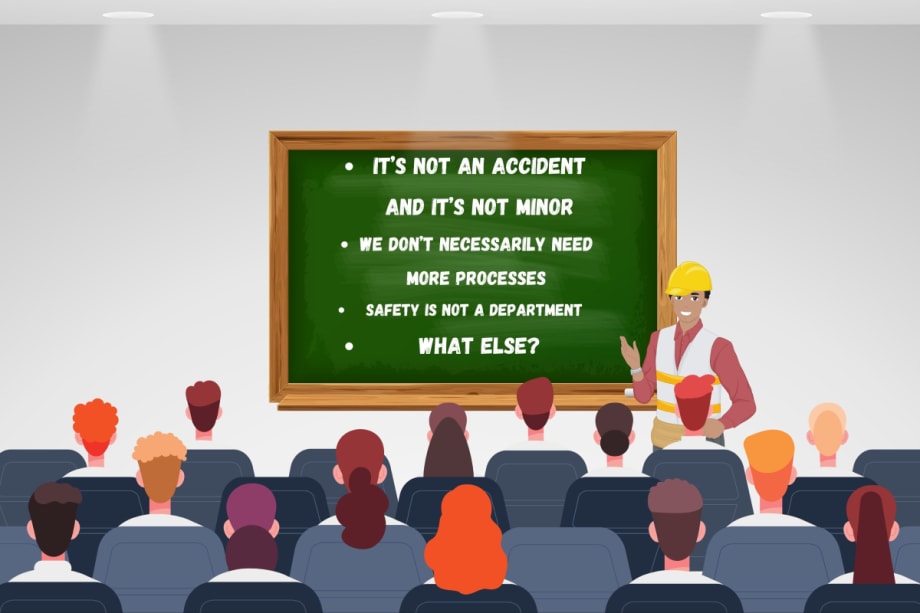
In a recent State of the Fleet Industry video episode, Fielkow discussed these traditional mindsets and a new way to attack them. Fielkow picked seven to discuss:

  • Safety is not a priority

  • It's not an accident and it’s not minor

  • Move from a blame culture to a just culture

  • We don’t necessarily need more processes

  • Safety is not a department

  • We’re drowning in data

  • Compliance doesn’t mean safe

Safety as a Core Value

Fielkow argues that the concept of safety should not be a priority, but a core value.

“Priorities shift, we could come to the office today with a list of things to do, then there’s a problem somewhere else and our list can get rearranged…they compete with each other all the time, that’s part of being in business. Values, on the other hand, are immutable. Nothing can or should compete with core values,” said Fielkow.

Accidents Aren’t Minor

This safety line of thinking then plays into looking at accidents.

Ad Loading...

Fielkow explains that the term ‘accident’ is a poor descriptor because it fails to acknowledge how preventable the crash or incident was, and the fact that labeling it an accident leads to the mindset that it is an isolated incident, leaving the company addressing the symptoms but never the source.

Leaving Blame Culture

Addressing mistakes or faults is a tricky position for leadership, as the wrongdoing must be acknowledged, but in an appropriate way. Fielkow argues that the current blame culture has too many negative connotations and might be too harsh when he says that “most safety failures are honest mistakes.”

“If you have a blame culture, you are kind of punishing everybody whenever there’s a safety failure. All you’re doing is destroying trust with your frontline employees. It’s hard to get people engaged, and safety is all about engagement, about doing the right thing when nobody’s looking,” said Brian Fielkow.

Safety culture in a company is something that is fostered. Fielkow says that instead of following the more critical, traditional method of what he calls “blame culture,” when something there’s a safety failure, and instead uses “coaching culture.”

Safety is a Way of Life

Nurturing a proper safety culture has the added benefit of bringing in the frontline employees into the process and extending safety problems to not just one department.

Ad Loading...

“If there’s a safety problem, you know, it’s sort of punted to the safety department. So then operations kind of washes their hands,” Fielkow said. “There has to be an understanding that safety is a way of life, everybody is responsible for it from the C-suit throughout.”

Keep Data Actionable

Fielkow acknowledges that in the modern day, there has been a massive influx of good data that can increase safety and operations. Similar to priorities and core values, the problem comes from how to implement or act on it.

“The key with data is this, you have to keep it actionable. If you have 100 data points, you’re not gonna really deal with any of them. What are the three, for, or five that are the most important to you? That’s the key.”

Safety Handbooks and Literacy

Fielkow also points to the fact that more than half of U.S. adults have poor literacy skills, according to the Organization for Economic Cooperation and Development (OECD). In contrast, safety handbooks are written for a much higher reading level.

“Having this big, thick handbook that nobody reads doesn’t get you there,” said Fielkow. “Actionable processes, simple checklists that we do every single time without failure, accountability when we take shortcuts or ignore processes…So let’s figure out how to make processes that work and then let’s enforce those processes in compliance without fail.”

He further points out that not acting on data can harm a fleet company, due to how easy it is for most lawyers to get their hands on the same data. Failing to act on data merely postpones or worst-case scenario, can be used against a company, while on the other hand, acting on too much data ends up stilling action. Finding the balance is key.

Compliance is Just the Beginning

It is using this system of nurturing that Fielkow argues that adding more safety regulations is not the solution.

Ad Loading...

“Compliance is important, but regulations spell the bare minimum…[Safety] is about managing your own behavior, and that’s something that the regulations can never cover. That’s where safety culture and leadership come into the equation.”

Fielkow also mentions how important safety data is, not only at the executive level but for the frontline employees and the development process. Essentially turning safety into more than just one aspect or department of the company.

The author and speaker plans on going further in-depth on these themes as the keynote speaker at the 2023 Fleet Safety Conference in Santa Clara on Nov. 8.


Originally posted on Automotive Fleet

Subscribe to Our Newsletter

More Small Fleet

SponsoredMarch 9, 2026

Boosting Last-Mile Fleet Uptime, Safety, and Value with AI Vehicle Inspections

AI-powered inspections are transforming last-mile fleets by replacing manual checks with highly accurate automated scans that detect defects in seconds. By giving fleet operations visibility into the daily condition of their vehicles, you can identify trends over the vehicle’s lifecycle that enable improved procurement decisions, route management, driver training and accountability.

Read More →
SponsoredMarch 1, 2026

How One Fleet Cut Motor Pool Costs by $45K With Smarter Key Control and Automation

Still managing your motor pool with spreadsheets and manual approvals? Loyola University replaced outdated processes with automated fleet management, eliminating overtime and saving up to $50,000 annually. See how they did it.

Read More →
SponsoredMarch 1, 2026

Artificial Intelligence in Field Service: North America

48% of field service leaders are investing in AI to manage customer communication and self-service. Get the latest on how fleets are using AI and thinking about the future.

Read More →
Ad Loading...
SafetyFebruary 4, 2026

Five Ways Seat Belts Help Prevent Injuries

There are five ways seat belts protect occupants from injuries, according to the Tennessee Department of Safety and Homeland Security.

Read More →
SponsoredJanuary 14, 2026

It’s here: The 2026 Fleet Technology Trends Report

What does AI mean for fleets? Get the answer — and learn other top tech trends.

Read More →
Wreaths Across America graphic highlighting the role of small fleets in delivering wreaths to honor veterans, featuring wreath icons and the American flag.
Small Fleetby Lauren FletcherDecember 8, 2025

Small Fleets, Big Impact: How Independent Drivers Power Wreaths Across America

Check out how small fleets and independent drivers power Wreaths Across America each December and why their impact matters more than ever.

Read More →
Ad Loading...
A stressed person covers their face, illustrating that 65% of small fleet managers handle all operations alone, according to a Vehicle Management Systems (VMS) survey.
Small Fleetby StaffNovember 12, 2025

VMS Survey Finds 65% of Small Fleet Managers Run Operations Alone

A new VMS survey shows small fleet managers are stretched thin, with most handling operations solo and eager to adopt digital tools for relief.

Read More →
Safe Driving on Halloween over spooky fall road
Safetyby StaffOctober 20, 2025

Tips for Driving Safely on Halloween Night

This video features a reminder from the Connecticut Department of Transportation (DOT) and the Connecticut Police Chiefs Association, urging drivers to prioritize safety this Halloween.

Read More →
VMS Co-CEO David Prusinski highlights the company’s AI-powered virtual fleet manager designed to improve uptime and reduce operating costs for fleets.
Green Fleetby Lauren FletcherOctober 6, 2025

AI, Access, and Uptime: VMS’s Next Chapter with David Prusinski

VMS’s new Co-CEO, David Prusinski, shares how an AI-first approach will give small fleets and repair shops the tools to compete like big players.

Read More →
Ad Loading...
Photo of tire tracks and winter scenes.
Small FleetMay 24, 2025

Fleet Managers Share Winter Prep Tips: It's Never Too Early!

Three fleets share best practices to prep vehicles for winter and prevent downtime when the cold sets in.

Read More →