




Rethink Your Tool Hauler
If you’re hauling a lot of tools for your contracting business, dump your pickup and consider this type of custom-built rolling toolbox.

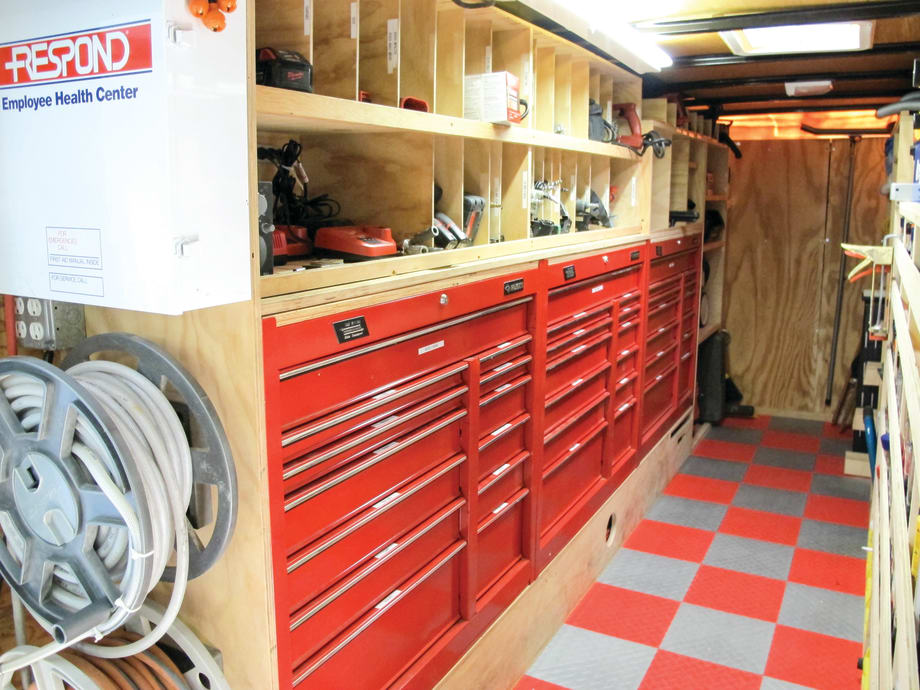
This trailer was outfitted with a combination of rolling toolboxes mounted without the wheels and custom-built shelves and cubby holes. The garden hose reel houses an electrical cord to plug into a job site for trailer power.

Using a trailer as a “rolling toolbox” keeps your pickup truck open for hauling materials, debris or the family, while saving on fuel because your tools are not carried around on needless trips.
“I’m of the opinion that a pickup truck is not a good tool hauler,” says Ron Paulk of Paulk Homes in Anacortes, Wash. For 20 of the 25 years that Paulk has been in the residential design and build business, he’s used a trailer — not a pickup truck or van — as his rolling toolbox.

This trailer was outfitted with a combination of rolling toolboxes mounted without the wheels and custom-built shelves and cubby holes. The garden hose reel houses an electrical cord to plug into a job site for trailer power.
Using a trailer keeps the truck open for hauling materials, debris or the family, Paulk says, adding that he spends less on fuel because his tools stay on the job site, not as extra weight in his constantly moving pickup. Instead, Paulk plants his tool trailer on job sites for the duration of the job, a few days to a few months. “It’s a mobile shop office,” he says. “It has everything I need and it’s locked and dry.”
Trailer registration is cheap, as is insurance, when it’s even required (check with your state). Trailer maintenance is virtually non-existent.
Paulk recognizes that maneuvering a tow trailer takes practice, especially on tight job sites and steep driveways, but the alternative is a much more expensive, dedicated truck or van.
The Specs
Paulk has typically bought a medium-sized (16-foot) tandem-axle trailer that is easily pulled by a half-ton pickup. While his tools and equipment would never exceed the trailer’s payload capacity, he prefers tandem axle to comfortably accommodate any weight and for better road handling. Tandem axle trailers require trailer brakes by law.
In terms of trailer height, Paulk’s requirements include being able to stand in one while also fitting it into a garage with an 8-foot door. For Paulk, this necessitates a trailer height of 6 feet 3 inches, which accommodates his height and the trailer’s wheels, frame and roof vent. Trailers can be bought in increments of 3 inches.
In terms of options, Paulk prefers plywood lining, a ramp door ($600 extra) instead of barn doors and a side door ($350) for quick access. A backup camera is a good call too. A typical ladder rack can be installed on top to haul longer materials, provided it meets your height requirements.
With those specs, a new trailer goes for about $5,000, Paulk says, adding that there’s no reason to buy used because trailers tend to hold their value. Brands to research include Pace, Haulmark, Wells Cargo and Interstate.
A Custom Interior
As a carpenter, Paulk custom builds his tool hauler interiors, including custom-sized cubby holes to store specific equipment and a work bench for minor tool assembly and repair. The cubbies are built with a ¾-inch lip that holds gear in place yet allows easy access — no bungees or tie-downs needed. Paulk uses clear, hard-plastic Viewtainer cylinders to keep smaller hardware organized and visible.
An option for those not so inclined is to buy one or two rolling toolboxes and mount them inside the trailer without the wheels, Paulk says, and look into trade-specific modular, adjustable shelf and drawer components from companies such as Adrian Steel.
The fully lit trailer is wired with 110v power and is able to connect to a job site via a 100-foot heavy-duty electrical cord accessible through the bottom of the trailer and stored in a garden hose reel. An air compressor has a permanent home in the trailer as well.
The flat white walls of a trailer are a good rolling billboard, and Paulk maximizes the space with a professional full vinyl wrap. That’s good advertising, though even better, he says, is when potential clients get a look inside the trailer. “I can’t tell you the amount of work I’ve gotten from people saying if this guy is that organized, he must do good work,” he says.
Read more small fleet profiles at www.businessfleet.com/profiles.
More Small Fleet


Developing Budget-Friendly Driver Safety Programs
From driver training and safety meetings to one-on-one coaching and incentive programs, several small fleets share how they have developed a safety culture with their drivers using low- to no-cost resources.
Read More →
Boosting Last-Mile Fleet Uptime, Safety, and Value with AI Vehicle Inspections
AI-powered inspections are transforming last-mile fleets by replacing manual checks with highly accurate automated scans that detect defects in seconds. By giving fleet operations visibility into the daily condition of their vehicles, you can identify trends over the vehicle’s lifecycle that enable improved procurement decisions, route management, driver training and accountability.
Read More →
Five Ways Seat Belts Help Prevent Injuries
There are five ways seat belts protect occupants from injuries, according to the Tennessee Department of Safety and Homeland Security.
Read More →
It’s here: The 2026 Fleet Technology Trends Report
What does AI mean for fleets? Get the answer — and learn other top tech trends.
Read More →
Small Fleets, Big Impact: How Independent Drivers Power Wreaths Across America
Check out how small fleets and independent drivers power Wreaths Across America each December and why their impact matters more than ever.
Read More →
VMS Survey Finds 65% of Small Fleet Managers Run Operations Alone
A new VMS survey shows small fleet managers are stretched thin, with most handling operations solo and eager to adopt digital tools for relief.
Read More →
Tips for Driving Safely on Halloween Night
This video features a reminder from the Connecticut Department of Transportation (DOT) and the Connecticut Police Chiefs Association, urging drivers to prioritize safety this Halloween.
Read More →
AI, Access, and Uptime: VMS’s Next Chapter with David Prusinski
VMS’s new Co-CEO, David Prusinski, shares how an AI-first approach will give small fleets and repair shops the tools to compete like big players.
Read More →
Fleet Managers Share Winter Prep Tips: It's Never Too Early!
Three fleets share best practices to prep vehicles for winter and prevent downtime when the cold sets in.
Read More →