




Ready for Your Drone Delivery License?
Commercial drone deliveries are destined to integrate with fleet, but new regulations remain barriers to speedy implementation.

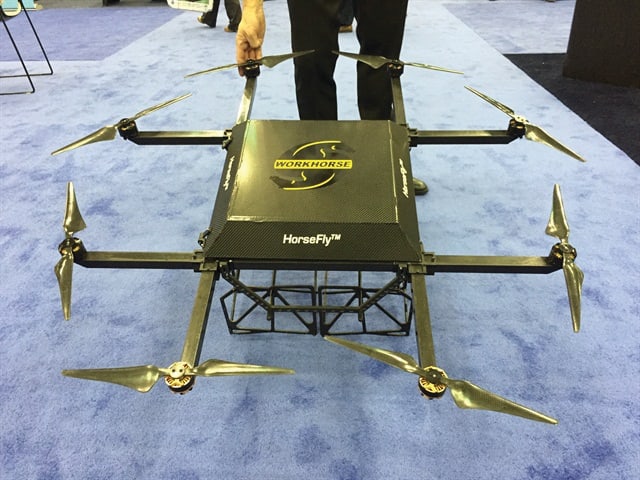
The HorseFly drone from Workhorse Custom Chassis delivers 10-lb. packages for 2 cents a mile.
The package delivery truck parks in a neighborhood. The driver removes three 5-lb. packages and attaches each to a drone. With the swipe of an iPad, the drones deploy from the roof of the truck. Using GPS, each drone finds its way autonomously to its delivery point, releases the package, and flies back to the truck.
A drone could similarly be deployed from a neighborhood warehouse or retail store to travel within 10 miles and deliver its package before returning to base.
These commercial uses of unmanned aerial vehicles (UAVs) are technologically possible today, and they promise to greatly reduce delivery expense. However, new rules from the Federal Aviation Administration (FAA) that took effect Aug. 29 governing commercial drone activity have essentially put drone deliveries on hold for now, at least in the U.S.
The HorseFly drone from Workhorse Custom Chassis delivers 10-lb. packages for 2 cents a mile.
In its rulemaking, the FAA eased some restrictions such as the requirement that drone pilots need commercial aviation licenses. This change will drive acceleration of other commercial applications in engineering, agriculture, insurance, emergency response, and real estate. However, drones are still required to stay within unaided sight of the pilot. They also must be under the control of a pilot instead of flying autonomously, which essentially eliminates manpower savings.
The main worry is safety — that autonomous flight and collision avoidance have not yet been perfected. While autonomous drones are today capable of landing to an accuracy of one meter, there are still many variables, including weather and human interference. Indeed, the Teamsters lobbied against pilots manning multiple drones until safety risks can be overcome.
Testing hasn’t stopped; it’s just migrated outside of the U.S. Amazon has relocated its drone testing headquarters to Canada and is conducting further tests in Europe. A Domino’s franchise in New Zealand has partnered with drone delivery company Flirtey to test drone pizza delivery in Auckland. In Germany, DHL is testing fully automated drone deliveries, including loading and unloading of packages.
Chinese online retailer JD.com is working with Wal-Mart to deliver packages of up to 33 lbs. in rural areas of China and over a distance of 12 miles. Each flight costs less than a dime, according to the company.
Right now, the U.S. seems content to let other countries do the heavy lifting when it comes to testing. Ironically, the quickest facilitator to drone delivery in the U.S. might be to prevent China from winning the drone “arms race.”
With these concerns, there may be another scenario that’s more palatable to the FAA: The Marines have already conducted thousands of delivery missions in Afghanistan using Lockheed Martin’s K-MAX unmanned aircraft system, which can handle up to 6,000 lbs. of cargo. In a commercial setting, this autonomous helicopter could be used similarly to an over-the-road big rig going warehouse to warehouse, landing on designated pads and thereby alleviating some safety concerns.
As drone deliveries become assimilated into the fleet and logistics business models, fleet operators will start addressing issues such as how to obtain the equivalent of a commercial driver’s license, drone pilot training, the potential redeployment of drivers as pilots, and union issues. This new delivery model may facilitate changes to the size and location of warehouses based on drone’s range limitations.
There is now a drone trade group (the Small UAV Coalition), drone trade publications, and even a commercial drone trade show, which convened in November in Las Vegas. The promise of commercial drone deliveries is great: they purport to reduce carbon output, alleviate vehicle congestion in urban environments, and cut delivery costs to pennies.
The industry will ultimately solve these challenges and drones will become an extension of transportation and delivery fleet services. But the present issues surrounding autonomous drone use foreshadows an even larger one for fleets — how to assimilate into the world of driverless vehicles.
More Small Fleet


Developing Budget-Friendly Driver Safety Programs
From driver training and safety meetings to one-on-one coaching and incentive programs, several small fleets share how they have developed a safety culture with their drivers using low- to no-cost resources.
Read More →
Boosting Last-Mile Fleet Uptime, Safety, and Value with AI Vehicle Inspections
AI-powered inspections are transforming last-mile fleets by replacing manual checks with highly accurate automated scans that detect defects in seconds. By giving fleet operations visibility into the daily condition of their vehicles, you can identify trends over the vehicle’s lifecycle that enable improved procurement decisions, route management, driver training and accountability.
Read More →
Five Ways Seat Belts Help Prevent Injuries
There are five ways seat belts protect occupants from injuries, according to the Tennessee Department of Safety and Homeland Security.
Read More →
It’s here: The 2026 Fleet Technology Trends Report
What does AI mean for fleets? Get the answer — and learn other top tech trends.
Read More →
Small Fleets, Big Impact: How Independent Drivers Power Wreaths Across America
Check out how small fleets and independent drivers power Wreaths Across America each December and why their impact matters more than ever.
Read More →
VMS Survey Finds 65% of Small Fleet Managers Run Operations Alone
A new VMS survey shows small fleet managers are stretched thin, with most handling operations solo and eager to adopt digital tools for relief.
Read More →
Tips for Driving Safely on Halloween Night
This video features a reminder from the Connecticut Department of Transportation (DOT) and the Connecticut Police Chiefs Association, urging drivers to prioritize safety this Halloween.
Read More →
AI, Access, and Uptime: VMS’s Next Chapter with David Prusinski
VMS’s new Co-CEO, David Prusinski, shares how an AI-first approach will give small fleets and repair shops the tools to compete like big players.
Read More →
Fleet Managers Share Winter Prep Tips: It's Never Too Early!
Three fleets share best practices to prep vehicles for winter and prevent downtime when the cold sets in.
Read More →